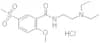
CAS 51012-33-0
:Tiaprid-Hydrochlorid
Beschreibung:
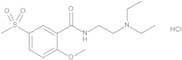
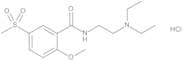
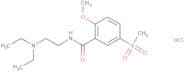
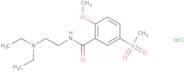
Tiaprid-Hydrochlorid ist ein Medikament, das hauptsächlich als Antipsychotikum und anxiolytisches Mittel verwendet wird. Es gehört zur Klasse der Medikamente, die als substituierte Benzamide bekannt sind, und wird häufig zur Behandlung verschiedener psychiatrischer Störungen eingesetzt, einschließlich Schizophrenie und angstbezogenen Erkrankungen. Die Substanz wirkt als Antagonist des Dopamin-D2-Rezeptors, was hilft, die Neurotransmitteraktivität im Gehirn zu modulieren. Tiaprid-Hydrochlorid zeichnet sich durch seine relativ hohe Löslichkeit in Wasser aus, was es für orale und injizierbare Formulierungen geeignet macht. Seine chemische Struktur umfasst einen Thiophenring, der zu seinen pharmakologischen Eigenschaften beiträgt. Die Verbindung wird typischerweise in kontrollierten Dosen verabreicht, und zu den Nebenwirkungen können Sedierung, gastrointestinale Störungen und extrapyramidale Symptome gehören, obwohl diese im Vergleich zu anderen Antipsychotika in der Regel weniger ausgeprägt sind. Wie bei jedem Medikament ist es wichtig, Tiaprid-Hydrochlorid unter ärztlicher Aufsicht zu verwenden, um die Wirksamkeit und mögliche unerwünschte Reaktionen zu überwachen.
Formel:C15H24N2O4S·ClH
InChl:InChI=1S/C15H24N2O4S.ClH/c1-5-17(6-2)10-9-16-15(18)13-11-12(22(4,19)20)7-8-14(13)21-3;/h7-8,11H,5-6,9-10H2,1-4H3,(H,16,18);1H
InChI Key:InChIKey=OTFDPNXIVHBTKW-UHFFFAOYSA-N
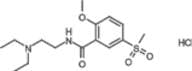
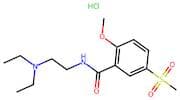
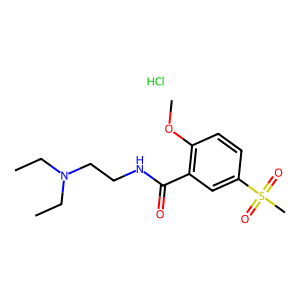
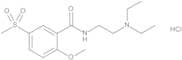
SMILES:C(NCCN(CC)CC)(=O)C1=C(OC)C=CC(S(C)(=O)=O)=C1.Cl
Synonyme:- Benzamide, N-(2-(diethylamino)ethyl)-2-methoxy-5-(methylsulfonyl)-, monohydrochloride
- Benzamide, N-[2-(diethylamino)ethyl]-2-methoxy-5-(methylsulfonyl)-, hydrochloride (1:1)
- Gramalil
- Italprid
- Luxoben
- N-(2-(Diethylamino)ethyl)-2-methoxy-5-(methylsulfonyl)benzamide hydrochloride
- N-(2-(Diethylamino)ethyl)-2-methoxy-5-(methylsulphonyl)benzamide monohydrochloride
- N-(2-(Diethylamino)ethyl)-5-(methylsulfonyl)-o-anisamide hydrochloride
- Sereprile
- Tiapridal
- Tiapride hydrochloride
- Weitere Synonyme anzeigen
Sortieren nach
Reinheit (%)
0
100
|
0
|
50
|
90
|
95
|
100
12 Produkte.
Tiapride Hydrochloride
CAS:Formel:C15H24N2O4S·HClReinheit:>99.0%(T)(HPLC)Farbe und Form:White to Almost white powder to crystalMolekulargewicht:364.89N-[2-(diethylamino)ethyl]-5-methanesulfonyl-2-methoxybenzamide hydrochloride
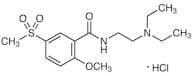
CAS:Formel:C15H25ClN2O4SReinheit:98%Farbe und Form:SolidMolekulargewicht:364.8880Tiapride hydrochloride
CAS:Tiapride is a selective blocker of D2/3 dopamine receptors in the brain.
Formel:C15H24N2O4S·HClReinheit:99.4% - 99.77%Farbe und Form:SolidMolekulargewicht:364.89Tiapride Hydrochloride
CAS:Kontrolliertes ProduktApplications Tiapride is a D2 and D3 dopamine receptor antagonist and a antipsychotic drug predominately used in the pharmacotherapy of patients with dementia.
References Huber, M., et al.: Pharmacopsy., 45, 182 (2012); Mediavilla, C., et al.: Brain. Res. Bull., 87, 346 (2012);Formel:C15H24N2O4S·ClHFarbe und Form:NeatMolekulargewicht:364.89Tiapride hydrochloride
CAS:Kontrolliertes ProduktDopamine (D2 and D3) receptor antagonist; inhibits NOS enzyme; neuroleptic agent
Formel:C15H24N2O4S·HClReinheit:Min. 98.5 Area-%Farbe und Form:White Off-White PowderMolekulargewicht:364.89 g/molTiapride HCl - Bio-X ™
CAS:Kontrolliertes ProduktTiapride is a dopamine receptor antagonist that is used in the treatment for anxiety and chorea in Huntington’s disease. It also is used to ease agitation in elderly patients. Although its mechanism of action is not fully understood, this drug is believed to modulate dopamine receptors in the brain, particularly D2 and D3 receptors, which can help regulate dopamine transmission and balance in the central nervous system.Formel:C15H24N2O4S·HClReinheit:Min. 95%Farbe und Form:PowderMolekulargewicht:364.89 g/mol



![N-[2-(diethylamino)ethyl]-5-methanesulfonyl-2-methoxybenzamide hydrochloride](/_next/image/?url=https%3A%2Fstatic.cymitquimica.com%2Fproducts%2FIN%2Fthumb%2FDA00IML5.jpg&w=3840&q=75)