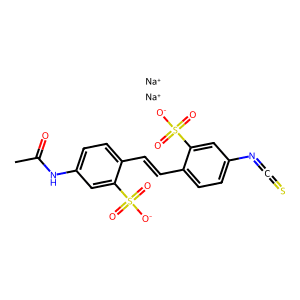
![Benzenesulfonic acid, 5-(acetylamino)-2-[2-(4-isothiocyanato-2-sulfophenyl)ethenyl]-, sodium salt …](/_next/image/?url=https%3A%2Fstatic.cymitquimica.com%2Fcas-image%2Fthumb-webp%2F229481-benzenesulfonic-acid-5-acetylamino-2-2-4-isothiocyanato-2-sulfophenyl-ethenyl-sodium-salt-1-2.webp&w=3840&q=75)
CAS 51023-76-8
:Benzolsulfonsäure, 5-(acetylamino)-2-[2-(4-isothiocyanato-2-sulfophenyl)ethenyl]-, Natriumsalz (1:2)
- SITS
- Disodium 4-acetamido-4′-isothiocyanatostilbene-2,2′-disulfonate
- Benzenesulfonic acid, 5-(acetylamino)-2-[2-(4-isothiocyanato-2-sulfophenyl)ethenyl]-, disodium salt
- Benzenesulfonic acid, 5-(acetylamino)-2-[2-(4-isothiocyanato-2-sulfophenyl)ethenyl]-, sodium salt (1:2)
Benzenesulfonic acid, 5-(acetylamino)-2-[2-(4-isothiocyanato-2-sulfophenyl)ethenyl]-, sodium salt (1:2)
CAS:Formel:C17H14N2NaO7S3Reinheit:80%Farbe und Form:SolidMolekulargewicht:477.48704-Acetamido-4'-isothiocyanatostilbene-2,2'-disulfonic acid disodium
CAS:4-Acetamido-4'-isothiocyanatostilbene-2,2'-disulfonic acid disodium, a fluorescent dye, is utilized for retrograde axonal transport demonstration, secondaryFormel:C17H12N2Na2O7S3Farbe und Form:SolidMolekulargewicht:498.464-Acetamido-4'-isothiocyanostilbene-2,2'-disulphonic acid sodium salt
CAS:4-Acetamido-4'-isothiocyanostilbene-2,2'-disulphonic acid sodium saltMolekulargewicht:498.46g/mol4-Acetamido-4'-isothiocyanatostilbene-2,2'-disulfonic Acid, Sodium Salt
CAS:Kontrolliertes ProduktStability Hygroscopic, Temperature Sensitive
Applications A fluorescent label for the specific and reversible labelling of the outer components of the plasma membrane. The reagent reacts with a fixed number of sites on the surface of cells concerned with anion permeation; does not pass through the osmotic barrier of the membrane; reacts under physiological conditions of temperature, pH and tonicity; and is detectable in small amounts. SEE ALSO NOTES FOR DIDS (CAT#D460600).Fluorescence: max. Abs. l = 336nm, max. Em. l = 436 nm.
References Maddy., A.H.: Biochim. Biophys. Acta., 88, 390 (1964), Cabantchik, Z.I., et al.: J. Membrane Biol., 10, 311 (1972); Am. J. Physiol. 262, C803 (1992); J. Biol. Chem. 266, 13355 (1991), Ma, W., et al.: J. Pharmacol. Exp. Ther., 328, 409 (2009),Formel:C17H12N2O7S3·2NaFarbe und Form:NeatMolekulargewicht:498.464-Acetamido-4'-isothiocyanatostilbene-2,2'-disulfonic acid, sodium salt
CAS:4-Acetamido-4'-isothiocyanatostilbene-2,2'-disulfonic acid, sodium salt (AITC-S) is a stilbene derivative with inhibitory properties. It has been shown to inhibit the uptake of camp in rat ventricular myocytes and caco-2 cells as well as the release of camp from rat renal proximal tubules. AITC-S also inhibits the transport of camp into the cells. The mechanism by which AITC-S inhibits uptake is not yet known, but it may be due to competition for a common carrier or an effect on intracellular metabolism. This compound has also been shown to have an acute ischemic protective effect on rats when administered before reperfusion following coronary artery occlusion.Formel:C17H12N2Na2O7S3Reinheit:Min. 95%Molekulargewicht:498.46 g/mol
![Benzenesulfonic acid, 5-(acetylamino)-2-[2-(4-isothiocyanato-2-sulfophenyl)ethenyl]-, s…](/_next/image/?url=https%3A%2Fstatic.cymitquimica.com%2Fproducts%2FIN%2Fthumb%2FDA006UQF.jpg&w=3840&q=75)