CAS 51076-46-1
:Pyridin-4-ylpropanedial
Beschreibung:
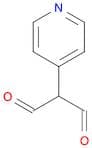
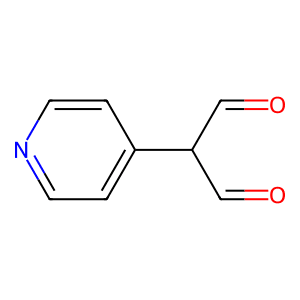
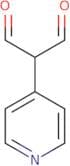
Pyridin-4-ylpropanedial, mit der CAS-Nummer 51076-46-1, ist eine organische Verbindung, die durch ihren Pyridinring und eine Propandial-Funktionalgruppe gekennzeichnet ist. Die Struktur weist ein Pyridin-Motiv auf, das an der 4-Position mit einer Propandialkette substituiert ist, die zwei Aldehydgruppen (-CHO) an den terminalen Enden umfasst. Diese Verbindung zeigt typischerweise eine polare Natur aufgrund der Anwesenheit der Aldehydfunktionalgruppen, die an Wasserstoffbrückenbindungen teilnehmen können. Pyridin-4-ylpropanedial kann in verschiedenen chemischen Synthesen und Forschungsanwendungen verwendet werden, insbesondere in der Entwicklung von Arzneimitteln und Agrochemikalien. Ihre Reaktivität wird durch die elektrophile Natur der Aldehydgruppen beeinflusst, was sie zu einem potenziellen Kandidaten für Kondensationsreaktionen und andere organische Transformationen macht. Darüber hinaus kann die Anwesenheit des Pyridinrings einzigartige elektronische Eigenschaften verleihen, die ihr Verhalten in biologischen Systemen und die Wechselwirkungen mit anderen Molekülen beeinflussen. Insgesamt ist Pyridin-4-ylpropanedial eine vielseitige Verbindung mit erheblichen Implikationen in der organischen Chemie und verwandten Bereichen.
Formel:C8H7NO2
InChl:InChI=1/C8H7NO2/c10-5-8(6-11)7-1-3-9-4-2-7/h1-6,8H
SMILES:c1cnccc1C(C=O)C=O
Synonyme:- 4-Pyridinylmalonaldehyde
- Propanedial, 2-(4-Pyridinyl)-
- Pyridin-4-ylmalonaldehyde
Sortieren nach
Reinheit (%)
0
100
|
0
|
50
|
90
|
95
|
100
4 Produkte.
2-(4-Pyridyl)malondialdehyde
CAS:Formel:C8H7NO2Reinheit:97%Farbe und Form:SolidMolekulargewicht:149.14672-(Pyridin-4-yl)malonaldehyde
CAS:2-(Pyridin-4-yl)malonaldehydeFormel:C8H7NO2Reinheit:98%Farbe und Form: yellow solidMolekulargewicht:149.15g/mol2-(4-Pyridyl)malondialdehyde
CAS:Formel:C8H7NO2Reinheit:97%Farbe und Form:SolidMolekulargewicht:149.1492-(4-Pyridyl)malondialdehyde
CAS:2-(4-Pyridyl)malondialdehyde (2-PMAL) is a zwitterionic molecule that is soluble in polar organic solvents. It forms hydrogen bonds with other molecules and has a microporous structure. 2-PMAL has been shown to be an x-ray contrast agent for imaging biological systems. The connectivity of 2-PMAL and the x-ray structure have been determined by single crystal x-ray diffraction studies. The adsorption of 2-PMAL on polymers has been studied experimentally, and its topology has been determined using helical modelling.
2-(4-Pyridyl)malondialdehyde is a compound with both planar and helical structures, which may give it the ability to adsorb onto surfaces or dissolve in water or organic solvents.Formel:C8H7NO2Reinheit:Min. 95%Molekulargewicht:149.15 g/mol