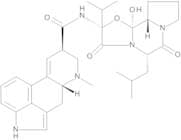
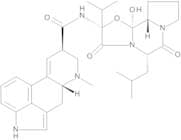
CAS 511-09-1
:Ergokryptin
- (2'Xi,12'Xi)-12'-Hydroxy-5'-(2-Methylpropyl)-3',6',18-Trioxo-2'-(Propan-2-Yl)Ergotaman
- (5'Alpha)-12'-Hydroxy-5'-(2-Methylpropyl)-3',6',18-Trioxo-2'-(Propan-2-Yl)Ergotaman
- (5′α)-12′-Hydroxy-2′-(1-methylethyl)-5′-(2-methylpropyl)ergotaman-3′,6′,18-trione
- 12'-Hydroxy-5'-(2-Methylpropyl)-3',6',18-Trioxo-2'-(Propan-2-Yl)Ergotaman
- 8H-Oxazolo[3,2-a]pyrrolo[2,1-c]pyrazine, ergotaman-3′,6′,18-trione deriv.
- ALPHA-Ergocryptine
- Ergocryptine
- Ergokryptine
- Ergotaman-3′,6′,18-trione, 12′-hydroxy-2′-(1-methylethyl)-5′-(2-methylpropyl)-, (5′α)-
- Indolo[4,3-fg]quinoline, ergotaman-3′,6′,18-trione deriv.
- NSC 169479
- NSC 407319
- Weitere Synonyme anzeigen
Bromocriptine EP Impurity B
CAS:Formel:C32H41N5O5Farbe und Form:Off-White SolidMolekulargewicht:575.71α-Ergocryptine
CAS:Stability Hygroscopic
Applications α-Ergocryptine is an ergopeptine and one of the ergot alkaloids. An impurity of 2-Bromo α-Ergocryptine Mesylate (B682600).
References Young, J., et al.: J. Environ. Sci. Health, 16, 83 (1981), Sugrue, M., et al.: J. Med. Chem., 40, 2793 (1997),Formel:C32H41N5O5Farbe und Form:NeatMolekulargewicht:575.7a-Ergocryptine
CAS:Kontrolliertes Produkta-Ergocryptine is an ergot alkaloid derivative, which is a compound sourced from the ergot fungus, particularly *Claviceps purpurea*. Its mode of action involves dopaminergic activity, primarily acting as a dopamine receptor agonist. By binding to dopamine receptors, a-Ergocryptine influences neurotransmitter pathways that regulate various physiological functions.Utilized predominantly in the field of neurology and endocrinology, a-Ergocryptine's applications include the treatment of Parkinson's disease, where it aids in managing symptoms by compensating for dopamine deficiencies. Additionally, it is employed in the control of hyperprolactinemia, effectively reducing elevated prolactin levels, and is sometimes used in addressing menstrual disorders linked to prolactin. Its ability to modulate prolactin and dopamine levels makes it a valuable tool in specific therapeutic protocols. However, its use requires careful medical supervision due to potential side effects and interactions with other medications, emphasizing the need for targeted application within clinical practice.
Formel:C32H41N5O5Reinheit:Min. 95%Molekulargewicht:575.7 g/mol