CymitQuimica logo

CAS 51114-94-4

:

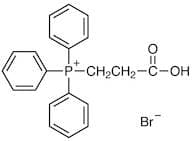
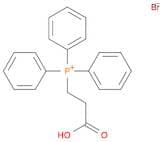
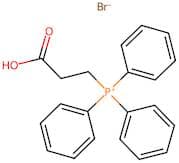
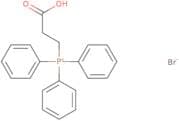
Phosphonium, (2-carboxyethyl)triphenyl-, bromid (1:1)

Beschreibung:
Phosphonium, (2-carboxyethyl)triphenyl-, bromid (1:1) ist eine quartäre Ammoniumverbindung, die durch ein positiv geladenes Phosphoniumion und ein Bromid-Gegenion gekennzeichnet ist. Diese Substanz weist einen Trifenylphosphonium-Kern auf, der für seine Lipophilie und seine Fähigkeit, biologische Membranen zu durchdringen, bekannt ist. Die Anwesenheit der 2-Carboxyethylgruppe führt zu einer polaren funktionellen Gruppe, die ihre Löslichkeit in polaren Lösungsmitteln erhöht und potenziell ihre Reaktivität und biologischen Wechselwirkungen beeinflusst. Als Bromidsalz ist es typischerweise unter Standardbedingungen stabil, kann jedoch in Gegenwart starker Nucleophile oder unter sauren oder basischen Bedingungen Hydrolyse oder andere Reaktionen durchlaufen. Phosphoniumverbindungen werden häufig in der organischen Synthese verwendet, insbesondere bei der Bildung von Phosphonium-Yliden, die wertvolle Zwischenprodukte in der Synthese verschiedener organischer Verbindungen sind. Darüber hinaus können sie aufgrund ihrer einzigartigen Eigenschaften Anwendungen in der medizinischen Chemie und Materialwissenschaft finden. Sicherheitsdaten sollten für den Umgang und die Lagerung konsultiert werden, wie bei allen chemischen Substanzen.
Formel:C21H20O2P·Br
InChl:InChI=1S/C21H19O2P.BrH/c22-21(23)16-17-24(18-10-4-1-5-11-18,19-12-6-2-7-13-19)20-14-8-3-9-15-20;/h1-15H,16-17H2;1H
InChI Key:InChIKey=BVKRDNIULHRLCO-UHFFFAOYSA-N
SMILES:[P+](CCC(O)=O)(C1=CC=CC=C1)(C2=CC=CC=C2)C3=CC=CC=C3.[Br-]
Synonyme:
  • (2-Carboxyethyl)(triphenyl)phosphonium bromide
  • (β-Carboxyethyl)triphenylphosphonium bromide
  • 3-(Triphenylphosphonium)propionic acid bromide
  • NSC 84145
  • Phosphonium, (2-Carboxyethyl)Triphenyl-, Bromide (1:1)
  • Phosphonium, (2-carboxyethyl)triphenyl-, bromide
  • (2-Carboxyethyl)triphenylphosphonium bromide
Sortieren nach

Reinheit (%)
0
100
|
0
|
50
|
90
|
95
|
100
5 Produkte.
  • (2-Carboxyethyl)triphenylphosphonium Bromide

    CAS:
    Formel:C21H20BrO2P
    Reinheit:>96.0%(T)(HPLC)
    Farbe und Form:White to Light yellow powder to crystal
    Molekulargewicht:415.27

    Ref: 3B-C3309

    5g
    47,00€
    25g
    138,00€
  • (2-CARBOXYETHYL)TRIPHENYLPHOSPHONIUM BROMIDE

    CAS:
    Formel:C21H20BrO2P
    Reinheit:97%
    Farbe und Form:Solid
    Molekulargewicht:415.2601

    Ref: IN-DA0037QR

    1g
    21,00€
    5g
    20,00€
    10g
    25,00€
    25g
    28,00€
    50g
    52,00€
    100g
    70,00€
    500g
    212,00€
    1000g
    303,00€
  • (2-Carboxyethyl)(triphenyl)phosphonium bromide

    CAS:
    (2-Carboxyethyl)(triphenyl)phosphonium bromide
    Formel:C21H20O2P·Br
    Reinheit:97%
    Farbe und Form: white solid
    Molekulargewicht:415.26g/mol

    Ref: 54-OR18825

    25g
    91,00€
  • (2-Carboxyethyl)triphenylphosphonium bromide

    CAS:
    Reinheit:98%
    Farbe und Form:Solid
    Molekulargewicht:415.27

    Ref: 10-F788815

    5g
    13,00€
    1kg
    430,00€
    25g
    21,00€
    100g
    61,00€
    500g
    240,00€
  • 2-Carboxyethyl(triphenyl)phosphonium bromide

    CAS:
    <p>2-Carboxyethyl(triphenyl)phosphonium bromide is a phosphonium salt that inhibits the adenosine receptors. It is also shown to have anti-cancer effects on cells. 2-Carboxyethyl(triphenyl)phosphonium bromide has been shown to inhibit the growth of cancer cells in cell culture and in animal models. It has been proposed as a potential therapeutic agent for neurodegenerative diseases, such as Parkinson's disease and Huntington's disease, due to its ability to inhibit the activity of the enzyme formylation. The drug binds to nucleophilic sites on proteins, which may be due to its structure activity relationship with adenosine receptors. The synthesis of this drug involves ethyl formate as a starting material, which undergoes an amination reaction with diisobutylaluminium followed by formylation with dibromomethane in acid catalyst conditions.</p>
    Formel:C21H20O2PBr
    Reinheit:Min. 95%
    Molekulargewicht:415.26 g/mol

    Ref: 3D-BCA11494

    50g
    607,00€