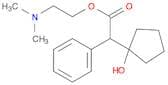
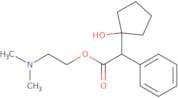
CAS 512-15-2
:Cyclopentolat
Beschreibung:
Cyclopentolat ist eine tertiäre Amin und ein Derivat der Tropensäure, das hauptsächlich als mydriatisches Mittel in der Augenheilkunde verwendet wird, um die Pupillen während Augenuntersuchungen zu erweitern. Es zeichnet sich durch seine Fähigkeit aus, die Wirkung von Acetylcholin an den muskarinischen Rezeptoren im Iris-Sphinktermuskel zu blockieren, was zur Pupillenerweiterung führt. Cyclopentolat wird typischerweise als Augentropfenlösung verabreicht und hat einen schnellen Wirkungseintritt, wobei die Effekte mehrere Stunden anhalten. Die Verbindung ist bekannt für ihre relativ geringe systemische Absorption, was die Nebenwirkungen minimiert. In Bezug auf die physikalischen Eigenschaften ist Cyclopentolat ein weißes bis fast weißes kristallines Pulver, das in Wasser löslich ist und ein pH-abhängiges Löslichkeitsprofil aufweist. Seine chemische Struktur umfasst einen Cyclopentanring, der zu seinen einzigartigen pharmakologischen Eigenschaften beiträgt. Wie bei jedem Medikament ist es wichtig, mögliche Nebenwirkungen zu berücksichtigen, einschließlich erhöhtem Augeninnendruck und Lichtempfindlichkeit, insbesondere bei empfindlichen Personen.
Formel:C17H25NO3
InChl:InChI=1S/C17H25NO3/c1-18(2)12-13-21-16(19)15(14-8-4-3-5-9-14)17(20)10-6-7-11-17/h3-5,8-9,15,20H,6-7,10-13H2,1-2H3
InChI Key:InChIKey=SKYSRIRYMSLOIN-UHFFFAOYSA-N
SMILES:C(C(OCCN(C)C)=O)(C1(O)CCCC1)C2=CC=CC=C2
Synonyme:- 1-Hydroxy-α-phenylcyclopentaneacetic acid, 2-(dimethylamino)ethyl ester
- 2-(Dimethylamino)Ethyl (1-Hydroxycyclopentyl)(Phenyl)Acetate
- 2-(Dimethylamino)ethyl 2-(1-hydroxycyclopentyl)-2-phenylacetate
- 2-Dimethylaminoethyl 1-hydroxy-α-phenylcyclopentaneacetate
- 2-Dimethylaminoethyl 2-(1-Hydroxycyclopentyl)-2-Phenylacetate
- <span class="text-smallcaps">DL</span>-Cyclopentolate
- Benzeneacetic acid, α-(1-hydroxycyclopentyl)-, 2-(dimethylamino)ethyl ester
- Ciclopentolato
- Cyclogyl
- Cyclopentaneacetic acid, 1-hydroxy-α-phenyl-, 2-(dimethylamino)ethyl ester
- Cyclopentoiate
- Cyclopentolat
- Cyclopentylate
- DL-Cyclopentolate
- Tsiklopentolat
- β-Dimethylaminoethyl (1-hydroxycyclopentyl)phenylacetate
- Mydrilate
- 2-Dimethylaminoethyl 1-hydroxy-alpha-phenylcyclopentaneacetate
- 2-dimethylaminoethyl 2-(1-hydroxycyclopentyl)-2-phenyl-ethanoate
- CYCLOPENTOLATE
- Benzeneacetic acid, a-(1-hydroxycyclopentyl)-, 2-(dimethylamino)ethylester
- 1-Hydroxy-alpha-phenylcyclopentaneacetic acid, 2-(dimethylamino)ethyl ester
- 2-(1-hydroxycyclopentyl)-2-phenyl-acetic acid 2-dimethylaminoethyl ester
- yclopentolate
- Benzeneacetic acid, alpha-(1-hydroxycyclopentyl)-, 2-(dimethylamino)ethyl ester
- α-(1-Hydroxycyclopentyl)benzeneacetic acid 2-(dimethylamino)ethyl
- beta-(Dimethylamino)ethyl (1-hydroxycyclopentyl)phenylacetate
- Cyplegin
- Weitere Synonyme anzeigen
Sortieren nach
Reinheit (%)
0
100
|
0
|
50
|
90
|
95
|
100
3 Produkte.
2-(Dimethylamino)ethyl 2-(1-hydroxycyclopentyl)-2-phenylacetate
CAS:Formel:C17H25NO3Molekulargewicht:291.38532-(Dimethylamino)ethyl 2-(1-hydroxycyclopentyl)-2-phenylacetate
CAS:Formel:C17H25NO3Reinheit:95.0%Molekulargewicht:291.391Cyclopentolate
CAS:Kontrolliertes ProduktCyclopentolate is a muscarinic antagonist and is used as an ophthalmic drug to produce mydriasis. Cyclopentolate inhibits the metabolism of cyclopentyl-CoA via the 3-hydroxyacyl-CoA dehydrogenase, which leads to the accumulation of cyclopentyl-CoA in cells. This inhibition can cause metabolic disorders such as hyperlipidemia and diabetes mellitus, which are characterized by increased acid formation and reduced glucose uptake. Cyclopentolate also binds to DNA, inhibiting transcription, replication, and repair of DNA. The binding affinity of cyclopentolate to DNA is approximately 2500 times higher than that of other drugs in its class. Cyclopentolate has been shown to inhibit leukemia inhibitory factor (LIF) and the production of acid from fluorescein angiographyFormel:C17H25NO3Reinheit:Min. 95%Farbe und Form:White/Off-White SolidMolekulargewicht:291.39 g/mol