CAS 513-74-6
:Ammoniumdithiocarbamat
Beschreibung:
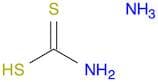
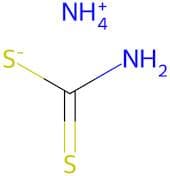
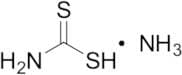
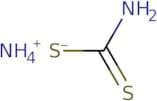
Ammoniumdithiocarbamat, mit der CAS-Nummer 513-74-6, ist eine anorganische Verbindung, die durch ihre Dithiocarbamat-Funktionalgruppe gekennzeichnet ist. Sie erscheint typischerweise als kristalliner Feststoff von weiß bis hellgelb und ist in Wasser löslich, was sie in verschiedenen Anwendungen nützlich macht. Diese Verbindung ist bekannt für ihre Rolle als Reagenz in der organischen Synthese und als Vorläufer in der Herstellung anderer Dithiocarbamat-Derivate. Sie zeigt Eigenschaften wie die eines Chelatbildners, was es ihr ermöglicht, Komplexe mit Metallionen zu bilden und ihre Nützlichkeit in der Landwirtschaft als Fungizid und Pestizid zu erhöhen. Darüber hinaus kann Ammoniumdithiocarbamat in der Bergbauindustrie zur Flotation von Mineralien eingesetzt werden. Ihre chemische Stabilität ist moderat, und sie sollte mit Vorsicht behandelt werden, da sie potenziell toxisch ist und Umweltbedenken bestehen. Insgesamt ist Ammoniumdithiocarbamat eine vielseitige Verbindung mit bedeutenden Anwendungen in der Industrie und Landwirtschaft.
Formel:CH6N2S2
InChl:InChI=1/CH3NS2.H3N/c2-1(3)4;/h(H3,2,3,4);1H3
InChI Key:InChIKey=DCYNAHFAQKMWDW-UHFFFAOYSA-N
SMILES:C(N)(=S)S.N
Synonyme:- Ammonium sulfocarbamate
- Carbamic acid, dithio-, monoammonium salt
- Carbamic acid, dithio-, monoammonium salt (8CI)
- Carbamodithioic Acid
- Carbamodithioic Acid Ammoniate
- Carbamodithioic acid, ammonium salt (1:1)
- Carbamodithioic acid, monoammonium salt
- Dithiocarbamic acid monoammonium salt
- Hsdb 5675
- Hydrazinecarbodithioic Acid
- Nsc 202959
- Ammonium dithiocarbamate
- Dithiocarbamic acid ammonium
- Nsc202959
- Carbamodithioic acid,ammonium salt
- ammonium dithiocarbamate NH4.CH2NS2
- Ammonium dithiocarbamate ISO 9001:2015 REACH
- AMMoniuM carbaModithioate
- Arotinolol impurity 3
- Dithiocarbamic acid ammonium salt
- Weitere Synonyme anzeigen
Sortieren nach
Reinheit (%)
0
100
|
0
|
50
|
90
|
95
|
100
4 Produkte.
Ammoniumdithiocarbamate
CAS:Ammoniumdithiocarbamate is a group p2 compound that reacts with hydrochloric acid to form a dithiocarbamic acid. This reaction is reversible and an equilibrium between the two compounds exists. Ammoniumdithiocarbamate can be used to synthesize nucleophilic substitutions, which are used in many industrial applications. The reactivity of ammoniumdithiocarbamate is increased by the presence of amp-activated protein, which increases hydrogen bonding interactions with the dithiocarbamic acid. Ammoniumdithiocarbamate has been shown in animal studies to inhibit inflammatory diseases and lung damage caused by carbon disulphide.Formel:CH6N2S2Reinheit:Min. 95%Farbe und Form:PowderMolekulargewicht:110.2 g/mol