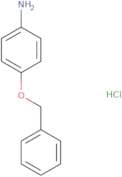
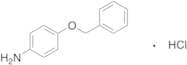
CAS 51388-20-6
:Benzenamin, 4-(phenylmethoxy)-, hydrochlorid (1:1)
Beschreibung:
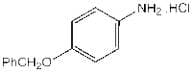
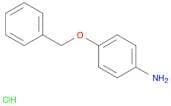
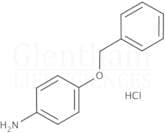
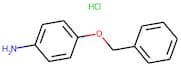
Benzenamin, 4-(phenylmethoxy)-, hydrochlorid (1:1), auch bekannt als 4-(Benzyloxy)anilin-Hydrochlorid, ist eine organische Verbindung, die durch ihre Amin- und Etherfunktionalgruppen gekennzeichnet ist. Sie weist einen Benzolring auf, der mit einer Phenylmethoxygruppe und einer Aminogruppe an der Para-Position substituiert ist. Die Hydrochloridform zeigt an, dass die Verbindung ein Salz ist, was ihre Löslichkeit in Wasser im Vergleich zu ihrer freien Basenform erhöht. Diese Verbindung erscheint typischerweise als weißes bis off-white kristallines Feststoff. Sie wird häufig in der organischen Synthese verwendet und kann als Zwischenprodukt bei der Herstellung von Farbstoffen, Arzneimitteln oder anderen chemischen Verbindungen dienen. Das Vorhandensein der Aminogruppe ermöglicht eine potenzielle Reaktivität in verschiedenen chemischen Reaktionen, einschließlich nucleophiler Substitutionen und Kupplungsreaktionen. Sicherheitsdaten sollten konsultiert werden, wie bei jedem chemischen Stoff, um den Umgang, die Lagerung und potenzielle Gefahren zu verstehen. Insgesamt sind Benzolamin-Derivate in der medizinischen Chemie und Materialwissenschaft aufgrund ihrer vielfältigen Anwendungen von Bedeutung.
Formel:C13H13NO·ClH
InChl:InChI=1S/C13H13NO.ClH/c14-12-6-8-13(9-7-12)15-10-11-4-2-1-3-5-11;/h1-9H,10,14H2;1H
InChI Key:InChIKey=KQBDLOVXZHOAJI-UHFFFAOYSA-N
SMILES:O(CC1=CC=CC=C1)C2=CC=C(N)C=C2.Cl
Synonyme:- 4-(Benzyloxy)aniline hydrochloride
- 4-(Phenylmethoxy)aniline hydrochloride
- 4-Aminodiphenyl ether hydrochloride
- 4-Benzyloxyaniline hydrochloric acid salt
- 4-Benzyloxyphenylamine hydrochloride
- 4-[(Phenylmethyl)oxy]aniline hydrochloride
- Benzenamine, 4-(phenylmethoxy)-, hydrochloride
- Benzenamine, 4-(phenylmethoxy)-, hydrochloride (1:1)
- p-(Benzyloxy)aniline hydrochloride
Sortieren nach
Reinheit (%)
0
100
|
0
|
50
|
90
|
95
|
100
7 Produkte.
4-Benzyloxyaniline hydrochloride, 98%
CAS:This Thermo Scientific Chemicals brand product was originally part of the Alfa Aesar product portfolio. Some documentation and label information may refer to the legacy brand. The original Alfa Aesar product / item code or SKU reference has not changed as a part of the brand transition to Thermo SciFormel:C13H14ClNOReinheit:98%Farbe und Form:Cream to brown or pale grey to pale pink to pink, Crystals or powder or crystalline powderMolekulargewicht:235.714-Benzyloxyaniline, HCl
CAS:Formel:C13H14ClNOReinheit:98%Farbe und Form:SolidMolekulargewicht:235.70944-(Benzyloxy)aniline hydrochloride
CAS:4-(Benzyloxy)aniline hydrochlorideFormel:C13H13NO·ClHReinheit:≥95%Farbe und Form: faint brown solidMolekulargewicht:235.71g/mol4-Benzyloxyaniline hydrochloride
CAS:4-Benzyloxyaniline hydrochloride (4BOAH) is a pro-apoptotic agent that induces cell death by binding to the estrogen receptor. It binds to the cytoplasmic region of the estrogen receptor, which prevents the estrogen receptor from binding to its target DNA sequence. This leads to apoptosis and cell death. 4BOAH has been shown to be an effective inhibitor of breast cancer in animal models and also shows anti-estrogen activity in human liver cells. 4BOAH is a reactive compound with a molecular weight of 239.46 g/mol, an empirical formula C9H11NO2Cl, and structural formula H-C-N=C=O. 4BOAH forms hydrogen bonds with other molecules because it has a lone pair of electrons on the nitrogen atom and can form covalent bonds with amines due to its electron withdrawing properties. The structure of 4BOAH is shown below:Formel:C13H13NO·HClReinheit:Min. 95%Farbe und Form:PowderMolekulargewicht:235.71 g/mol4-(Benzyloxy)aniline hydrochloride
CAS:Formel:C13H14ClNOReinheit:98%Farbe und Form:SolidMolekulargewicht:235.714-(Benzyloxy)aniline Hydrochloride
CAS:Kontrolliertes ProduktApplications 4-(Benzyloxy)aniline Hydrochloride is used as a reagent in the synthesis of a series of amino acid derivatives as novel chromogenic enzyme substrates for the detection of aminopeptidase activity in clinically important microorganisms.
References Cellier, M., et al.: Bioorg. Med. Chem., 22, 5249 (2014)Formel:C16H20FN3O2SFarbe und Form:NeatMolekulargewicht:337.412