CAS 51529-34-1
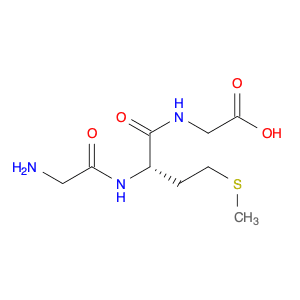
:H-Gly-Met-Gly-OH
Beschreibung:
Die chemische Substanz, die als H-Gly-Met-Gly-OH bekannt ist, mit der CAS-Nummer 51529-34-1, ist ein Peptid, das aus drei Aminosäuren besteht: Glycin (Gly), Methionin (Met) und einem weiteren Glycin (Gly). Dieses Peptid zeichnet sich durch seine relativ einfache Struktur aus, die eine N-terminale Histidin-Gruppe (H) und eine C-terminale Hydroxylgruppe (OH) umfasst. Es wird typischerweise als Dipeptid oder Tripeptid klassifiziert, abhängig vom Kontext seiner Verwendung. Die Anwesenheit von Methionin führt zu einem Schwefelatom, das an verschiedenen biochemischen Prozessen, einschließlich Redoxreaktionen, teilnehmen kann. Peptide wie H-Gly-Met-Gly-OH werden häufig auf ihre potenziellen biologischen Aktivitäten untersucht, einschließlich antioxidativer Eigenschaften und Rollen in der zellulären Signalübertragung. Sie können auch als Bausteine für komplexere Biomoleküle oder als therapeutische Mittel in der Arzneimittelentwicklung dienen. Die Stabilität, Löslichkeit und Reaktivität dieses Peptids können von Faktoren wie pH und Temperatur beeinflusst werden, was es wichtig macht, diese Bedingungen in experimentellen Anwendungen zu berücksichtigen.
Formel:C9H17N3O4S
InChl:InChI=1/C9H17N3O4S/c1-17-3-2-6(12-7(13)4-10)9(16)11-5-8(14)15/h6H,2-5,10H2,1H3,(H,11,16)(H,12,13)(H,14,15)/t6-/m0/s1
SMILES:CSCC[C@@H](C(=NCC(=O)O)O)N=C(CN)O
Synonyme:- Glycine, N-(N-glycyl-L-methionyl)-
- Glycylmethionylglycine
- 4-(Glycylamino)-6-(Methylsulfanyl)-3-Oxonorleucine
- {[N-(ammonioacetyl)-L-methionyl]amino}acetate
Sortieren nach
Reinheit (%)
0
100
|
0
|
50
|
90
|
95
|
100
2 Produkte.
H-Gly-Met-Gly-OH
CAS:H-Gly-Met-Gly-OH is an amide containing a sulfoxide group. It is synthesized from the amino acid glycine and the tripeptide Met-Gly-Gly. The synthesis of HMG was first reported by Sato in 1907, although it was not used as a drug until 1983. This drug has potential antitumor activity and inhibits the growth of certain tumor cells. HMG is metabolized by peptidases, which hydrolyze the peptide bond between glycine and Met-Gly-Gly. Hydrolysis of HMG yields glyoxylic acid (H2O2) and the amino acids glycine and methanol. HMG also inhibits the uptake of glucose into cells, which may be related to its antitumor effect. X-ray diffraction studies have shown that HMG has a carboxylate group at C6 that binds to three oxygen atoms, which are present in twoFormel:C9H17N3O4SReinheit:Min. 95%Molekulargewicht:263.32 g/mol