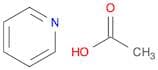
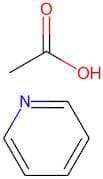
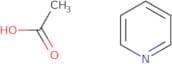
CAS 5153-63-9
:Pyridiniumacetat
Beschreibung:
Pyridiniumacetat ist eine organische Verbindung, die aus einem Pyridinium-Kation und einem Acetat-Anion besteht. Es wird typischerweise als weißes kristallines Feststoff gefunden, das in Wasser und polaren organischen Lösungsmitteln löslich ist. Die Verbindung zeichnet sich durch ihre hygroskopischen Eigenschaften aus, was bedeutet, dass sie Feuchtigkeit aus der Luft aufnehmen kann. Pyridiniumacetat wird häufig in verschiedenen Anwendungen verwendet, einschließlich als Puffer in der biochemischen und analytischen Chemie aufgrund seiner Fähigkeit, die pH-Stabilität aufrechtzuerhalten. Es kann auch als Reagenz in der organischen Synthese und als Quelle von Pyridinderivaten dienen. Die Anwesenheit des Pyridinium-Ions trägt zu seiner Basizität bei, während das Acetat-Ion saure Eigenschaften bietet, die interessante Wechselwirkungen in Lösung ermöglichen. Darüber hinaus kann Pyridiniumacetat antimikrobielle Eigenschaften aufweisen, was es in pharmazeutischen und landwirtschaftlichen Anwendungen von Interesse macht. Sicherheitsdaten zeigen, dass es mit Vorsicht behandelt werden sollte, wie viele chemische Substanzen, um mögliche Reizungen oder unerwünschte Reaktionen zu vermeiden.
Formel:C7H9NO2
InChl:InChI=1/C5H5N.C2H4O2/c1-2-4-6-5-3-1;1-2(3)4/h1-5H;1H3,(H,3,4)
InChI Key:InChIKey=GAPYKZAARZMMGP-UHFFFAOYSA-N
SMILES:C=1C=CN=CC1.C(C)(O)=O
Synonyme:- Acetic acid pyridinyl salt
- Acetic acid, compd. with pyridine (1:1)
- Pyridinal acetate
- Pyridine Acetate (1:1)
- Pyridine, acetate
- Pyridinium acetate
- pyridin-1-ium:acetate
Sortieren nach
Reinheit (%)
0
100
|
0
|
50
|
90
|
95
|
100
3 Produkte.
Pyridinium acetate
CAS:Kontrolliertes Produkt<p>Pyridinium acetate is a chemical compound with the molecular formula of C6H5N3O2. It is a white solid with a melting point of 61 °C. This compound belongs to the class of organic compounds called heterocycles, which contain atoms other than carbon in their ring structures. Pyridinium acetate has been shown to have an inhibitory effect on collagen synthesis and can be used for the treatment of high blood pressure. The synthesis of pyridinium acetate is done by a synthetase enzyme that requires ATP, citric acid, and sodium citrate as substrates. This pathway creates pyridinium acetate from two molecules of aspartic acid and one molecule of acetic acid. The final product contains a carbonyl group, which gives it its acidic properties. Pyridinium acetate also has an acidic pH optimum at 3-4 and is resistant to mutants such as E. coli K-12 that</p>Formel:C5H5N·C2H4O2Reinheit:Min. 95%Farbe und Form:PowderMolekulargewicht:139.15 g/mol