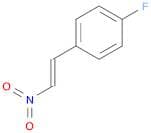
![1-Fluoro-4-[(1E)-2-nitroethenyl]benzene](/_next/image/?url=https%3A%2Fstatic.cymitquimica.com%2Fcas-image%2Fthumb-webp%2F452170-1-fluoro-4-1e-2-nitroethenyl-benzene.webp&w=3840&q=75)
CAS 5153-69-5
:1-Fluor-4-[(1E)-2-nitroethenyl]benzol
- (E)-1-Fluoro-4-(2-nitroethenyl)benzene
- (E)-1-Fluoro-4-(2-nitrovinyl)benzene
- (E)-4-Fluoro-(2-nitrovinyl)benzene
- (E)-β-Nitro-4-fluorostyrene
- 1-Fluoro-4-[(1E)-2-nitroethenyl]benzene
- 1-fluoro-4-[(E)-2-nitroethenyl]benzene
- 4-Fluoro-trans-β-nitrostyrene
- Benzene, 1-fluoro-4-(2-nitroethenyl)-, (E)-
- Benzene, 1-fluoro-4-[(1E)-2-nitroethenyl]-
- Benzene, 4-fluoro-1-(2-nitroethenyl)- (9CI)
- E-4-Fluoro-β-nitrostyrene
- E-p-Fluoro-β-nitrostyrene
- Styrene, p-fluoro-beta-nitro-, (E)-
- Styrene, p-fluoro-β-nitro-, (E)-
- trans p-Fluorophenyl-1 nitro-2 ethylene
- trans p-Fluorophenyl-1 nitro-2 ethylene [French]
- trans-4-Fluoro-β-nitrostyrene
- Weitere Synonyme anzeigen
trans-4-fluoro-β-nitrostyrene
CAS:Formel:C8H6FNO2Reinheit:98%Farbe und Form:SolidMolekulargewicht:167.1371(E)-1-fluoro-4-(2-nitrovinyl)benzene
CAS:(E)-1-fluoro-4-(2-nitrovinyl)benzene is an alkylating agent that reacts with nucleophiles to form covalent bonds. It is catalysed by a lipase and has been used in the synthesis of 5-hydroxytryptamine type 1A receptor antagonists. The reaction can be accelerated by the addition of hydrosilanes. The kinetic and structural studies have shown that this reaction proceeds through a concerted mechanism, but the mechanism of this reaction remains unclear. (E)-1-fluoro-4-(2-nitrovinyl)benzene also has a dipole moment, which makes it a biomolecular compound. This compound may act as a neurotransmitter or neuromodulator, based on its binding affinity for 5-hydroxytryptamine type 1A receptors.br>br>
The use of 5HT1a antagonist is mainly limited to the treatment of anxiety disorders such asFormel:C8H6FNO2Reinheit:Min. 95%Molekulargewicht:167.14 g/mol