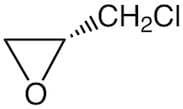
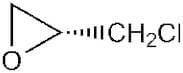
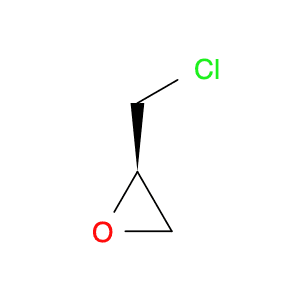
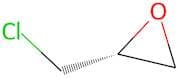
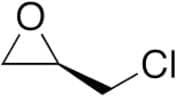
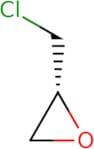
CAS 51594-55-9
:(-)-Epichlorhydrin
Beschreibung:
(-)-Epichlorhydrin, mit der CAS-Nummer 51594-55-9, ist eine farblose bis blassgelbe Flüssigkeit, die durch ihren starken, stechenden Geruch gekennzeichnet ist. Es handelt sich um eine Epoxidverbindung, spezifisch um eine Chlorhydrine, die für ihre Reaktivität aufgrund der Anwesenheit sowohl einer Epoxidgruppe als auch eines Chloratoms bekannt ist. Diese Verbindung ist in Wasser und organischen Lösungsmitteln löslich, was sie in verschiedenen chemischen Anwendungen vielseitig macht. Sie wird hauptsächlich als Zwischenprodukt in der Synthese von Epoxidharzen verwendet, die weit verbreitet in Beschichtungen, Klebstoffen und Verbundmaterialien eingesetzt werden. (-)-Epichlorhydrin wird auch in der Produktion von Glycerin und anderen chemischen Derivaten eingesetzt. Aufgrund ihrer reaktiven Natur kann sie an verschiedenen chemischen Reaktionen teilnehmen, einschließlich Ringöffnungsreaktionen und nucleophilen Substitutionen. Es ist jedoch wichtig, diese Substanz mit Vorsicht zu behandeln, da sie als gefährliches Material eingestuft ist, mit potenziellen Gesundheitsrisiken bei Exposition. Es sollten angemessene Sicherheitsmaßnahmen getroffen werden, wenn mit (-)-Epichlorhydrin in Labor- oder Industrieumgebungen gearbeitet wird.
Formel:C3H5ClO
InChl:InChI=1S/C3H5ClO/c4-1-3-2-5-3/h3H,1-2H2/t3-/m0/s1
InChI Key:InChIKey=BRLQWZUYTZBJKN-VKHMYHEASA-N
SMILES:C(Cl)[C@H]1CO1
Synonyme:- (-)-2-(Chloromethyl)oxirane
- (-)-Epichlorohydrin
- (2R)-2-(chloromethyl)oxirane
- (R)-(-)-2-(Chloromethyl)oxirane
- (R)-(Chloromethyl)oxirane
- (R)-1-Chloro-2,3-epoxypropane
- (R)-3-Chloro-1,2-epoxypropane
- Oxirane, (chloromethyl)-, (2R)-
- Oxirane, (chloromethyl)-, (R)-
- Oxirane, 2-(chloromethyl)-, (2R)-
- (R)-(-) Epichlorohydrin
- (R)-(-)-Epichlorohydrin
- Weitere Synonyme anzeigen
Sortieren nach
Reinheit (%)
0
100
|
0
|
50
|
90
|
95
|
100
10 Produkte.
(R)-Epichlorohydrin
CAS:Formel:C3H5ClOReinheit:>98.0%(GC)Farbe und Form:Colorless to Light yellow clear liquidMolekulargewicht:92.52(R)-(-)-Epichlorohydrin, 98+%
CAS:This Thermo Scientific Chemicals brand product was originally part of the Alfa Aesar product portfolio. Some documentation and label information may refer to the legacy brand. The original Alfa Aesar product / item code or SKU reference has not changed as a part of the brand transition to Thermo SciFormel:C3H5ClOReinheit:98+%Farbe und Form:Clear colorless, LiquidMolekulargewicht:92.52(2R)-(-)-3-Chloro-1,2-propenoxide
CAS:(2R)-(-)-3-Chloro-1,2-propenoxideFormel:C3H5ClOReinheit:99%Farbe und Form: clear. almost colourless liquidMolekulargewicht:92.52g/molR-(-)-Epichlorohydrin
CAS:Formel:C3H5ClOReinheit:99.0%Farbe und Form:Liquid, ClearMolekulargewicht:92.52(R)-Epichlorohydrin
CAS:Kontrolliertes ProduktApplications R-enantiomer of Epichlorohydrin, an important industrial chemical, is a bifunctional alkylating agent with the potential to form DNA cross-links. It is used as a solvent for natural and synthetic resins, gums, cellulose esters and ethers, paints, varnishes, nail enamels and lacquers, cement for Celluloid. Also, it is used as stabilizer.
Not a dangerous good if item is equal to or less than 1g/ml and there is less than 100g/ml in the package
References Romano, K.P. et al.: Chem. Res. Toxicol., 20, 832 (2007); Smyth, H.F., et al.: J. Ind. Hyg. Toxicol., 30, 63 (1948);Formel:C3H5ClOFarbe und Form:NeatMolekulargewicht:92.52(R)-Epichlorohydrin
CAS:(R)-Epichlorohydrin is an organic compound with the chemical formula (CHClO). It is a colorless liquid with a sweet odor. It has been used as an industrial solvent and in the production of other chemicals. It can also be used to inhibit microbial growth by reacting with sulfhydryl groups, which are necessary for some enzymes to function. (R)-Epichlorohydrin is synthesized from dichloroethane by chlorination followed by oxidation: The reaction mechanism proceeds through chlorination of the ethylene molecule followed by a stepwise oxidation of the resultant chlorine atoms to form epichlorohydrin: The first step involves conversion of dichloroethane into dichloroethylene, which reacts with chlorine gas to produce ethyl chloride: This intermediate then reacts with hydrogen peroxide (HOOH) to form chloroethanol, which in turn reacts with oxygen gas (O2) toFormel:C3H5ClOReinheit:Min. 98%Farbe und Form:Colorless Clear LiquidMolekulargewicht:92.52 g/mol