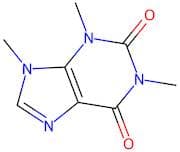
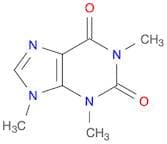
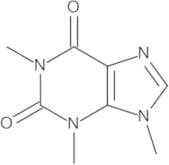
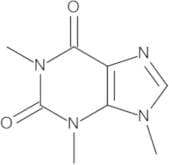
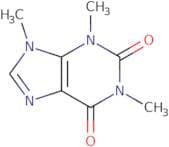
CAS 519-32-4
:Isokoffein
- 1,3,9-Trimethyl-1H-purine-2,6(3H,9H)-dione
- 1,3,9-Trimethyl-2,3,6,9-tetrahydro-1H-purine-2,6-dione
- 1,3,9-Trimethylpurine-2,6-dione
- 1,3,9-Trimethylxanthine
- 1,3,9-trimethyl-3,9-dihydro-1H-purine-2,6-dione
- 1H-Purine-2,6-dione, 3,9-dihydro-1,3,9-trimethyl-
- 3,9-Dihydro-1,3,9-trimethyl-1H-purine-2,6-dione
- 9-Methyltheophylline
- Isocaffeine
- NSC 28332
- 2,6-Dihydroxy-1,3,9-trimethylpurine, Isocaffeine
- CAFFEINE IMP C
- 2,6-DIHYDROXY-1,3,9-TRIMETHYLPURINE
- Caffeine IMpurity C (Isocaffeine)
- 1,3,9- Trimethyllxanthine
- 1,3,9-TRIMETHYLXANTHINE (ISOCAFFEINE) 2, 6-DIHYDROXY-1,3,9-T
- Caffeine EP Impurity C
- Weitere Synonyme anzeigen
Caffeine Related Compound C (1,3,9-Trimethyl-3,9-dihydro-1H-purine-2,6-dione)
CAS:Compounds containing a pyrimidine ring, whether or not hydrogenated, or piperazine ring in the structure, nesoiFormel:C8H10N4O2Farbe und Form:White Fine PowderMolekulargewicht:194.080381,3,9-Trimethyl-3,9-dihydro-1H-purine-2,6-dione
CAS:1,3,9-Trimethyl-3,9-dihydro-1H-purine-2,6-dioneFormel:C8H10N4O2Reinheit:97%Molekulargewicht:194.19Caffeine EP Impurity C (Caffeine USP Related Compound C, Isocaffeine)
CAS:Formel:C8H10N4O2Farbe und Form:White To Off-White SolidMolekulargewicht:194.191,3,9-Trimethyl-3,9-dihydro-1H-purine-2,6-dione (Isocaffeine)
CAS:Kontrolliertes ProduktFormel:C8H10N4O2Farbe und Form:NeatMolekulargewicht:194.19Isocaffeine
CAS:Applications Isocaffeine is an impurity of Caffeine (C080100), a xanthine alkaloid that acts as a stimulant drug and a reversible acetylcholinesterase inhibitor.
References Zubair, U.M., et al.: Anal. Profiles Drug Subs., 15, 71 (1986); Cherrah, Y., et al.: Biochem. Pharmacol., 37, 1311 (1988);Formel:C8H10N4O2Farbe und Form:NeatMolekulargewicht:194.191,3,9-Trimethylxanthine
CAS:Kontrolliertes Produkt1,3,9-Trimethylxanthine is a naturally occurring purine alkaloid that has been shown to have cytosolic calcium ion-antagonistic properties. It can also act as an antioxidant by donating electrons to free radicals and inhibiting lipid peroxidation. This compound is found in coffee beans and other sources of caffeine. It binds to the receptor for adenosine, which causes the antagonistic effects on intracellular calcium concentration. Trimethylxanthine can also be used to treat ventricular arrhythmias and increase locomotor activity in mammals. Trimethylxanthine has been shown to be effective in wastewater treatment as it removes organic pollutants from water by oxidizing them with hydrogen peroxide or chlorine gas.
Formel:C8H10N4O2Reinheit:Min. 95%Farbe und Form:White PowderMolekulargewicht:194.19 g/molIsocaffeine-d3
CAS:Kontrolliertes ProduktFormel:C8D3H7N4O2Farbe und Form:NeatMolekulargewicht:197.209