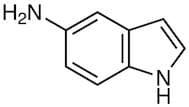
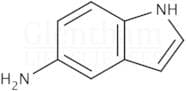
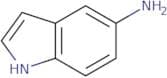
CAS 5192-03-0
:5-Aminoindol
- (Indol-5-yl)amine
- 1H-Indol-5-Amine
- 1H-Indol-5-ylamine
- 5-Amino Indole
- 5-Amino-1H-indole
- 5-Indolamine
- Indol-5-Ylamine
- Indole, 5-amino-
- NSC 61452
- 5-Aminoindole
5-Aminoindole
CAS:Formel:C8H8N2Reinheit:>98.0%(GC)(T)Farbe und Form:White to Gray to Brown powder to crystalMolekulargewicht:132.171H-Indol-5-amine
CAS:1H-Indol-5-amine (5-Aminoindole) is an indole derivative that can be used as an absorbent in (HCIC) and for the synthesis of tetracyclic heterocycles.
Formel:C8H8N2Reinheit:98.76%Farbe und Form:SolidMolekulargewicht:132.165-Amino-1H-indole
CAS:5-Amino-1H-indoleFormel:C8H8N2Reinheit:97%Farbe und Form: very dark grey to black solidMolekulargewicht:132.16g/mol5-Aminoindole
CAS:5-Aminoindole is a versatile chemical intermediate that can be used in the synthesis of many different types of compounds. It has been used as a building block for the synthesis of complex molecules, such as antibiotics and other pharmaceuticals. 5-Aminoindole is also useful in research because it is a reagent that can be used to study the reaction between proteins and nucleic acids. This chemical reacts with calf thymus DNA to produce 5-aminoindole phosphate, which can then react with an activated phosphate group on a protein or nucleic acid. 5-Aminoindole is a high quality reagent that will provide you with excellent results in your experiments.Formel:C8H8N2Molekulargewicht:132.17 g/mol5-Aminoindole
CAS:5-Aminoindole is a hydrogen bond acid. It has been shown to have an optimum concentration of 0.1 mM in the presence of 0.2 mM potassium chloride and 2 mM magnesium chloride, which is similar to the pH range for biological systems. 5-Aminoindole also acts as a competitive inhibitor of quinoline derivatives, such as chloroquine and hydroxychloroquine, which are used in the treatment of malaria and rheumatoid arthritis. The compound has been shown to be active against primary cells grown in culture, including mouse erythrocytes and human hepatocytes. When used with agarose gel electrophoresis or electrochemical impedance spectroscopy, 5-aminoindole shows excellent selectivity for kinases over other enzymes. 5-Aminoindole is not reactive under physiological conditions because it does not have any redox potentials that can be measured by Langmuir adsorption isother
Formel:C8H8N2Reinheit:Min. 97%Farbe und Form:Brown PowderMolekulargewicht:132.16 g/molRef: 3D-FA03582
Ausgelaufenes produkt