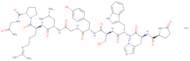
CAS 51952-41-1
:Gonadorelinhydrochlorid
Beschreibung:
Gonadorelinhydrochlorid ist ein synthetisches Dekapeptid, das als Analogon des gonadotropinfreisetzenden Hormons (GnRH) dient. Es wird hauptsächlich in medizinischen Anwendungen eingesetzt, um die Freisetzung von luteinisierendem Hormon (LH) und follikelstimulierendem Hormon (FSH) aus der vorderen Hypophyse zu stimulieren und somit die Fortpflanzungsfunktionen zu beeinflussen. Die Substanz wird typischerweise durch Injektion verabreicht und wird in verschiedenen klinischen Kontexten eingesetzt, einschließlich der Behandlung bestimmter Arten von Unfruchtbarkeit und hormonbedingten Störungen. Gonadorelinhydrochlorid zeichnet sich durch seine Stabilität und Löslichkeit in Wasser aus, was die Verwendung in therapeutischen Formulierungen erleichtert. Die Verbindung wird in der Regel an einem kühlen, trockenen Ort gelagert, um ihre Wirksamkeit zu erhalten. Ihre pharmakologischen Wirkungen sind dosisabhängig und können je nach Zeitpunkt und Häufigkeit der Verabreichung eine Reihe biologischer Aktivitäten aufweisen. Wie bei jedem Peptidhormon ist es in der klinischen Praxis wichtig, mögliche Nebenwirkungen und Kontraindikationen sorgfältig zu berücksichtigen.
Formel:C55H76ClN17O13
InChl:InChI=1/C55H75N17O13.ClH/c1-29(2)19-38(49(80)67-37(9-5-17-60-55(57)58)54(85)72-18-6-10-43(72)53(84)62-25-44(56)75)66-46(77)26-63-47(78)39(20-30-11-13-33(74)14-12-30)68-52(83)42(27-73)71-50(81)40(21-31-23-61-35-8-4-3-7-34(31)35)69-51(82)41(22-32-24-59-28-64-32)70-48(79)36-15-16-45(76)65-36;/h3-4,7-8,11-14,23-24,28-29,36-43,61,73-74H,5-6,9-10,15-22,25-27H2,1-2H3,(H2,56,75)(H,59,64)(H,62,84)(H,63,78)(H,65,76)(H,66,77)(H,67,80)(H,68,83)(H,69,82)(H,70,79)(H,71,81)(H4,57,58,60);1H
SMILES:CC(C)CC(C(=NC(CCCNC(=N)N)C(=O)N1CCCC1C(=NCC(=N)O)O)O)N=C(CN=C(C(Cc1ccc(cc1)O)N=C(C(CO)N=C(C(Cc1c[nH]c2ccccc12)N=C(C(Cc1cnc[nH]1)N=C(C1CCC(=N1)O)O)O)O)O)O)O.Cl
Synonyme:- Gonadorelin hydrochloride [USAN]
- LH-RH hydrochloride
- 5-Oxo-L-prolyl-L-histidyl-L-tryptophyl-L-seryl-L-tyrosylglycyl-
- wL-leucyl-L-arginyl-L-prolylglycinamide hydrochloride. Note-Gonadorelin Hydrochloride is C55H75N17O13 as the monohydrochloride or the dihydrochloride or as a mixture of these
- 5-Oxo-L-prolyl-L-histidyl-L-tryptophyl-L-seryl-L-tyrosylglycyl-L-leucyl-L-arginyl-L-prolylglycinamide hydrochloride
- Factrel
- Gonadorelin HCl
- Unii-3Pfc574Ita
- Luteinizing hormone-releasing factor hydrochloride
- Luteinizing Hormone-Releasing Factor (Swine), Hydrochloride
- Gonadorelin hydrochloride
- Weitere Synonyme anzeigen
Sortieren nach
Reinheit (%)
0
100
|
0
|
50
|
90
|
95
|
100
3 Produkte.
Gonadorelin Hydrochloride
CAS:Hormones, prostaglandins, thromboxanes and leukotrienes, natural or synthetic; derivatives and analogues thereof, etc, nesoiFormel:C55H75N17O13·2HClFarbe und Form:White Off-White PowderMolekulargewicht:1181.57303Gonadorelin HCl
CAS:Gonadorelin HCl, a decapeptide, boosts pituitary LH and FSH production.Formel:C55H76ClN17O13Farbe und Form:SolidMolekulargewicht:1218.77LHRH hydrochloride salt
CAS:LHRH is a hormone that has been used to treat endometriosis, prostate cancer, and ovarian cysts. It is an agonist of the gonadotropin-releasing hormone receptor (GnRH receptor). LHRH binds to the GnRH receptor in the pituitary gland and stimulates the release of follicle-stimulating hormone and luteinizing hormone. This leads to increased production of estrogen and testosterone. LHRH has been shown to be effective in treating infectious diseases such as tuberculosis and HIV/AIDS. LHRH can also be used as a diagnostic aid for determining whether or not a tumor is cancerous by measuring its protein content.Formel:C55H75N17O13·xHClReinheit:Min. 95%Molekulargewicht:1,182.29 g/mol