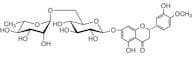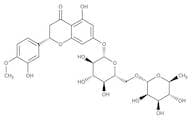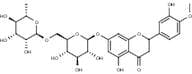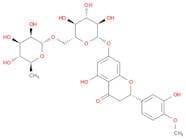
CAS 520-26-3
:Hesperidin
Beschreibung:
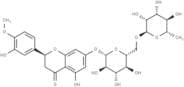
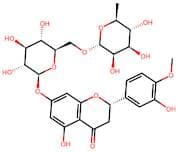
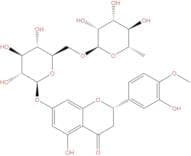
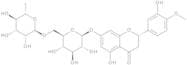
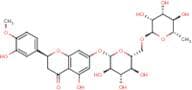
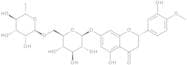
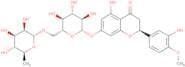
Hesperidin ist ein Flavonoid-Glykosid, das hauptsächlich in Zitrusfrüchten vorkommt, insbesondere in den Schalen von Orangen und Zitronen. Es ist bekannt für seine antioxidativen Eigenschaften und potenziellen gesundheitlichen Vorteile, einschließlich entzündungshemmender und gefäßschützender Wirkungen. Die chemische Struktur von Hesperidin besteht aus einem Flavanon-Rückgrat, speziell Hesperetin, das an eine Rutinose-Zuckergruppe gebunden ist. Diese Verbindung wird häufig auf ihre Rolle bei der Förderung der Herz-Kreislauf-Gesundheit und der Verbesserung der Durchblutung untersucht. Hesperidin ist auch bekannt für seine Fähigkeit, die Aufnahme anderer Nährstoffe zu verbessern und kann zu den allgemeinen gesundheitlichen Vorteilen beitragen, die mit dem Verzehr von Zitrusfrüchten verbunden sind. In Bezug auf die Löslichkeit ist Hesperidin im Allgemeinen in Wasser und Alkohol löslich, was es für verschiedene Formulierungen in Nahrungsergänzungsmitteln und funktionellen Lebensmitteln geeignet macht. Seine CAS-Nummer, 520-26-3, ist eine eindeutige Kennung, die die Identifizierung und das Studium dieser Verbindung in wissenschaftlicher Literatur und regulatorischen Kontexten erleichtert. Insgesamt ist Hesperidin eine bedeutende bioaktive Verbindung mit verschiedenen Anwendungen in Gesundheit und Ernährung.
Formel:C28H34O15
InChl:InChI=1S/C28H34O15/c1-10-21(32)23(34)25(36)27(40-10)39-9-19-22(33)24(35)26(37)28(43-19)41-12-6-14(30)20-15(31)8-17(42-18(20)7-12)11-3-4-16(38-2)13(29)5-11/h3-7,10,17,19,21-30,32-37H,8-9H2,1-2H3/t10-,17-,19+,21-,22+,23+,24-,25+,26+,27+,28+/m0/s1
InChI Key:InChIKey=QUQPHWDTPGMPEX-QJBIFVCTSA-N
SMILES:O=C1C=2C(O[C@@H](C1)C3=CC(O)=C(OC)C=C3)=CC(O[C@@H]4O[C@H](CO[C@H]5[C@H](O)[C@H](O)[C@@H](O)[C@H](C)O5)[C@@H](O)[C@H](O)[C@H]4O)=CC2O
Synonyme:- (2S)-5-hydroxy-2-(3-hydroxy-4-methoxyphenyl)-4-oxo-3,4-dihydro-2H-chromen-7-yl 6-O-(6-deoxy-alpha-L-erythro-hexopyranosyl)-beta-D-threo-hexopyranoside
- (2S)-5-hydroxy-2-(3-hydroxy-4-methoxyphenyl)-4-oxo-3,4-dihydro-2H-chromen-7-yl 6-O-(6-deoxy-alpha-L-mannopyranosyl)-beta-D-glucopyranoside
- (2S)-5-hydroxy-2-(3-hydroxy-4-methoxyphenyl)-4-oxo-3,4-dihydro-2H-chromen-7-yl 6-O-(6-deoxy-beta-L-mannopyranosyl)-beta-D-glucopyranoside
- (2S)-7-[[6-O-(6-Deoxy-α-<span class="text-smallcaps">L</smallcap>-mannopyranosyl)-β-<smallcap>D</span>-glucopyranosyl]oxy]-2,3-dihydro-5-hydroxy-2-(3-hydroxy-4-methoxyphenyl)-4H-1-benzopyran-4-one
- (2S)-Hesperidin
- (S)-7-[[6-O-(6-Deoxy-alpha-L-mannopyranosyl)-beta-D-glucopyranosyl]oxy]-2,3-dihydro-5-hydroxy-2-(3-hydroxy-4-methoxyphenyl)-4H-1-benzopyran-4-one
- 4H-1-Benzopyran-4-one, 7-[[6-O-(6-deoxy-α-<span class="text-smallcaps">L</smallcap>-mannopyranosyl)-β-<smallcap>D</span>-glucopyranosyl]oxy]-2,3-dihydro-5-hydroxy-2-(3-hydroxy-4-methoxyphenyl)-, (2S)-
- 4H-1-Benzopyran-4-one, 7-[[6-O-(6-deoxy-α-<span class="text-smallcaps">L</smallcap>-mannopyranosyl)-β-<smallcap>D</span>-glucopyranosyl]oxy]-2,3-dihydro-5-hydroxy-2-(3-hydroxy-4-methoxyphenyl)-, (S)-
- 4H-1-Benzopyran-4-one, 7-[[6-O-(6-deoxy-α-L-mannopyranosyl)-β-D-glucopyranosyl]oxy]-2,3-dihydro-5-hydroxy-2-(3-hydroxy-4-methoxyphenyl)-, (2S)-
- 4H-1-Benzopyran-4-one, 7-[[6-O-(6-deoxy-α-L-mannopyranosyl)-β-D-glucopyranosyl]oxy]-2,3-dihydro-5-hydroxy-2-(3-hydroxy-4-methoxyphenyl)-, (S)-
- 5-Hydroxy-2-(3-Hydroxy-4-Methoxy-Phenyl)-7-[3,4,5-Trihydroxy-6-[(3,4,5 -Trihydroxy-6-Methyl-Oxan-2-Yl)Oxymethyl]Oxan-2-Yl]Oxy-Chroman-4-One
- 5-hydroxy-2-(3-hydroxy-4-methoxyphenyl)-4-oxo-3,4-dihydro-2H-chromen-7-yl 6-O-(6-deoxyhexopyranosyl)hexopyranoside
- 7-[[6-O-(6-deoxy-.alpha.-L-mannopyranosyl)-.be ta.-D-glucopyranosyl ]oxy]-2,3-dihydro-5-hydroxy-2-(3-hydroxy-4-methox yphenyl)-, (S)-, 4H-1-Benzopyran-4-one, 7-[[6-O- (6-deoxy-.alpha.-L-mannopyranosyl-.bet a.-D-glucopyranosyl] oxy]-2,3-dihydro-5-hydr
- 7-[[6-O-(6-deoxy-α-L-mannopyranosyl)-β-D-glucopyranosyl]oxy]-2,3-dihydro-5-hydroxy-2-(3-hydroxy-4-methoxyphenyl)-4H-1-benzopyran-4-one
- Atripliside B
- Cirantin
- Flavanone, 3',5,7-trihydroxy-4'-methoxy-, 7-(6-O-α-L-rhamnosyl-D-glucoside)
- Flavanone, 3′,5,7-trihydroxy-4′-methoxy-, 7-(6-O-α-<span class="text-smallcaps">L</smallcap>-rhamnosyl-<smallcap>D</span>-glucoside)
- Glucopyranoside
- Hesperetin 7-O-rutinoside
- Hesperetin 7-[6-O- (6-deoxy-.alpha.-L-mannopyranosyl)]-.beta.-D-gluco pyranosid e)
- Hesperetin 7-rhamnoglucoside
- Hesperetin 7-rutinoside
- Hesperidin
- Hesperidina
- Hesperidine
- Hesperidoside
- Hesperitin 7-O-rutinoside
- Hesperitin-7-rhamnoglucoside
- Nsc 44184
- Nsc44184
- S)-(-)-Hesperidine
- Usaf cf-3
- Vitamin P
- hesperetin-7[6-O-(6-deoxy-.alpha.-L-mannopyranosyl)]-beta-D-
- (2S)-7-[[6-O-(6-Deoxy-α-L-mannopyranosyl)-β-D-glucopyranosyl]oxy]-2,3-dihydro-5-hydroxy-2-(3-hydroxy-4-methoxyphenyl)-4H-1-benzopyran-4-one
- Weitere Synonyme anzeigen
Sortieren nach
Reinheit (%)
0
100
|
0
|
50
|
90
|
95
|
100
Hesperidin
CAS:Formel:C28H34O15Reinheit:>90.0%(T)(HPLC)Farbe und Form:White to Light yellow powder to crystalMolekulargewicht:610.57Hesperidin, 95%
CAS:Acts as an antioxidantFormel:C28H34O15Reinheit:95%Farbe und Form:White to pale yellow, PowderMolekulargewicht:610.57Hesperidin
CAS:Hesperidin analytical standard provided with w/w absolute assay, to be used for quantitative titration.Formel:C28H34O15Reinheit:(HPLC) ≥98%Farbe und Form:PowderMolekulargewicht:610.57Hesperidin
CAS:Other glycosides, natural or reproduced by synthesis, and their salts, ethers, esters and other derivativesFormel:C28H34O15Farbe und Form:Beige PowderMolekulargewicht:610.18977(2S)-5-hydroxy-2-(3-hydroxy-4-methoxyphenyl)-7-{[(2S,3R,4S,5S,6R)-3,4,5-trihydroxy-6-({[(2R,3R,4R,5R,6S)-3,4,5-trihydroxy-6-methyloxan-2-yl]oxy}methyl)oxan-2-yl]oxy}-3,4-dihydro-2H-1-benzopyran-4-one
CAS:Formel:C28H34O15Reinheit:97%Farbe und Form:SolidMolekulargewicht:610.5606Hesperidin
CAS:Hesperidin (Cirantin), a citrus-fruit flavanone glycoside, boasts antioxidant, anti-inflammatory, anti-carcinogenic, and cardiovascular benefits.Formel:C28H34O15Reinheit:97.74% - 97.75%Farbe und Form:Fine Brownish Powder Solid PowderMolekulargewicht:610.56Hesperidin (Diosmin EP Impurity B)
CAS:Formel:C28H34O15Farbe und Form:White To Off-White SolidMolekulargewicht:610.57Hesperidin
CAS:Formel:C28H34O15Reinheit:≥ 90.0%Farbe und Form:Off-white to yellow or brown powderMolekulargewicht:610.56Hesperidin
CAS:Hesperidin, a bioflavonoid, is an abundant and inexpensive by-product of Citrus cultivation, has antioxidant, anti-inflammatory, hypolipidemic, vasoprotective and anticarcinogenic and cholesterol lowering actions; can improves the health of capillaries by reducing the capillary permeability; can inhibit following enzymes: phospholipase A2, lipoxygenase, HMG-CoA reductase and cyclo-oxygenase.Formel:C28H34O15Reinheit:95%~99%Farbe und Form:PowderMolekulargewicht:610.565Diosmin EP Impurity B
CAS:Kontrolliertes ProduktFormel:C28H34O15Farbe und Form:NeatMolekulargewicht:610.56Hesperidin
CAS:Natural glycosideFormel:C28H34O15Reinheit:≥ 90.0 % (HPLC)Farbe und Form:PowderMolekulargewicht:610.57Hesperidine
CAS:Kontrolliertes ProduktImpurity Diosmin EP Impurity B
Applications Hesperidine (Diosmin EP Impurity B) is a flavanone found in citrus fruits, also regarded as Vitamin P.
References Ananth, V., et al.: J. Pharm. Res., 2, 1739 (2009), Cejudo B., et al.: J. Agric. Food Chem., 58, 11814 (2010),Formel:C28H34O15Farbe und Form:Light YellowMolekulargewicht:610.56S-Hesperidin
CAS:Please enquire for more information about S-Hesperidin including the price, delivery time and more detailed product information at the technical inquiry form on this pageFormel:C28H34O15Molekulargewicht:610.56 g/molHesperidin (natural)
CAS:Hesperidin is a bioflavonoid compound, which is naturally sourced from citrus fruits, primarily found in the peels of oranges and lemons. Its mode of action involves acting as a potent antioxidant by scavenging free radicals and reducing oxidative stress. Hesperidin also exhibits anti-inflammatory effects by modulating various signaling pathways and inhibiting the release of pro-inflammatory cytokines.In scientific applications, hesperidin is extensively studied for its potential therapeutic benefits. Its antioxidant properties make it a candidate for mitigating oxidative damage in various tissues, while its anti-inflammatory effects are explored in the context of chronic inflammatory conditions. Research has shown potential cardiovascular benefits, including the improvement of endothelial function and lipid profiles. Additionally, hesperidin is investigated for its neuroprotective effects and potential in managing metabolic disorders. These diverse applications highlight the significance of hesperidin in pharmacological research, aiming to leverage its natural properties for health benefits.Formel:C28H34O15Reinheit:Min. 90 Area-%Farbe und Form:Off-White PowderMolekulargewicht:610.56 g/molrac Hesperidine-d3
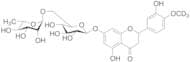
CAS:Kontrolliertes ProduktFormel:C28D3H31O15Farbe und Form:NeatMolekulargewicht:613.579