CAS 52062-26-7
:4-Methoxypyridin-2,6-dicarbonsäure
Beschreibung:
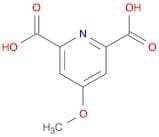
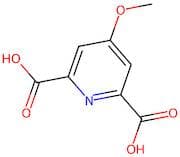
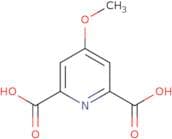
4-Methoxypyridin-2,6-dicarbonsäure, mit der CAS-Nummer 52062-26-7, ist eine organische Verbindung, die durch ihre Pyridinringstruktur gekennzeichnet ist, die mit zwei Carbonsäuregruppen und einer Methoxygruppe substituiert ist. Diese Verbindung zeigt typischerweise ein weißes bis schmutzig-weißes kristallines Aussehen und ist in polaren Lösungsmitteln wie Wasser und Alkoholen löslich, was auf die Anwesenheit der Carbonsäurefunktionalgruppen zurückzuführen ist. Sie hat potenzielle Anwendungen in der Pharmazeutik und Agrochemie und dient oft als Zwischenprodukt in der Synthese verschiedener biologisch aktiver Verbindungen. Die Anwesenheit der Methoxygruppe kann ihre Reaktivität und Löslichkeit beeinflussen, während die Dicarbonsäurefunktionalität an verschiedenen chemischen Reaktionen, einschließlich Esterifizierung und Amidierung, teilnehmen kann. Darüber hinaus kann die Verbindung spezifische biologische Aktivitäten aufweisen, was sie in der medizinischen Chemie von Interesse macht. Wie bei vielen organischen Verbindungen sind eine ordnungsgemäße Handhabung und Lagerung entscheidend, um ihre Stabilität zu erhalten und eine Zersetzung zu verhindern.
Formel:C8H7NO5
InChl:InChI=1/C8H7NO5/c1-14-4-2-5(7(10)11)9-6(3-4)8(12)13/h2-3H,1H3,(H,10,11)(H,12,13)
SMILES:COc1cc(C(=O)O)nc(c1)C(=O)O
Synonyme:- 2,6-Pyridinedicarboxylic Acid, 4-Methoxy-
- 4-Methoxy-2,6-pyridindicarbons?ure
- 4-Methoxy-2,6-pyridinedicarboxylic acid
- 52062-26-7
- 4-Methoxypyridine-2,6-dicarboxylic acid
Sortieren nach
Reinheit (%)
0
100
|
0
|
50
|
90
|
95
|
100
4 Produkte gefunden.
4-Methoxypyridine-2,6-dicarboxylic acid
CAS:Formel:C8H7NO5Reinheit:98%Farbe und Form:SolidMolekulargewicht:197.14494-Methoxypyridine-2,6-dicarboxylic acid
CAS:4-Methoxypyridine-2,6-dicarboxylic acidReinheit:98%Molekulargewicht:197.14g/mol4-Methoxypyridine-2,6-dicarboxylic acid
CAS:4-Methoxypyridine-2,6-dicarboxylic acid is a molecule that can act as a ligand to bind metal ions. It has been shown to be able to form dicarboxylate complexes with chloride and nucleophilic metals such as zinc and copper. 4-Methoxypyridine-2,6-dicarboxylic acid has also been shown to have the ability to form duplexes with DNA, which could potentially inhibit transcription and replication. X-ray crystallography studies of 4-methoxypyridine-2,6-dicarboxylic acid reveal that it adopts a tetradentate coordination geometry with four oxygen atoms in the equatorial plane of the molecule. The molecule is also capable of forming molecular orbitals through its interactions with ligands and metal ions.Formel:C8H7NO5Reinheit:Min. 95%Molekulargewicht:197.14 g/mol