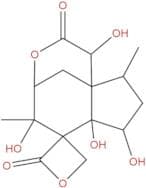
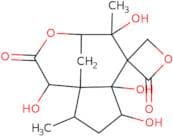
CAS 5230-87-5
:(-)-Anisatin
Beschreibung:
(-)-Anisatin, mit der CAS-Nummer 5230-87-5, ist eine natürlich vorkommende Verbindung, die als Sesquiterpenlacton klassifiziert ist. Es stammt hauptsächlich von der Pflanzenart Illicium anisatum, die allgemein als Sternanis bekannt ist. Diese Verbindung zeichnet sich durch ihre komplexe molekulare Struktur aus, die ein bicyclisches Gerüst und eine Lacton-Funktionalgruppe umfasst. (-)-Anisatin zeigt eine Reihe biologischer Aktivitäten, einschließlich antimikrobieller und insektizider Eigenschaften, was es für die pharmakologische Forschung von Interesse macht. Es wurde auf seine potenziellen Auswirkungen auf das zentrale Nervensystem untersucht, insbesondere als Neurotoxin, das die Freisetzung von Neurotransmittern beeinflusst. Die Verbindung kommt typischerweise in kristalliner Form vor und ist in organischen Lösungsmitteln löslich. Ihre Stereochemie ist signifikant, da die (-) Bezeichnung ihre spezifische optische Aktivität anzeigt, die ihre biologischen Interaktionen beeinflussen kann. Aufgrund ihrer starken Wirkungen wird (-)-Anisatin in Laborumgebungen mit Vorsicht behandelt, und ihre Verwendung ist in vielen Jurisdiktionen geregelt. Insgesamt stellt (-)-Anisatin ein faszinierendes Studienobjekt innerhalb der Naturstoffchemie und Pharmakologie dar.
Formel:C15H20O8
InChl:InChI=1S/C15H20O8/c1-6-3-7(16)15(21)13(6)4-8(23-10(18)9(13)17)12(2,20)14(15)5-22-11(14)19/h6-9,16-17,20-21H,3-5H2,1-2H3/t6-,7-,8-,9+,12+,13+,14+,15-/m1/s1
InChI Key:InChIKey=GEVWHIDSUOMVRI-QWNPAUMXSA-N
SMILES:O[C@]12[C@@]3(C[C@]([C@](C)(O)[C@]14C(=O)OC4)(OC(=O)[C@@H]3O)[H])[C@H](C)C[C@H]2O
Synonyme:- (-)-Anisatin
- (1R,3′S,4R,5R,6aR,7R,9R,9aS)-Hexahydro-1,5,6a,7-tetrahydroxy-5,9-dimethylspiro[4H-4,9a-methanocyclopent[d]oxocin-6(2H),3′-oxetane]-2,2′-dione
- (1S,2R,4R,5R,6S,7R,8R,11R)-4,5,7,11-Tetrahydroxy-2,7-dimethyl-10H-spiro[9-oxatricyclo[6.3.1.0~1,5~]dodecane-6,3'-oxetane]-2',10-dione
- Spiro[4H-4,9a-methanocyclopent[d]oxocin-6(2H),3′-oxetane]-2,2′-dione, hexahydro-1,5,6a,7-tetrahydroxy-5,9-dimethyl-, (1R,3′S,4R,5R,6aR,7R,9R,9aS)-
- Spiro[6H-4,9a-methanocyclopent[d]oxocin-6,3′-oxetane]-2,2′(1H)-dione, 4aβ,5,6a,7,8,9-hexahydro-1α,5β,6aβ,7β-tetrahydroxy-5,9α-dimethyl-
- Spiro[6H-4,9a-methanocyclopent[d]oxocin-6,3′-oxetane]-2,2′(1H)-dione, hexahydro-1,5,6a,7-tetrahydroxy-5,9-dimethyl-, (1R,3′S,4R,5R,6aR,7R,9R,9aS)-
- Spiro[6H-4,9a-methanocyclopent[d]oxocin-6,3′-oxetane]-2,2′(1H)-dione, hexahydro-1,5,6a,7-tetrahydroxy-5,9-dimethyl-, [1R-(1α,4β,5β,6β,6aβ,7β,9α,9aβ)]-
Sortieren nach
Reinheit (%)
0
100
|
0
|
50
|
90
|
95
|
100
3 Produkte.
Anisatin
CAS:LactoneFormel:C15H20O8Reinheit:≥ 95.0 % (HPLC)Farbe und Form:PowderMolekulargewicht:328.32Anisatin
CAS:Anisatin is a potent kinase inhibitor that has been shown to have anticancer properties. It works by inhibiting the activity of kinases, which are enzymes that play a crucial role in cell signaling and growth. Anisatin has been found in Chinese medicinal plants and has been shown to induce apoptosis (cell death) in cancer cells. This compound has also been found in human urine and may have potential as a tumor marker or therapeutic target for cancer treatment. Anisatin is an analog of another protein inhibitor, which suggests that it may have similar properties and could be used as an effective anticancer agent.Formel:C15H20O8Reinheit:Min. 95%Molekulargewicht:328.31 g/mol