CAS 52372-86-8
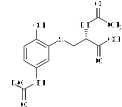
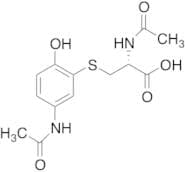
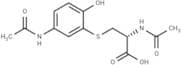
:Paracetamol-Mercapturat
- 3-[(5-Acetamido-2-hydroxyphenyl)thio]-N-acetylalanine
- <span class="text-smallcaps">L</span>-Cysteine, N-acetyl-S-[5-(acetylamino)-2-hydroxyphenyl]-
- Acetaminophen mercapturate
- N-Acetyl-2-(N-acetyl-<span class="text-smallcaps">L</span>-cysteinyl)-4-aminophenol
- N-Acetyl-S-[5-(acetylamino)-2-hydroxyphenyl]-<span class="text-smallcaps">L</span>-cysteine
- Paracetamol mercapturate
- Pcm-M
- l-Cysteine, N-acetyl-S-[5-(acetylamino)-2-hydroxyphenyl]-
- N-Acetyl-S-[5-(acetylamino)-2-hydroxyphenyl]-L-cysteine
Acetaminophen Mercapturate
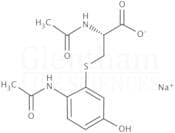
CAS:Formel:C13H16N2O5SFarbe und Form:White To Off-White SolidMolekulargewicht:312.343-(N-Acetyl-L-cystein-S-yl) acetaminophen sodium salt
CAS:Formel:C13H16N2O5SReinheit:≥ 95.0%Farbe und Form:Off-white to grey solidMolekulargewicht:334.323-(N-Acetyl-L-cystein-S-yl) Acetaminophen
CAS:Kontrolliertes ProduktStability Very Hygroscopic
Applications Paracetamol Mercapturate is a metabolite of Acetaminophen (A161220) (1,2). Acetaminophen is a widely used analgesic and antipyretic drug. It can also be used in biological study of urinary antihypertensive drug metabolite screening using molecular networking coupled to high-resolution mass spectrometry fragmentation.
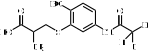
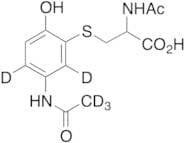
References (1) Trettin, A., et al.: J. Chromatogr. B., 963, 105 (2014) (2) Pickering, G., et al.: Clin. Pharmacol. Ther., 90, 707 (2011)Formel:C13H16N2O5SFarbe und Form:NeatMolekulargewicht:312.34rac-Acetaminophen Mercapturate-d5 (Major)
CAS:Kontrolliertes ProduktApplications rac-Acetaminophen Mercapturate-d5 (Major), is a labeled analogue and free acid of 3-(N-Acetyl-L-cystein-S-yl) Acetaminophen Disodium Salt (A172100), which is a metabolite of Acetaminophen (A161220). Acetaminophen is an analgesic and antipyretic agent used as a pain reliever to treat headache, muscle aches, and arthritis (1,2,3).
References van der Hooft, J.,et al.: Metabolomics, 12, 1 (2016)Formel:C13H11D5N2O5SFarbe und Form:NeatMolekulargewicht:317.37Acetaminophen mercapturate
CAS:Paracetamol Mercapturate is a metabolite of Acetaminophen. It can also be used in the biological study of urinary antihypertensive drugs.Formel:C13H16N2O5SReinheit:98%Farbe und Form:SolidMolekulargewicht:312.343-(N-Acetyl-L-cystein-S-yl) Acetaminophen
CAS:Kontrolliertes Produkt3-(N-Acetyl-L-cystein-S-yl) Acetaminophen is a metabolite of acetaminophen and has been shown to be associated with the development of hepatotoxicity. It is produced by CYP2E1 and can be detected in urine, serum, and plasma. 3-(N-Acetyl-L-cystein-S-yl) Acetaminophen may be used as a biomarker for liver injury caused by acetaminophen overdose. It has also been linked to an increased risk of cardiovascular events such as myocardial infarction and stroke. 3-(N-Acetyl-L-cystein-S-yl) Acetaminophen is not considered to be toxic or carcinogenic in humans.Formel:C13H16N2O5SReinheit:Min. 95%Molekulargewicht:312.34 g/mol