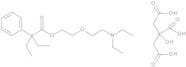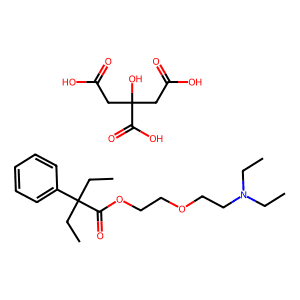
CAS 52432-72-1
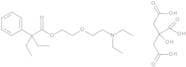
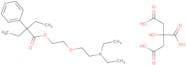
:Oxeladin-Citrat
Beschreibung:
Oxeladin-Citrat ist eine chemische Verbindung, die hauptsächlich für ihre Verwendung als Hustenstiller anerkannt ist. Sie wird als antitussives Mittel klassifiziert, was bedeutet, dass sie hilft, Husten zu lindern, indem sie auf das Husten-Zentrum im Gehirn wirkt. Die Verbindung ist ein Citratsalz von Oxeladin, das ihre Löslichkeit und Bioverfügbarkeit verbessert. Oxeladin-Citrat wird typischerweise in Form von Sirup oder Tabletten verabreicht und ist oft in Formulierungen zur Behandlung von Atemwegserkrankungen enthalten. Ihr Wirkmechanismus beinhaltet die Hemmung des Hustenreflexes, ohne die mukoziliäre Funktion der Atemwege zu beeinträchtigen. Die Substanz wird im Allgemeinen gut vertragen, kann jedoch wie jedes Medikament Nebenwirkungen haben, einschließlich Schläfrigkeit oder gastrointestinalen Störungen. Es ist wichtig, Oxeladin-Citrat unter medizinischer Aufsicht zu verwenden, insbesondere bei Personen mit bestehenden Gesundheitszuständen oder solchen, die andere Medikamente einnehmen. Wie bei allen Arzneimitteln ist die Einhaltung der empfohlenen Dosierungen und Richtlinien entscheidend für Sicherheit und Wirksamkeit.
Formel:C20H33NO3·C6H8O7
InChl:InChI=1S/C20H33NO3.C6H8O7/c1-5-20(6-2,18-12-10-9-11-13-18)19(22)24-17-16-23-15-14-21(7-3)8-4;7-3(8)1-6(13,5(11)12)2-4(9)10/h9-13H,5-8,14-17H2,1-4H3;13H,1-2H2,(H,7,8)(H,9,10)(H,11,12)
InChI Key:InChIKey=KVKJFNUGVOFNGU-UHFFFAOYSA-N
SMILES:C(C(OCCOCCN(CC)CC)=O)(CC)(CC)C1=CC=CC=C1.C(CC(O)=O)(CC(O)=O)(C(O)=O)O
Synonyme:- 2-(2-(Diethylamino)ethoxy)ethyl 2-ethyl-2-phenylbutanoate 2-hydroxypropane-1,2,3-tricarboxylate
- 2-(2-Diethylaminoethoxy)-ethyl 2-ethyl-2-phenylbutyrate citrate
- 2-Methylpropane-1,2,3-Tricarboxylic Acid - 2-[2-(Diethylamino)Ethoxy]Ethyl 2-Ethyl-2-Phenylbutanoate (1:1)
- Benzeneacetic acid, α,α-diethyl-, 2-[2-(diethylamino)ethoxy]ethyl ester, 2-hydroxy-1,2,3-propanetricarboxylate (1:1)
- Butyric acid, 2-ethyl-2-phenyl-, 2-(2-diethylaminoethoxy)ethyl ester, citrate
- N,N-diethyl-2-{2-[(2-ethyl-2-phenylbutanoyl)oxy]ethoxy}ethanaminium 3,4-dicarboxy-3-hydroxybutanoate
- Oxeladin Dihydrogen Citrate
- Oxeladine citrate
- Paxeladine
- Pectamol
- Petcamon
- Silopentol
- Weitere Synonyme anzeigen
Sortieren nach
Reinheit (%)
0
100
|
0
|
50
|
90
|
95
|
100
7 Produkte.
OXELADIN HYDROGEN CITRATE CRS
CAS:OXELADIN HYDROGEN CITRATE CRSFormel:C26H41NO10Farbe und Form:Crystalline Powder. White. Powder.Molekulargewicht:527.6044Oxeladin citrate
CAS:Oxeladin citrate: potent, non-addictive cough suppressant safe for all ages and heart patients; no common antitussive side effects.Formel:C26H41NO10Reinheit:97.23%Farbe und Form:SolidMolekulargewicht:527.6Oxeladin Citrate
CAS:Formel:C20H33NO3·C6H8O7Farbe und Form:White To Off-White SolidMolekulargewicht:335.49 192.13Oxeladin Hydrogen Citrate
CAS:Kontrolliertes ProduktFormel:C20H33NO3·C6H8O7Farbe und Form:NeatMolekulargewicht:527.60Oxeladin citrate salt
CAS:Kontrolliertes ProduktOxeladin is a citrate salt that is used to treat chronic bronchitis, as well as other infections of the respiratory tract. It is prescribed in combination with sodium citrate, which acts as an osmotic laxative. Oxeladin can be administered orally or intravenously and has a low risk of side effects. This drug binds to fatty acids in the bloodstream, preventing them from being reabsorbed into the body and thus causing diarrhea. The active form of oxeladin is an analog of citric acid and it has been shown to have cancer-fighting properties in addition to its use for treating inflammatory diseases such as rheumatoid arthritis.Formel:C20H33NO3·C6H8O7Reinheit:Min. 95%Molekulargewicht:527.6 g/mol