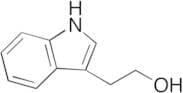
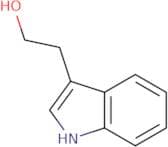
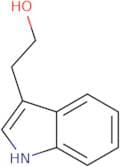
CAS 526-55-6
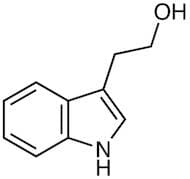
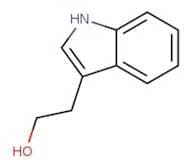
:Tryptophol
- 1H-Indole-3-ethanol
- 2-(1H-Indol-3-yl)ethan-1-ol
- 2-(1H-indol-3-yl)ethanol
- 2-(3-Indole)ethanol
- 2-(3-Indolyl)ethanol
- 3-(2-Hydroxyethyl)-1H-indole
- 3-(2-Hydroxyethyl)indole
- 3-(2-Hydroxyethyl)indole~2-(3-Indolyl)ethanol
- 3-(β-Hydroxyethyl)indole
- Indole-3-ethanol
- NSC 3884
- beta-3-Indolylethanol
- β-(3-Indole)ethanol
- Tryptophol
- Weitere Synonyme anzeigen
3-Indoleethanol
CAS:Formel:C10H11NOReinheit:>98.0%(GC)Farbe und Form:White to Light yellow to Light orange powder to crystalMolekulargewicht:161.20Tryptophol, 97%
CAS:This Thermo Scientific Chemicals brand product was originally part of the Alfa Aesar product portfolio. Some documentation and label information may refer to the legacy brand. The original Alfa Aesar product / item code or SKU reference has not changed as a part of the brand transition to Thermo SciFormel:C10H11NOReinheit:97%Farbe und Form:Yellow to orange or pale brown to brown, Crystals or powder or crystalline powder or fused/lumpy solidMolekulargewicht:161.202-(1H-Indol-3-yl)ethan-1-ol
CAS:"2-(1H-Indol-3-yl)ethan-1-ol is a sleep-inducing liver metabolite formed post disulfiram or during alcoholic fermentation."Formel:C10H11NOReinheit:99.18% - 99.84%Farbe und Form:Light Brown CrystalsMolekulargewicht:161.203-(2-Hydroxyethyl)-1H-indole
CAS:3-(2-Hydroxyethyl)-1H-indoleFormel:C10H11NOReinheit:98%Farbe und Form: yellow-brown solidMolekulargewicht:161.20g/molTryptophol
CAS:Kontrolliertes ProduktApplications Tryptophol is a metabolite formed in the liver after disulfiram treatment that induces sleep in humans. It is also a secondary product of alcoholic fermentation.
References Cornford, E.M., et al.: J Clin Invest, 63, 1241-1248 (1979)Formel:C10H11NOFarbe und Form:NeatMolekulargewicht:161.2Tryptophol
CAS:Tryptophol is a chemical intermediate that is used in the synthesis of many other chemicals. It is a complex compound with CAS number 526-55-6 and has been shown to be an effective reagent for the synthesis of fine chemicals, speciality chemicals, research chemicals, and versatile building blocks. Tryptophol can be used as a building block in organic synthesis reactions.Formel:C10H11NOMolekulargewicht:161.21 g/molTryptophol
CAS:Tryptophol is a fatty acid that is found in the seeds of plants, such as the castor oil plant. Tryptophol has been shown to have metabolic rate-increasing properties and can be used to prepare samples for analysis. This compound is water-soluble and can be extracted from aqueous solutions using acetate or ethyl acetate. Tryptophol has been demonstrated to have genotoxic effects in some studies, but not others. It has also been shown to be a potential antimicrobial agent against microbial metabolism, but not resistant mutants. Tryptophol has been shown to increase the growth rate of galleria mellonella larvae.
Formel:C10H11NOReinheit:Min. 95%Farbe und Form:White PowderMolekulargewicht:161.2 g/mol