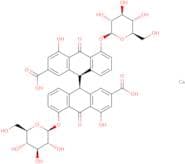
![[9,9′-Bianthracene]-2,2′-dicarboxylic acid, 5,5′-bis(β-D-glucopyranosyloxy)-9,9′,10,10′-tetrahydro…](/_next/image/?url=https%3A%2Fstatic.cymitquimica.com%2Fcas-image%2Fthumb-webp%2F395980-99-bianthracene-22-dicarboxylic-acid-55-bis-b-d-glucopyranosyloxy-991010-tetrahydro-44-dihydroxy-1010-dioxo-calcium-salt-1-9r-9s.webp&w=3840&q=75)
CAS 52730-37-7
:[9,9'-Bianthracen]-2,2'-dicarbonsäure, 5,5'-bis(β-D-glucopyranosyloxy)-9,9',10,10'-tetrahydro-4,4'-dihydroxy-10,10'-dioxo-, Calciumsalz (1:?), (9R,9'S)-
Beschreibung:
Die chemische Substanz, die als "[9,9'-Bianthracen]-2,2'-dicarbonsäure, 5,5'-bis(β-D-glucopyranosyloxy)-9,9',10,10'-tetrahydro-4,4'-dihydroxy-10,10'-dioxo-, Calciumsalz (1:?), (9R,9'S)-" mit der CAS-Nummer 52730-37-7 bekannt ist, ist eine komplexe organische Verbindung, die durch ihr Bianthracen-Rückgrat gekennzeichnet ist, das aus zwei Anthracen-Einheiten besteht. Diese Verbindung weist mehrere funktionelle Gruppen auf, darunter Carbonsäure- und Glucopyranosyl-Moieties, die zu ihrer Löslichkeit und potenziellen biologischen Aktivität beitragen. Das Vorhandensein von Hydroxyl- und Dioxo-Gruppen deutet darauf hin, dass sie antioxidative Eigenschaften aufweisen könnte. Als Calciumsalz hat es wahrscheinlich eine verbesserte Stabilität und Löslichkeit in wässrigen Umgebungen, was es für verschiedene Anwendungen in der Biochemie und Materialwissenschaft geeignet macht. Die durch die Notation (9R,9′S) angegebene Stereochemie deutet auf spezifische räumliche Anordnungen von Atomen hin, die die Reaktivität der Verbindung und ihre Wechselwirkungen mit biologischen Systemen beeinflussen können. Insgesamt könnte diese Substanz potenzielle Anwendungen in der Pharmazie sowie in der Entwicklung funktioneller Materialien haben.
Formel:C42H38O20·xCa
InChl:InChI=1S/C42H38O20.Ca/c43-11-23-31(47)35(51)37(53)41(61-23)59-21-5-1-3-15-25(17-7-13(39(55)56)9-19(45)27(17)33(49)29(15)21)26-16-4-2-6-22(60-42-38(54)36(52)32(48)24(12-44)62-42)30(16)34(50)28-18(26)8-14(40(57)58)10-20(28)46;/h1-10,23-26,31-32,35-38,41-48,51-54H,11-12H2,(H,55,56)(H,57,58);/t23-,24-,25-,26+,31-,32-,35+,36+,37-,38-,41-,42-;/m1./s1
InChI Key:InChIKey=JJUPVRKDTYVTST-YHPXQAAXSA-N
SMILES:O=C1C=2C([C@@](C=3C1=C(O[C@@H]4O[C@H](CO)[C@@H](O)[C@H](O)[C@H]4O)C=CC3)([C@@]5(C=6C(C(=O)C=7C5=CC=CC7O[C@@H]8O[C@H](CO)[C@@H](O)[C@H](O)[C@H]8O)=C(O)C=C(C(O)=O)C6)[H])[H])=CC(C(O)=O)=CC2O.[Ca]
Synonyme:- [9,9′-Bianthracene]-2,2′-dicarboxylic acid, 5,5′-bis(β-D-glucopyranosyloxy)-9,9′,10,10′-tetrahydro-4,4′-dihydroxy-10,10′-dioxo-, calcium salt (1:?), (9R,9′S)-
- [9,9′-Bianthracene]-2,2′-dicarboxylic acid, 5,5′-bis(β-D-glucopyranosyloxy)-9,9′,10,10′-tetrahydro-4,4′-dihydroxy-10,10′-dioxo-, calcium salt, (R*,S*)-
- [9,9′-Bianthracene]-2,2′-dicarboxylic acid, 5,5′-bis(β-D-glucopyranosyloxy)-9,9′,10,10′-tetrahydro-4,4′-dihydroxy-10,10′-dioxo-, calcium salt, (9R,9′S)-
- Sennoside B calcium salt
- Weitere Synonyme anzeigen
Sortieren nach
Reinheit (%)
0
100
|
0
|
50
|
90
|
95
|
100
1 Produkte.
Sennoside b calciumsalt
CAS:Sennoside b is a natural compound found in the plant Senna obtusifolia and has been shown to have an effect on myeloma cells, as well as on enzyme activities and energy metabolism. Sennoside b has also been shown to inhibit phospholipase A2 (PLA2) activity and prostaglandin E2 (PGE2) levels in a mouse myeloma cell line. The pathogenic mechanism of sennoside b is unclear, but it may be due to its locomotor activity-reducing effects or due to its effect on gut motility. The optimum extraction process for sennoside b is not clear, but it should be carried out with care due to its chemical stability. Sennoside b has also been shown to have beneficial effects on hepatic steatosis and bowel disease, thus making it a potential treatment for these conditions. Multivariate logistic regression analysis was used to identify factors that may predictFormel:C42H36CaO20Reinheit:Min. 95%Molekulargewicht:900.8 g/mol