CAS 52766-27-5
:L-Lysyl-L-Prolin
Beschreibung:
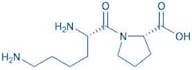
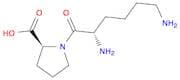
L-Lysyl-L-Prolin, mit der CAS-Nummer 52766-27-5, ist ein Dipeptid, das aus den Aminosäuren Lysin und Prolin besteht. Es ist durch seine spezifische Sequenz gekennzeichnet, in der Lysin, eine essentielle Aminosäure, mit Prolin, einer nicht-essentiellen Aminosäure, verbunden ist. Diese Verbindung kommt typischerweise in verschiedenen biologischen Systemen vor und kann eine Rolle bei der Proteinsynthese und den Zellfunktionen spielen. L-Lysyl-L-Prolin zeigt Eigenschaften, die für Peptide typisch sind, wie die Löslichkeit in Wasser und die Fähigkeit, Wasserstoffbrückenbindungen aufgrund seiner polaren funktionellen Gruppen zu bilden. Seine Struktur umfasst eine Aminogruppe, eine Carboxylgruppe und eine charakteristische Seitenkette von Lysin, die zu seiner basischen Natur beiträgt. Die Anwesenheit von Prolin führt zu einer einzigartigen zyklischen Struktur, die die Konformation und Stabilität des Peptids beeinflussen kann. L-Lysyl-L-Prolin könnte potenzielle Anwendungen in der Pharmazie und Biochemie haben, insbesondere in Studien zu Proteininteraktionen und Stoffwechselwegen.
Formel:C11H21N3O3
InChl:InChI=1S/C11H21N3O3/c12-6-2-1-4-8(13)10(15)14-7-3-5-9(14)11(16)17/h8-9H,1-7,12-13H2,(H,16,17)/t8-,9-/m0/s1
InChI Key:InChIKey=AIXUQKMMBQJZCU-IUCAKERBSA-N
SMILES:C([C@H](CCCCN)N)(=O)N1[C@H](C(O)=O)CCC1
Synonyme:- 205: PN: EP2161028 PAGE: 11 claimed protein
- 21: PN: WO2020097235 SEQID: 250 claimed protein
- 3-4-Substance P
- 37: PN: WO2005081628 SEQID: 1037 claimed protein
- 53: PN: WO2014102101 SEQID: 353 claimed protein
- 53: PN: WO2014102104 SEQID: 152 claimed protein
- <span class="text-smallcaps">L</smallcap>-Lysyl-<smallcap>L</span>-proline
- <span class="text-smallcaps">L</smallcap>-Proline, 1-<smallcap>L</span>-lysyl-
- <span class="text-smallcaps">L</smallcap>-Proline, <smallcap>L</span>-lysyl-
- L-Proline, 1-L-lysyl-
- L-lysyl-L-proline
- Lys-pro
- Lysylproline
- Proline, 1-<span class="text-smallcaps">L</span>-lysyl-
- Substance P<sub>3-4</sub>
- Substance P3-4
- Proline, 1-L-lysyl-
- Weitere Synonyme anzeigen
Sortieren nach
Reinheit (%)
0
100
|
0
|
50
|
90
|
95
|
100
4 Produkte.
H-Lys-Pro-OH
CAS:This dipeptide has the potential as a very promising healing agent in ulcer therapy. Daily oral applications to rats accelerated ulcer healing as well by stimulation of angiogenesis as by good mucous regeneration. In mice, a single administration stimulated granulation tissue production.Formel:C11H21N3O3Reinheit:> 99%Farbe und Form:WhiteMolekulargewicht:243.31Lysylproline
CAS:Lysylproline Third & fourth amino acid in substance P sequence.Formel:C11H21N3O3Farbe und Form:SolidMolekulargewicht:243.3H-Lys-Pro-OH hydrochloride salt
CAS:H-Lys-Pro-OH hydrochloride salt is a monoclonal antibody that is used to treat psychotic disorders. It blocks the binding of gamma-aminobutyric acid (GABA) to its receptor, which reduces neuronal activity and has a calming effect on the central nervous system. H-Lys-Pro-OH hydrochloride salt also inhibits the phosphatase enzyme and prevents it from breaking down phosphotungstic acid, which is used in this process. The antibody also binds to the analog of gamma aminobutyric acid, preventing it from binding with its receptor. H-Lys-Pro-OH hydrochloride salt may be advantageous in treating kidney fibrosis because it prevents cell proliferation and growth in tissue cultures by inhibiting enzymes involved in collagen synthesis. H-Lys-Pro-OH hydrochloride salt may also be useful as an antitumor agent because it inhibits tumor growth by blocking uptake and replication of DNA.Formel:C11H21N3O3Reinheit:Min. 95%Molekulargewicht:243.3 g/mol