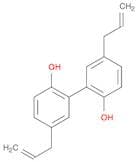
CAS 528-43-8
:Magnolol
Beschreibung:
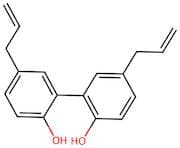
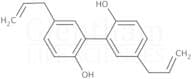
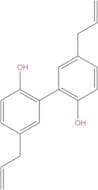
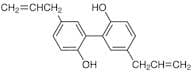
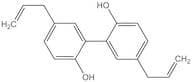
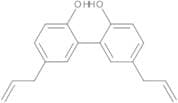
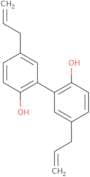
Magnolol ist eine natürliche Verbindung, die hauptsächlich aus der Rinde des Magnolienbaums gewonnen wird, insbesondere aus Arten wie Magnolia officinalis. Es wird als biphenolische Verbindung klassifiziert, die durch ihre zwei aromatischen Ringe gekennzeichnet ist, die durch eine Kohlenstoffkette verbunden sind. Magnolol zeigt eine Reihe biologischer Aktivitäten, einschließlich entzündungshemmender, antioxidativer und antimikrobieller Eigenschaften, was es für die pharmakologische Forschung von Interesse macht. Die Substanz ist typischerweise ein weißes bis blassgelbes kristallines Feststoff mit einem Schmelzpunkt, der je nach Reinheit und spezifischen Bedingungen variiert. Es ist in organischen Lösungsmitteln wie Ethanol und Methanol löslich, hat jedoch eine begrenzte Löslichkeit in Wasser. Magnolol wurde auf seine potenziellen therapeutischen Wirkungen untersucht, einschließlich seiner Rolle bei der Angstreduzierung und seiner Fähigkeit, die kognitive Funktion zu verbessern. Darüber hinaus wird es aufgrund seiner antimikrobiellen Eigenschaften für potenzielle Anwendungen in der Lebensmittelkonservierung und in Kosmetika erforscht. Insgesamt stellt Magnolol eine bedeutende Verbindung sowohl in der traditionellen Medizin als auch in der modernen wissenschaftlichen Forschung dar.
Formel:C18H18O2
InChl:InChI=1/C18H18O2/c1-3-5-13-7-9-17(19)15(11-13)16-12-14(6-4-2)8-10-18(16)20/h3-4,7-12,19-20H,1-2,5-6H2
InChI Key:InChIKey=VVOAZFWZEDHOOU-UHFFFAOYSA-N
SMILES:OC=1C(=CC(CC=C)=CC1)C2=CC(CC=C)=CC=C2O
Synonyme:- 2,2′-Bichavicol
- 2,2′-Biphenyldiol, 5,5′-diallyl-
- 2-(2-Hydroxy-5-prop-2-enylphenyl)-4-prop-2-enylphenol
- 5,5'-Di(Prop-2-En-1-Yl)Biphenyl-2,2'-Diol
- 5,5′-Di-2-propen-1-yl[1,1′-biphenyl]-2,2′-diol
- 5,5′-Diallyl-2,2′-biphenyldiol
- Magnolia Extract
- NSC 293099
- [1,1′-Biphenyl]-2,2′-diol, 5,5′-di-2-propen-1-yl-
- [1,1′-Biphenyl]-2,2′-diol, 5,5′-di-2-propenyl-
- Honokiol std.
- MAGNOLOL
- Magnolol std.
- 5',5-di-2-propenyl-(1,1'-Biphenyl)-2,2'-diol
- 5,5'-DIALLYL-BIPHENYL-2,2'-DIOL
- MAGNOLOL(SH)
- 1’-Biphenyl)-2,2’-diol,5’,5-di-2-propenyl-(1
- Magnolia officinalis Rehd.et Wils
- MAGNOLIABARKEXTRACT
- 5,5'-DIALLYL-2,2'-DIHYDROXYBIPHENYL
- MAGNOLOL 98.0% BY HPLC
- Weitere Synonyme anzeigen
Sortieren nach
Reinheit (%)
0
100
|
0
|
50
|
90
|
95
|
100
14 Produkte.
Magnolol
CAS:Magnolol analytical standard provided with w/w absolute assay, to be used for quantitative titration.Formel:C18H18O2Reinheit:(HPLC) ≥99%Farbe und Form:PowderMolekulargewicht:266.34Magnolol
CAS:Magnolol (5,5'-Diallyl-2,2'-biphenyldiol) is a dual agonist of RXRα( EC50=10.4 μM) and PPARγ(EC50=17.7 μM). It blocks TNF-α-induced NF-KB activation.Formel:C18H18O2Reinheit:99.49% - 99.98%Farbe und Form:A Bioactive Compound Found In The Bark Of The Houpu MagnoliaMolekulargewicht:266.33Magnolol
CAS:Formel:C18H18O2Reinheit:≥ 97.0% (dried basis)Farbe und Form:White to off-white powder or crystalsMolekulargewicht:266.3Magnolol
CAS:Magnolol is a dual agonist of both RXRα and PPARγ, with EC50 values of 10.4 μM and 17.7 μM, respectively. Magnolol has antifungal, antibacterial, anti-oxidative, antidepressant-like, anti- tumor, and neuroprotective effects, it also prevents skin photoaging in UVB-irradiated hairless mice. Magnolol has a wide spectrum of targets including TNF-α, NF-KB, GSK3β.Formel:C18H18O2Reinheit:95%~99%Molekulargewicht:266.34Magnolol
CAS:Formel:C18H18O2Reinheit:>98.0%(GC)Farbe und Form:White to Almost white powder to crystalMolekulargewicht:266.34Magnolol
CAS:PolyphenolFormel:C18H18O2Reinheit:≥ 95.0 % (HPLC)Farbe und Form:PowderMolekulargewicht:266.34Magnolol
CAS:Kontrolliertes ProduktApplications Magnolol is the bioactive phytochemicals found in Magnolia officinalis (1). Magnolol has been used to treat anxiety, cough, headache and allergies (2). It also inhibits tumor necrosis factor-α-*induced ICAM-1 expression in human lung epithelial cells.
Not a dangerous good if item is equal to or less than 1g/ml and there is less than 100g/ml in the package
References (1) Amorati, R., et al.: J Org Chem. (2015) 80:10651-9.(2) Wu, C., et. al.: Inflammation (2014) 37:1957-67Formel:C18H18O2Farbe und Form:Off-WhiteMolekulargewicht:266.33Magnolol
CAS:Magnolol is a bioactive compound, which is a type of lignan extracted from the bark of the magnolia tree, primarily Magnolia officinalis. It exhibits a diverse range of pharmacological activities, primarily attributed to its anti-inflammatory and antioxidant properties. Through the modulation of various signaling pathways, including the NF-κB pathway, magnolol effectively inhibits the activation of inflammatory mediators and scavenges free radicals.Formel:C18H18O2Reinheit:Min. 95%Farbe und Form:PowderMolekulargewicht:266.33 g/mol5,5′-Diallyl-[1,1′-biphenyl]-2,2′-diol
CAS:Formel:C18H18O2Reinheit:99%Farbe und Form:SolidMolekulargewicht:266.34












![5,5′-Diallyl-[1,1′-biphenyl]-2,2′-diol](/_next/image/?url=https%3A%2Fstatic.cymitquimica.com%2Fproducts%2F10%2Fthumb%2FF079442.jpg&w=3840&q=75)