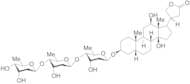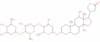
CAS 5297-10-9
:Dihydrodigoxin
- (3β,5β,12β)-3-[(O-2,6-Dideoxy-β-<span class="text-smallcaps">D</smallcap>-ribo-hexopyranosyl-(1→4)-O-2,6-dideoxy-β-<smallcap>D</smallcap>-ribo-hexopyranosyl-(1→4)-2,6-dideoxy-β-<smallcap>D</span>-ribo-hexopyranosyl)oxy]-12,14-dihydroxycardanolide
- 20,22-Dihydrodigoxin
- 3-{[2,6-Dideoxyhexopyranosyl-(1->4)-2,6-Dideoxyhexopyranosyl-(1->4)-2,6-Dideoxyhexopyranosyl]Oxy}-12,14-Dihydroxycardanolide
- 5β-Cardanolide, 3β-[(O-2,6-dideoxy-β-<span class="text-smallcaps">D</smallcap>-ribo-hexopyranosyl-(1→4)-O-2,6-β-<smallcap>D</smallcap>-ribo-hexopyranosyl-(1→4)-2,6-dideoxy-β-<smallcap>D</span>-ribo-hexopyranosyl)oxy]-12β,14-dihydroxy-
- Brn 1339019
- Cardanolide, 3-((O-2,6-dideoxy-beta-D-ribo-hexopyranosyl-(1-4)-O-2,6-dideoxy-beta-D-ribo-hexopyranosyl-(1-4)-2,6-dideoxy-beta-D-ribo-hexopyranosyl)oxy)-12,14-dihydroxy-, (3-beta,5-beta,12-beta)-
- Cardanolide, 3-((O-2,6-dideoxy-beta-d-ribo-hexopyranosyl-(1.4)-O-2,6-dideoxy-beta-d-ribo-hexopyranosyl-(1.4)-2,6-dideoxy-beta-d-ribo-hexopyranosyl)oxy)-12,14-dihydroxy-, (3beta,5beta,12beta)-
- Cardanolide, 3-[(O-2,6-dideoxy-β-<span class="text-smallcaps">D</smallcap>-ribo-hexopyranosyl-(1→4)-O-2,6-dideoxy-β-<smallcap>D</smallcap>-ribo-hexopyranosyl-(1→4)-2,6-dideoxy-β-<smallcap>D</span>-ribo-hexopyranosyl)oxy]-12,14-dihydroxy-, (3β,5β,12β)-
- Digoxin, 20,22-dihydro-
- Digoxin, dihydro-
- Digoxin, dihydro- (6CI)
- Dihydrodigoxin
- 5β-Cardanolide, 3β-[(O-2,6-dideoxy-β-D-ribo-hexopyranosyl-(1→4)-O-2,6-β-D-ribo-hexopyranosyl-(1→4)-2,6-dideoxy-β-D-ribo-hexopyranosyl)oxy]-12β,14-dihydroxy-
- (3β,5β,12β)-3-[(O-2,6-Dideoxy-β-D-ribo-hexopyranosyl-(1→4)-O-2,6-dideoxy-β-D-ribo-hexopyranosyl-(1→4)-2,6-dideoxy-β-D-ribo-hexopyranosyl)oxy]-12,14-dihydroxycardanolide
- Weitere Synonyme anzeigen
Dihydrodigoxin (Mixture of Diastereomers)
CAS:Kontrolliertes ProduktApplications Dihydrodigoxin is a cardioinactive metabolite of Digoxin (D446575) that gets excreted in the urine after Digoxin administration in humans.
Not a dangerous good if item is equal to or less than 1g/ml and there is less than 100g/ml in the package
References Clark, D.R., et al.: Drug Metab. Dispos., 2, 148 (1974); Reuning, R.H., et al.: Drug Metab. Dispos., 13, 51 (1985); Butler, V.P., et al.: Pharmacology, 221, 123 (1982)Formel:C41H66O14Farbe und Form:NeatMolekulargewicht:782.95Dihydrodigoxin
CAS:Dihydrodigoxin is a cardiac glycoside that has been used in the treatment of congestive heart failure. It is usually administered orally and can be detected by fluorescence detector because it contains a fluorescent derivative. Dihydrodigoxin has been shown to decrease renal excretion of digoxin, which may lead to drug interactions. This drug also decreases the activity of several enzymes, including dehydroascorbic acid reductase (DHAR). DHAR catalyzes the conversion of dehydroascorbic acid to ascorbic acid, which is necessary for collagen synthesis. Dihydrodigoxin also causes preeclampsia in pregnant women and decreases blood flow to the uterus.
Formel:C41H66O14Reinheit:Min. 95%Farbe und Form:PowderMolekulargewicht:783 g/molRef: 3D-FAA29710
Ausgelaufenes produkt