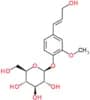
CAS 531-29-3
:Coniferin
Beschreibung:
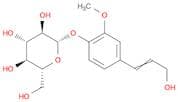
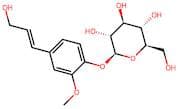
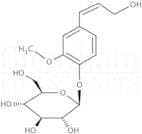
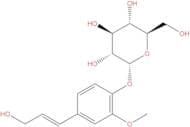
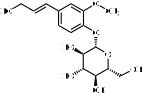
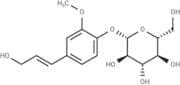
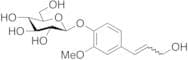
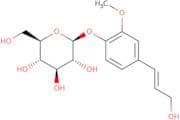
Coniferin, mit der CAS-Nummer 531-29-3, ist ein phenolisches Glycosid, das hauptsächlich in Nadelbäumen vorkommt, insbesondere im Holz und der Rinde von Arten wie Kiefer und Fichte. Es handelt sich um eine natürliche Verbindung, die als Vorläufer von Lignin dient und zur strukturellen Integrität der Zellwände von Pflanzen beiträgt. Coniferin ist durch seine molekulare Formel gekennzeichnet, die ein Glukose-Moiety enthält, das an ein Coniferylalkohol gebunden ist, eine Art phenolischer Verbindung. Diese glykosidische Bindung macht Coniferin wasserlöslich, was ihm ermöglicht, eine Rolle beim Transport von phenolischen Verbindungen innerhalb der Pflanze zu spielen. In Bezug auf seine chemischen Eigenschaften zeigt Coniferin antioxidative Aktivität und könnte potenzielle Anwendungen in der Pharmazie und Lebensmittelkonservierung haben, da es in der Lage ist, freie Radikale zu scavengen. Darüber hinaus wurde es für seine Rolle in den Abwehrmechanismen von Pflanzen gegen Pathogene untersucht. Insgesamt ist Coniferin eine wichtige Verbindung sowohl in ökologischen als auch in industriellen Kontexten, die die komplexe Chemie der sekundären Pflanzenmetaboliten widerspiegelt.
Formel:C16H22O8
InChl:InChI=1S/C16H22O8/c1-22-11-7-9(3-2-6-17)4-5-10(11)23-16-15(21)14(20)13(19)12(8-18)24-16/h2-5,7,12-21H,6,8H2,1H3/t12-,13-,14+,15-,16-/m1/s1
InChI Key:InChIKey=SFLMUHDGSQZDOW-IBEHDNSVSA-N
SMILES:O(C1=C(OC)C=C(C=CCO)C=C1)[C@@H]2O[C@H](CO)[C@@H](O)[C@H](O)[C@H]2O
Synonyme:- 4-(3-Hydroxy-1-propen-1-yl)-2-methoxyphenyl β-glucopyranoside
- 4-(3-Hydroxy-1-propenyl)-2-methoxyphenyl b-D-Glucopyranoside
- 4-Hydroxy-3-methoxy-1-(g-hydroxypropenyl)benzene-4-D-Glucoside
- 4-Hydroxy-3-methoxy-1-(γ-hydroxypropenyl)benzene-4-<span class="text-smallcaps">D</span>-glucoside
- 531-29-3
- Abietin
- Coniferin
- Coniferosid
- Coniferoside
- Laricin
- beta-D-glucopyranoside, 4-[(1E)-3-hydroxy-1-propen-1-yl]-2-methoxyphenyl
- β-<span class="text-smallcaps">D</span>-Glucopyranoside, 4-(3-hydroxy-1-propenyl)-2-methoxyphenyl
- β-Glucopyranoside, 4-(3-hydroxy-1-propen-1-yl)-2-methoxyphenyl
- 4-[(1E)-3-Hydroxyprop-1-en-1-yl]-2-methoxyphenyl beta-D-glucopyranoside
- 4-[(1E)-3-Hydroxyprop-1-en-1-yl]-2-methoxyphenyl-beta-D-glucopyranoside
- Weitere Synonyme anzeigen
Sortieren nach
Reinheit (%)
0
100
|
0
|
50
|
90
|
95
|
100
8 Produkte.
Coniferin
CAS:Coniferin has ATP-dependent transport activity; the extracts of the Balanophora involucrate and trans-Coniferin have anti-oxidation effects; the chromogenic coniferin analog show the exclusive presence of beta-glucosidase activity in the differentiating xylem, similar to peroxidase activity.Formel:C16H22O8Reinheit:95%~99%Farbe und Form:Off-white PowderMolekulargewicht:342.344coniferin
CAS:Coniferin (Abietin) is a glucoside in coniferyl alcohol. It inhibits fungal growth and melanisation, has ATP-dependent transporter and antioxidant properties.
Formel:C16H22O8Reinheit:99.83% - 99.87%Farbe und Form:SolidMolekulargewicht:342.34Coniferin
CAS:Coniferin is a phenolic compound found in plants. It is a 4-hydroxycinnamic acid ester of p-hydroxybenzoic acid. Coniferin can be used as an additive for food and animal feed, as well as a preservative for cellulose. Coniferin has been shown to inhibit the growth of cancer cells, such as K562 cells, by affecting energy metabolism and polymerase chain reaction activities. The physiological effects of coniferin have not been extensively studied but it has been shown to inhibit enzyme activities in plant tissues. Coniferin has also been shown to act synergistically with crystalline cellulose and dihydroconiferyl alcohol to produce HPC powder, which is used for the preparation of HPC-cellulose membranes for protein separation.Formel:C16H22O8Reinheit:Min. 95%Molekulargewicht:342.34 g/mol