CAS 532-28-5
:Mandelonitril
Beschreibung:
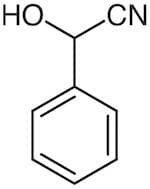
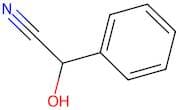
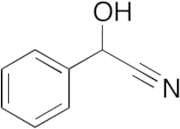
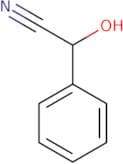
Mandelonitril, mit der CAS-Nummer 532-28-5, ist eine organische Verbindung, die durch ihre Cyanohydrin-Struktur gekennzeichnet ist, die spezifisch aus Benzaldehyd und Wasserstoffcyanid abgeleitet ist. Sie erscheint als farblose bis blassgelbe Flüssigkeit und hat einen charakteristischen mandelartigen Geruch, der auf ihre strukturelle Ähnlichkeit mit Benzaldehyd zurückzuführen ist. Die Verbindung ist bekannt für ihre Reaktivität, insbesondere in nucleophilen Additionsreaktionen, aufgrund der Anwesenheit sowohl einer Nitril- als auch einer Hydroxylgruppe. Mandelonitril ist in Wasser und organischen Lösungsmitteln löslich, was sie in verschiedenen chemischen Anwendungen vielseitig macht. Sie wird häufig in der organischen Synthese verwendet, insbesondere bei der Herstellung von Arzneimitteln und Agrochemikalien. Darüber hinaus kann Mandelonitril einer Hydrolyse unterzogen werden, um Mandelensäure zu erzeugen, was ihre Nützlichkeit in chemischen Prozessen weiter erhöht. Sie sollte jedoch mit Vorsicht behandelt werden, da sie potenziell toxisch ist und die Anwesenheit von Cyanid gesundheitliche Risiken birgt. Angemessene Sicherheitsmaßnahmen und Protokolle sind unerlässlich, wenn mit dieser Verbindung in Labor- oder Industrieumgebungen gearbeitet wird.
Formel:C8H7NO
InChl:InChI=1S/C8H7NO/c9-6-8(10)7-4-2-1-3-5-7/h1-5,8,10H
InChI Key:InChIKey=NNICRUQPODTGRU-UHFFFAOYSA-N
SMILES:C(C#N)(O)C1=CC=CC=C1
Synonyme:- (2S)-hydroxy(phenyl)ethanenitrile
- (±)-α-Mandelonitrile
- 2-Hydroxy-2-phenylacetonitrile
- Alpha-hydroxy phenylacetonitrile
- Benzaldehydcyanhydrin
- Benzaldehyde cyanohydrin
- Benzaldehydecyanohydrin
- Benzeneacetonitrile, α-hydroxy-
- Hydroxy(Phenyl)Acetonitrile
- Mandelic acid nitrile
- NSC 77668
- Phenylglycolonitrile
- alpha-Hydroxyphenylacetonitrile
- dl-Mandelonitrile
- α-Cyanobenzyl alcohol
- α-Hydroxybenzeneacetonitrile
- α-Hydroxybenzyl cyanide
- α-Hydroxyphenylacetonitrile
- Weitere Synonyme anzeigen
Sortieren nach
Reinheit (%)
0
100
|
0
|
50
|
90
|
95
|
100
6 Produkte.
Mandelonitrile
CAS:Formel:C8H7NOReinheit:>97.0%(GC)Farbe und Form:White or Colorless to Yellow powder to lump to clear liquidMolekulargewicht:133.15Mandelonitrile
CAS:MandelonitrileFormel:C8H7NOReinheit:90%Farbe und Form: brown liquidMolekulargewicht:133.15g/molMandelonitrile (>90%)
CAS:Kontrolliertes ProduktApplications Mandelonitrile along side hydroxynitrile lyase is used to induced cyanogenesis in seeds.
Not a dangerous good if item is equal to or less than 1g/ml and there is less than 100g/ml in the package
References Halter, Jonas G., et al.: J. of Materials Chem., 2(3), 853-858 (2014)Formel:C8H7NOReinheit:>90%Farbe und Form:NeatMolekulargewicht:133.15Mandelonitrile
CAS:Mandelonitrile is a chemical compound that is used as an intermediate in the production of other chemicals. It can be synthesized from sodium carbonate and hydrogen cyanide using an intramolecular hydrogen transfer reaction. Mandelonitrile is commonly used as a precursor to acetic acid, which is the main ingredient in vinegar. This compound has been shown to have enzyme inhibitory activity against plant enzymes such as phosphofructokinase, acetolactate synthase, and malic enzyme. Mandelonitrile also exhibits antibacterial properties against Group P2 bacteria such as Escherichia coli and Bacillus subtilis. The optimum pH for this reaction is 2-3. Kinetic studies have shown that the rate of the reaction increases with increasing temperature, but decreases with increasing pH.Formel:C8H7NOReinheit:Min. 95%Farbe und Form:Clear LiquidMolekulargewicht:133.15 g/mol