CAS 5323-57-9
:Chinolin-2,4-dicarbonsäure
Beschreibung:
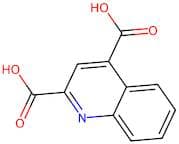
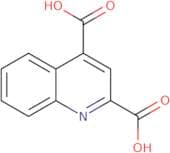
Chinolin-2,4-dicarbonsäure ist eine aromatische organische Verbindung, die durch ihre Chinolinstruktur gekennzeichnet ist, die aus einem fusionierten Benzol- und Pyridinring besteht. Diese Verbindung weist zwei Carbonsäuregruppen (-COOH) auf, die sich an den Positionen 2 und 4 des Chinolins befinden, was zu ihren sauren Eigenschaften beiträgt und ihre Löslichkeit in polaren Lösungsmitteln erhöht. Sie erscheint typischerweise als kristalliner Feststoff und ist bekannt für ihre potenziellen Anwendungen in verschiedenen Bereichen, einschließlich Pharmazie, Agrochemie und als Baustein in der organischen Synthese. Das Vorhandensein der Carbonsäuregruppen ermöglicht die Bildung von Salzen und Estern, was sie in chemischen Reaktionen vielseitig macht. Chinolinderivate werden häufig auf ihre biologischen Aktivitäten untersucht, einschließlich antimikrobieller und antitumoraler Eigenschaften. Darüber hinaus ermöglicht die Struktur der Verbindung eine potenzielle Koordination mit Metallionen, was in der Katalyse und Materialwissenschaft nützlich sein kann. Insgesamt ist Chinolin-2,4-dicarbonsäure eine bedeutende Verbindung sowohl in der synthetischen als auch in der angewandten Chemie.
Formel:C11H7NO4
InChl:InChI=1/C11H7NO4/c13-10(14)7-5-9(11(15)16)12-8-4-2-1-3-6(7)8/h1-5H,(H,13,14)(H,15,16)
SMILES:c1ccc2c(c1)c(cc(C(=O)O)n2)C(=O)O
Synonyme:- 2,4-Quinolinedicarboxylic Acid
Sortieren nach
Reinheit (%)
0
100
|
0
|
50
|
90
|
95
|
100
4 Produkte.
Quinoline-2,4-dicarboxylic acid
CAS:Formel:C11H7NO4Reinheit:95%Farbe und Form:SolidMolekulargewicht:217.1776Quinoline-2,4-dicarboxylic acid
CAS:Quinoline-2,4-dicarboxylic acidReinheit:95%Molekulargewicht:217.18g/molQuinoline 2,4-dicarboxylic acid
CAS:Quinoline 2,4-dicarboxylic acid (QDA) is a novel cytotoxic agent that targets cervical cancer cells. It inhibits the uptake of glucose and other nutrients by cervical cancer cells, leading to cell death through apoptosis. QDA also inhibits the expression of genes involved in cross-linking reactions, which are important for the structural integrity of proteins. This agent has been shown to inhibit the growth of aniline-induced breast cancer cells and glutamate-stimulated PC12 cells. QDA binds to DNA and forms covalent bonds with nucleotide bases, inhibiting DNA synthesis, as well as interfering with protein synthesis and cell division. The QDA mechanism is similar to that of benzoquinolines and estrone sulfate.
Formel:C11H7NO4Reinheit:Min. 95%Farbe und Form:White PowderMolekulargewicht:217.18 g/mol