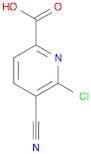
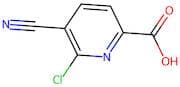
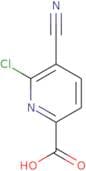
CAS 53234-56-3
:6-Chlor-5-cyano-2-pyridincarbonsäure
Beschreibung:
6-Chlor-5-cyano-2-pyridincarbonsäure ist eine heterocyclische organische Verbindung, die durch ihren Pyridinring gekennzeichnet ist, der sowohl eine Chloro- als auch eine Cyano-Gruppe sowie eine Carbonsäure-Funktionalgruppe enthält. Die Anwesenheit des Chlorsubstituenten an der Position 6 und der Cyano-Gruppe an der Position 5 trägt zu seiner einzigartigen chemischen Reaktivität und potenziellen Anwendungen in verschiedenen Bereichen, einschließlich der Pharmazie und Agrochemie, bei. Diese Verbindung ist typischerweise ein Feststoff bei Raumtemperatur und in polaren Lösungsmitteln löslich, was für Carbonsäuren üblich ist. Ihre saure Natur wird der Carbonsäuregruppe zugeschrieben, die es ihr ermöglicht, an Säure-Base-Reaktionen teilzunehmen. Die Cyano-Gruppe kann auch an nucleophilen Reaktionen teilnehmen, was diese Verbindung in der synthetischen Chemie vielseitig macht. Darüber hinaus kann die Anwesenheit des Pyridinrings spezifische biologische Aktivitäten verleihen, was sie in der medizinischen Chemie von Interesse macht. Insgesamt ist 6-Chlor-5-cyano-2-pyridincarbonsäure eine wertvolle Verbindung für Forschung und Entwicklung in verschiedenen chemischen Anwendungen.
Formel:C7H3ClN2O2
InChl:InChI=1S/C7H3ClN2O2/c8-6-4(3-9)1-2-5(10-6)7(11)12/h1-2H,(H,11,12)
InChI Key:InChIKey=ROPFRDWKBGCDEZ-UHFFFAOYSA-N
SMILES:C(O)(=O)C=1N=C(Cl)C(C#N)=CC1
Synonyme:- 6-Chloro-5-cyanopyridine-2-carboxylic acid
- 6-Chloro-5-cyanopicolinic acid
- 2-Pyridinecarboxylic acid, 6-chloro-5-cyano-
- 6-Chloro-5-cyano-2-pyridinecarboxylic acid
Sortieren nach
Reinheit (%)
0
100
|
0
|
50
|
90
|
95
|
100
4 Produkte.
6-Chloro-5-cyanopicolinic acid
CAS:Formel:C7H3ClN2O2Reinheit:95%Farbe und Form:SolidMolekulargewicht:182.56396-Chloro-5-cyanopicolinic acid
CAS:6-Chloro-5-cyanopicolinic acidReinheit:98%Molekulargewicht:182.566g/mol6-chloro-5-cyanopyridine-2-carboxylic acid
CAS:6-Chloro-5-cyanopyridine-2-carboxylic acid is an antitumor agent that inhibits tumor cell proliferation and induces cell death. It has been shown to be a selective inhibitor of the enzyme hepg2, which is involved in the conversion of cholesterol to bile acids. 6-Chloro-5-cyanopyridine-2-carboxylic acid has also been shown to inhibit the growth of tumor cells by binding to pyrimidine derivatives and acylating them. This reaction leads to the formation of reactive nitrogen species that cause DNA damage and lead to apoptotic cell death. The compound can be synthesized efficiently through an acylation reaction with benzoyl chloride.Formel:C7H3ClN2O2Reinheit:Min. 95%Molekulargewicht:182.6 g/mol