CAS 533-49-3
:L-Erythrose
Beschreibung:
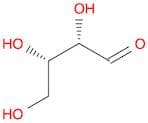
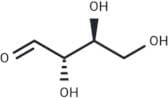
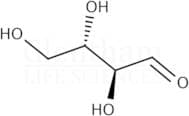
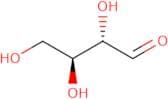
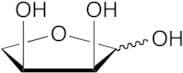
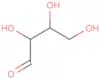
L-Erythrose ist ein vierkohliger Aldose-Zucker, der als Tetrose klassifiziert ist, mit der chemischen Formel C4H8O4. Es ist ein Stereoisomer von D-Erythrose und zeichnet sich durch das Vorhandensein einer Aldehydfunktion am Ende des Moleküls aus. L-Erythrose ist ein farbloser, kristalliner Feststoff, der in Wasser löslich ist, was seine polare Natur aufgrund der Hydroxylgruppen (-OH) widerspiegelt. Es spielt eine bedeutende Rolle in verschiedenen biochemischen Stoffwechselwegen, einschließlich des Pentosephosphatwegs, der für den Zellstoffwechsel und die Synthese von Nukleotiden entscheidend ist. Die Verbindung zeigt optische Aktivität, mit einer spezifischen Drehung, die je nach Konzentration und Temperatur variiert. L-Erythrose kann an Maillard-Reaktionen teilnehmen, die zur Geschmacks- und Farbgebung in der Lebensmittelchemie beitragen. Seine CAS-Nummer, 533-49-3, wird zur Identifizierung in chemischen Datenbanken verwendet. Insgesamt ist L-Erythrose sowohl in biologischen Systemen als auch in industriellen Anwendungen wichtig, insbesondere bei der Synthese anderer organischer Verbindungen.
Formel:C4H8O4
InChl:InChI=1S/C4H8O4/c5-1-3(7)4(8)2-6/h1,3-4,6-8H,2H2/t3-,4+/m1/s1
InChI Key:InChIKey=YTBSYETUWUMLBZ-DMTCNVIQSA-N
SMILES:[C@@H]([C@@H](C=O)O)(CO)O
Synonyme:- (2S,3S)-2,3,4-Trihydroxybutanal
- Erythrose, L-
- Butanal, 2,3,4-trihydroxy-, [S-(R*,R*)]-
- Butanal, 2,3,4-trihydroxy-, (2S,3S)-
- L-Erythrose
Sortieren nach
Reinheit (%)
0
100
|
0
|
50
|
90
|
95
|
100
6 Produkte.
Butanal, 2,3,4-trihydroxy-, (2S,3S)-
CAS:Formel:C4H8O4Reinheit:95%Farbe und Form:SolidMolekulargewicht:120.1039L-Erythrose
CAS:L-Erythrose is a tetrasaccharide and an aldose,,involved in the synthesis of erythritol, and can characterize erythrose reductase (ER) activity.Formel:C4H8O4Farbe und Form:SolidMolekulargewicht:120.1L-Erythrose
CAS:Formel:C4H8O4Reinheit:≥ 95.0%Farbe und Form:Colourless or pale yellow syrupMolekulargewicht:120.10L-Erythrose
CAS:L-Erythrose is a monosaccharide that contains an hydroxyl group on the second carbon atom. It can be synthesized by a synthetic scheme involving glycolaldehyde and hydroxylamine. L-Erythrose has been shown to inhibit the enzyme phosphoglycerate kinase, which converts 2-phosphoglycerate into phosphoenolpyruvate. L-Erythrose has also been shown to inhibit dehydroascorbic acid reductase, which converts dehydroascorbic acid into ascorbic acid, and galactitol reductase, which converts galactitol into D-tagatose. The mutant strain of Escherichia coli K12 that was engineered to produce L-erythrose showed a decreased susceptibility to phage infection and an increased resistance to oxidative stress. In addition, the polyol pathway in E. coli was induced by L-erythrose treatment.Formel:C4H8O4Reinheit:(%) Min. 90%Farbe und Form:Slightly Yellow PowderMolekulargewicht:120.1 g/molL-Erythrose (~0.1 M solution in water)
CAS:Kontrolliertes ProduktApplications L-Erythrose is a rare aldotetrose that have been used as a chirality factor used in QSAR studies of chiral molecules.
References Yang, C.S., et al.: QSAR. Combin. Sci., 24, 1047 (2005); Nishimura, K., et al.: J. BIosci. Bioeng., 101, 303 (2006); Mizanur, R.M., et al.: J. Biosci. Bioeng., 92, 237 (2001);Formel:C4H8O4Farbe und Form:ColourlessMolekulargewicht:120.1