CAS 534-30-5
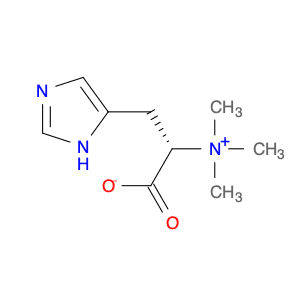
:Histidin-Betain
- 1H-Imidazole-4-ethanaminium, α-carboxy-N,N,N-trimethyl-, inner salt, (αS)-
- N(alpha),N(alpha),N(alpha)-trimethyl-L-histidinium(1+)
- Ammonium, (1-carboxy-2-imidazol-4-ylethyl)trimethyl-, hydroxide, inner salt, L-
- Histidine-betaine
- Hercynine
- (alphaS)-alpha-Carboxy-N,N,N-trimethyl-1H-imidazole-4-ethanaminium inner salt
- N(alpha),N(alpha),N(alpha)-trimethyl-L-histidine
- α-N,N,N-Trimethylhistidine
- 1H-Imidazole-4-ethanaminium, α-carboxy-N,N,N-trimethyl-, inner salt, (S)-
- (S)-3-(1H-Imidazol-5-yl)-2-(trimethylammonio)propanoate
1H-Imidazole-4-ethanaminium, a-carboxy-N,N,N-trimethyl-, inner salt,(aS)-
CAS:Formel:C9H15N3O2Reinheit:95%Farbe und Form:SolidMolekulargewicht:197.2343Ref: IN-DA01CBH9
1g31,00€5g69,00€10g129,00€15g150,00€25g155,00€50g291,00€75g574,00€100g529,00€50kg15.168,00€100kg38.561,00€100mg24,00€250mg25,00€300kg86.762,00€L-Hercynine-d3
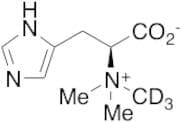
CAS:Kontrolliertes ProduktApplications L-Hercynine-d3 is the isotope labelled analog of Hercynine (H288900); a precursor of L-(+)-Ergothioneine (E600000) which is a natural molecule isolated from the rye ergot fungus and later identified in rat erythrocytes and liver and in numerous other animal tissues. Its antioxidizing properties may afford the compound therapeutic potential or it may be used as a food additive or in cosmetics.
References Genghof, D.S., et al.: J. Bacteriol., 95, 340 (1968); Nakamura, T., et al.: Biol. Pharm. Bull., 31, 1580 (2008); Yang, J., et al.: Food Chem., 114, 898 (2009); Grigat, S., et al.: Drug Metab. Disposition, 37, 330 (2009);Formel:C9H12D3N3O2Farbe und Form:Off-White To Light YellowMolekulargewicht:200.25L-Hercynine
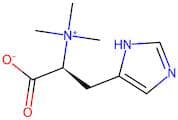
CAS:Kontrolliertes ProduktApplications L-Hercynine is a precursor of L-(+)-Ergothioneine (E600000); a natural molecule isolated from the rye ergot fungus and later identified in rat erythrocytes and liver and in numerous other animal tissues. Its antioxidizing properties may afford the compound therapeutic potential or it may be used as a food additive or in cosmetics.
References Genghof, D.S., et al.: J. Bacteriol., 95, 340 (1968); Nakamura, T., et al.: Biol. Pharm. Bull., 31, 1580 (2008); Yang, J., et al.: Food Chem., 114, 898 (2009); Grigat, S., et al.: Drug Metab. Disposition, 37, 330 (2009);Formel:C9H15N3O2Farbe und Form:NeatMolekulargewicht:197.23