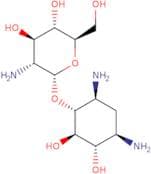
CAS 534-47-4
:Paromamin
Beschreibung:
Paromamin, mit der CAS-Nummer 534-47-4, ist eine chemische Verbindung, die zur Klasse der Aminoglykosid-Antibiotika gehört. Sie zeichnet sich hauptsächlich durch ihre Aminozuckerstruktur aus, die für ihre biologische Aktivität entscheidend ist. Paromamin zeigt antibakterielle Eigenschaften, insbesondere gegen eine Reihe von gramnegativen Bakterien, was sie im Bereich der Mikrobiologie und Pharmakologie wertvoll macht. Die Verbindung wirkt, indem sie die Proteinsynthese in Bakterien hemmt und so ihre antimikrobiellen Effekte entfaltet. Paromamin wird häufig auf seine potenziellen Anwendungen zur Behandlung von Infektionen untersucht, insbesondere in Fällen, in denen Resistenzen gegen andere Antibiotika ein Problem darstellen. Darüber hinaus umfasst ihre chemische Struktur mehrere Hydroxylgruppen, die zu ihrer Löslichkeit in Wasser und ihrer Wechselwirkung mit biologischen Systemen beitragen. Wie bei vielen Aminoglykosiden kann die Verwendung von Paromamin mit bestimmten Nebenwirkungen verbunden sein, insbesondere Nephrotoxizität und Ototoxizität, was eine sorgfältige Überwachung während der therapeutischen Anwendung erforderlich macht. Insgesamt stellt Paromamin eine wichtige Verbindung in der Antibiotika-Forschung und -Entwicklung dar.
Formel:C12H25N3O7
InChl:InChI=1S/C12H25N3O7/c13-3-1-4(14)11(10(20)7(3)17)22-12-6(15)9(19)8(18)5(2-16)21-12/h3-12,16-20H,1-2,13-15H2/t3-,4+,5-,6-,7+,8-,9-,10-,11-,12-/m1/s1
InChI Key:InChIKey=JGSMDVGTXBPWIM-HKEUSBCWSA-N
SMILES:O([C@H]1[C@H](O)[C@@H](O)[C@H](N)C[C@@H]1N)[C@H]2O[C@H](CO)[C@@H](O)[C@H](O)[C@H]2N
Synonyme:- Neomycin D
- 4-O-α-D-Glucosaminyl-2-deoxystreptamine
- 4-O-(2-Amino-2-deoxy-α-D-glucopyranosyl)-2-deoxy-D-streptamine
- Paromamine
- D-Streptamine, 4-O-(2-amino-2-deoxy-α-D-glucopyranosyl)-2-deoxy-
Sortieren nach
Reinheit (%)
0
100
|
0
|
50
|
90
|
95
|
100
2 Produkte.
Paromamine 3HCl
CAS:Paromamine is a chemical compound that inhibits protein synthesis by enzymatic inactivation. It has been shown to have a broad spectrum of antibacterial activity against Gram-positive and Gram-negative bacteria. Paromamine also has the ability to inhibit bacterial growth at high salt concentrations, making it an attractive candidate for development as an oral antibiotic drug. Paromamine is synthesized from natural products, such as salicylaldehyde or phenylhydrazine, which are readily available and inexpensive. The reaction mechanism for the formation of paromamine starts with dehydration of the hydroxyl group on the hydrazine to form a carbonyl group. This carbonyl group reacts with sephadex g-100 to form a cyanohydrin. The cyanohydrin reacts with ammonia to form an amide bond between the two nitrogen atoms in the molecule, which forms paromamine.Formel:C12H25N3O7·3HClReinheit:Min. 95%Molekulargewicht:323.34 g/mol