CAS 535-34-2
:Cystathionin
Beschreibung:
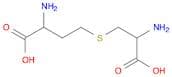
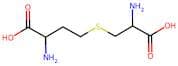
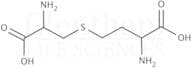
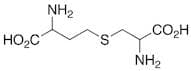
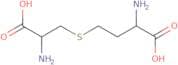
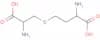
Cystathionin ist eine natürlich vorkommende Aminosäure und ein wichtiger Zwischenstoff im Transsulfurationsweg, der am Stoffwechsel von schwefelhaltigen Aminosäuren, insbesondere Methionin und Cystein, beteiligt ist. Es handelt sich um ein Dipeptid, das aus der Kondensation von Homocystein und Serin gebildet wird und eine entscheidende Rolle bei der Synthese von Cystein spielt. Cystathionin zeichnet sich durch seine Strukturformel aus, die eine Thioetherbindung und eine Carbonsäuregruppe umfasst, was zu seiner Reaktivität und biologischen Funktionen beiträgt. Es existiert in zwei stereoisomeren Formen, wobei die L-Form biologisch aktiv ist. In Bezug auf die Löslichkeit ist Cystathionin in Wasser löslich, was seine biologischen Interaktionen erleichtert. Erhöhte Werte von Cystathionin im Körper können auf bestimmte Stoffwechselstörungen hinweisen, einschließlich Homocystinurie. Darüber hinaus kann Cystathionin an verschiedenen biochemischen Wegen beteiligt sein, die zelluläre Prozesse beeinflussen und zur Regulierung von oxidativem Stress beitragen. Seine CAS-Nummer, 535-34-2, wird zur Identifizierung in chemischen Datenbanken und regulatorischen Kontexten verwendet.
Formel:C7H14N2O4S
InChl:InChI=1/C7H14N2O4S/c8-4(6(10)11)1-2-14-3-5(9)7(12)13/h4-5H,1-3,8-9H2,(H,10,11)(H,12,13)/t4-,5?/m0/s1
InChI Key:InChIKey=ILRYLPWNYFXEMH-UHFFFAOYSA-N
SMILES:C(CCSCC(C(O)=O)N)(C(O)=O)N
Synonyme:- (3Alpha,5Alpha,17Alpha)-Androstane-3,17-Diol
- 2-Amino-4-[(2-amino-2-carboxyethyl)sulfanyl]butanoic acid
- 2-Azaniumyl-4-(2-azaniumyl-2-carboxylatoethyl)sulfanylbutanoate
- <span class="text-smallcaps">DL</span>-Allocystathionine
- <span class="text-smallcaps">DL</span>-Cystathionine
- <span class="text-smallcaps">DL</span>-Homocysteine, S-(2-amino-2-carboxyethyl)-
- Butyric acid, α-amino-γ-(2-amino-2-carboxyethylmercapto)-
- Cystathionine, <span class="text-smallcaps">DL</span>-
- Cystathionine, DL-
- DL-Allocystathionine
- DL-Cystathionine
- DL-Homocysteine, S-(2-amino-2-carboxyethyl)-
- Homocysteine, S-(2-amino-2-carboxyethyl)-
- NSC 118379
- S-(2-Amino-2-carboxyethyl)-DL-homocysteine
- S-(2-Amino-2-carboxyethyl)homocysteine
- S-(2-amino-2-carboxyethyl)-L-homocysteine
- S-[(2R)-2-amino-2-carboxyethyl]-L-homocysteine
- DL,DL-allo-Cystathionine, S-(2-Amino-2-carboxyethyl)homocysteine
- CYSTATHIONINE
- dl,dl-allo-cystathionine
- -2-Amino-4-((2-amino-2-carboxyethyl)
- 2-amino-4-[(2-amino-3-hydroxy-3-keto-propyl)thio]butyric acid
- 2-amino-4-(2-amino-3-hydroxy-3-oxopropyl)sulfanylbutanoic acid
- D,L-CYSTATHIONINE
- 2-aMino-4-((2-aMino-2-carboxyethyl)thio)butanoic acid
- 2-azanyl-4-(2-azanyl-3-hydroxy-3-oxo-propyl)sulfanyl-butanoic acid
- Allocystathionine
- Weitere Synonyme anzeigen
Sortieren nach
Reinheit (%)
0
100
|
0
|
50
|
90
|
95
|
100
6 Produkte.
(2S)-2-Amino-4-((2-amino-2-carboxyethyl)thio)butanoic acid
CAS:Formel:C7H14N2O4SReinheit:97%Farbe und Form:SolidMolekulargewicht:222.2621D,L-Cystathionine
CAS:Formel:C7H14N2O4SReinheit:(HPLC) ≥ 90.0%Farbe und Form:White to off-white powderMolekulargewicht:222.30D,L-Cystathionine
CAS:Kontrolliertes ProduktApplications Intermediate for transsulfuration whereby a mammal transfers the sulfur of methionine via homocysteine to cysteine.
References Thompson, J.W., et al.: J. Biol. Chem., 266, 17011 (1991), Yoshida, Y., et al.: Microbiol., 148, 3961 (2002), Jiracek, J., et al.: J. Med. Chem., 49, 3982 (2006),Formel:C7H14N2O4SFarbe und Form:NeatMolekulargewicht:222.26D,L-Cystathionine
CAS:Cystathionine is a sulfur-containing amino acid that is the precursor of cysteine. Cystathionine synthase, the enzyme that catalyzes the formation of cystathionine, is inhibited by L-cysteine and glutathione. Cystathionine has been shown to be an important growth factor for fibroblasts and osteoblasts in culture as well as a regulator of gene expression. It also has been shown to be essential for iron homeostasis, as it increases iron absorption from the gut and reduces iron excretion in bile. Cystathionine is a highly reactive molecule with a high redox potential and can cause oxidative injury to cells, which may contribute to bowel disease. Cystathionine has been shown to have receptor activity in neurons, and its physiological effects are similar to those of glutamate.Formel:C7H14N2O4SReinheit:Min. 95%Farbe und Form:PowderMolekulargewicht:222.26 g/mol