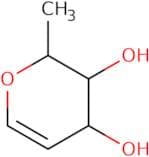
CAS 53657-42-4
:2,6-Anhydro-1,5-didesoxyhex-5-enitol
Beschreibung:
2,6-Anhydro-1,5-didesoxyhex-5-enitol, mit der CAS-Nummer 53657-42-4, ist eine chemische Verbindung, die zur Klasse der Zuckerdérivate gehört. Sie zeichnet sich durch ihre einzigartige Struktur aus, die eine anhydrische Zuckergruppe und eine Doppelbindung umfasst, was zu ihrer Reaktivität und potenziellen Anwendungen in der organischen Synthese beiträgt. Diese Verbindung ist typischerweise eine farblose bis blassgelbe Flüssigkeit oder ein Feststoff, abhängig von ihrer Reinheit und Form. Sie ist in polaren Lösungsmitteln wie Wasser und Alkoholen löslich, was für viele Zuckerdérivate typisch ist. Die Anwesenheit von Hydroxylgruppen in ihrer Struktur ermöglicht Wasserstoffbrückenbindungen, die ihre physikalischen Eigenschaften und Reaktivität beeinflussen. Darüber hinaus kann 2,6-Anhydro-1,5-didesoxyhex-5-enitol biologische Aktivität zeigen, was sie für die pharmazeutische und biochemische Forschung von Interesse macht. Ihre Stabilität und Reaktivität können je nach Umweltbedingungen wie pH und Temperatur variieren, die wichtige Überlegungen bei der Handhabung und Anwendung sind.
Formel:C6H10O3
InChl:InChI=1/C6H10O3/c1-4-6(8)5(7)2-3-9-4/h2-8H,1H3
SMILES:CC1C(C(C=CO1)O)O
Synonyme:- Hex-5-Enitol, 2,6-Anhydro-1,5-Dideoxy-
Sortieren nach
Reinheit (%)
0
100
|
0
|
50
|
90
|
95
|
100
1 Produkte.
L-Rhamnal
CAS:L-Rhamnal is a sodium sulfide that is used in the synthesis of stereoselective compounds. It has been shown to have anti-leukemic properties and may be useful for the treatment of lymphocytic leukemia. L-Rhamnal has been shown to inhibit tumor growth and metastasis in animal models of cancer, as well as being cytotoxic to human leukemic cells. L-Rhamnal inhibits the proliferation of these cells by blocking DNA synthesis and preventing cell division. The hydroxymethyl group on L-rhamnal interacts with chloride ions to form a salt that can be degraded into hydrogen sulfide gas, which is known to be toxic to some organisms. The chloride ion also reacts with triterpene alcohols, glycosidic bonds, potassium phosphate, or borohydride reduction agents like sodium borohydride or lithium aluminum hydride. These reactions are used in carbohydrate chemistry and aldehydeFormel:C6H10O3Reinheit:Min. 95%Molekulargewicht:130.14 g/mol