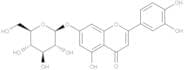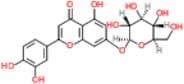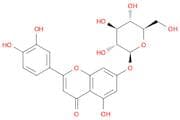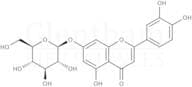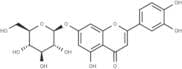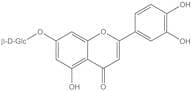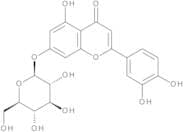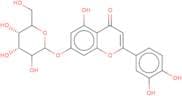
CAS 5373-11-5
:Luteolin 7-O-Glucosid
Beschreibung:
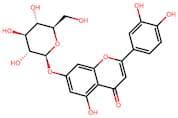
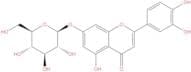
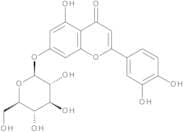
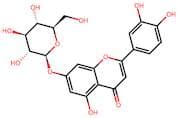
Luteolin 7-O-Glucosid ist ein Flavonoidglycosid, eine Art von Verbindung, die häufig in verschiedenen Pflanzen vorkommt, insbesondere in Früchten, Gemüse und Kräutern. Es ist durch seine Struktur gekennzeichnet, die aus einem Luteolinglykon verbunden mit einem Glukosemolekül an der Position 7 besteht. Diese Verbindung zeigt eine Reihe von biologischen Aktivitäten, einschließlich antioxidativer, entzündungshemmender und potenzieller antikrebslicher Eigenschaften, was sie für die pharmakologische Forschung von Interesse macht. Luteolin 7-O-Glucosid ist in Wasser und organischen Lösungsmitteln löslich, was die Extraktion aus pflanzlichen Quellen erleichtert. Seine Präsenz in diätetischen Quellen trägt zu den gesundheitlichen Vorteilen bei, die mit einer pflanzenreichen Ernährung verbunden sind. Darüber hinaus kann es eine Rolle in den Abwehrmechanismen der Pflanze gegen Krankheitserreger und Umweltstress spielen. Die Verbindung wird oft auf ihre potenziellen therapeutischen Anwendungen untersucht, einschließlich ihrer Auswirkungen auf verschiedene zelluläre Signalwege und ihrer Fähigkeit, oxidativen Stress zu modulieren. Insgesamt ist Luteolin 7-O-Glucosid eine bedeutende Verbindung sowohl in der Ernährung als auch in der medizinischen Chemie.
Formel:C21H20O11
InChl:InChI=1S/C21H20O11/c22-7-16-18(27)19(28)20(29)21(32-16)30-9-4-12(25)17-13(26)6-14(31-15(17)5-9)8-1-2-10(23)11(24)3-8/h1-6,16,18-25,27-29H,7H2/t16-,18-,19+,20-,21-/m1/s1
InChI Key:InChIKey=PEFNSGRTCBGNAN-QNDFHXLGSA-N
SMILES:O=C1C=2C(OC(=C1)C3=CC(O)=C(O)C=C3)=CC(O[C@@H]4O[C@H](CO)[C@@H](O)[C@H](O)[C@H]4O)=CC2O
Synonyme:- 2-(3,4-Dihydroxyphenyl)-5-hydroxy-7-[(2S,3R,4S,5S,6R)-3,4,5-trihydroxy-6-(hydroxymethyl)oxan-2-yl]oxychromen-4-one
- 2-(3,4-Dihydroxyphenyl)-7-(Beta-D-Glucopyranosyloxy)-5-Hydroxy-4H-1-Benzopyr
- 2-(3,4-Dihydroxyphenyl)-7-(beta-D-glucopyranosyloxy)-5-hydroxy-4H-1-benzopyran-4-one
- 2-(3,4-Dihydroxyphenyl)-7-(β-<span class="text-smallcaps">D</span>-glucopyranosyloxy)-5-hydroxy-4H-1-benzopyran-4-one
- 2-(3,4-Dihydroxyphenyl)-7-(β-D-glucopyranosyloxy)-5-hydroxy-4H-1-benzopyran-4-on
- 2-(3,4-dihidroxifenil)-7-(β-D-glucopiranosiloxi)-5-hidroxi-4H-1-benzopirano-4-ona
- 2-(3,4-dihydroxyphenyl)-5-hydroxy-4-oxo-4H-chromen-7-yl beta-D-glucopyranoside
- 2-(3,4-dihydroxyphenyl)-5-hydroxy-4-oxo-4H-chromen-7-yl hexopyranoside
- 2-(3,4-dihydroxyphenyl)-7-(β-D-glucopyrannosyloxy)-5-hydroxy-4H-1-benzopyranne-4-one
- 2-(3,4-dihydroxyphenyl)-7-(β-D-glucopyranosyloxy)-5-hydroxy-4H-1-benzopyran-4-one
- 3′,4′,5,7-Tetrahydroxyflavone 7-β-<span class="text-smallcaps">D</span>-glucopyranoside
- 3′,4′,5-Trihydroxyflavone 7-O-β-<span class="text-smallcaps">D</span>-glucopyranoside
- 4H-1-Benzopyran-4-One,2-(3,4-Dihydroxyphenyl)-7-(Beta-D-Glucopyranosyloxy)-5-H
- 4H-1-Benzopyran-4-one, 2-(3,4-dihydroxyphenyl)-7-(beta-D-glucopyranosyloxy)-5-hydroxy-
- 4H-1-Benzopyran-4-one, 2-(3,4-dihydroxyphenyl)-7-(β-<span class="text-smallcaps">D</span>-glucopyranosyloxy)-5-hydroxy-
- 4H-1-Benzopyran-4-one, 2-(3,4-dihydroxyphenyl)-7-(β-D-glucopyranosyloxy)-5-hydroxy-
- 7-(β-<span class="text-smallcaps">D</span>-Glucosyloxy)-3′,4′,5-trihydroxyflavone
- 7-Glucoluteolin
- 7-Glucosylluteolin
- 7-O-β-<span class="text-smallcaps">D</span>-Glucosylluteolin
- 7-β-D-Glucosylluteolin
- 7-β-Glucosylluteolin
- Cinaroside
- Cynaroside
- Furo[3,4-e]-1,3-benzodioxol-8(6H)-one, 6-(1,3-dioxolo[4,5-g]isoquinolin-5-yl)-
- Glucoluteolin
- Luteolin 7-O-D-glucoside
- Luteolin 7-O-glucopyranoside
- Luteolin 7-O-glucoside
- Luteolin 7-O-monoglucoside
- Luteolin 7-O-β-<span class="text-smallcaps">D</span>-glucopyranoside
- Luteolin 7-O-β-<span class="text-smallcaps">D</span>-glucoside
- Luteolin 7-O-β-D-glucopyranoside
- Luteolin 7-O-β-D-glucoside
- Luteolin 7-O-β-glucopyranoside
- Luteolin 7-O-β-glucoside
- Luteolin 7-monoglucoside
- Luteolin 7-β-<span class="text-smallcaps">D</span>-glucoside
- Luteolin 7-β-D-glucoside
- Luteolin 7-β-glucoside
- Luteolin 7-β-monoglucoside
- Luteolin, 7-β-<span class="text-smallcaps">D</span>-glucopyranoside
- Luteolin, 7-β-D-glucopyranoside
- Luteolin-7-D-glucopyranoside
- Luteolin-7-O-<sup>4</sup>C<sub>1</sub>-β-<span class="text-smallcaps">D</span>-glucoside
- Luteoline-7-glucoside
- Luteoloside
- Nephrocizin
- Weitere Synonyme anzeigen
Sortieren nach
Reinheit (%)
0
100
|
0
|
50
|
90
|
95
|
100
16 Produkte.
Luteolin-7-O-glucoside
CAS:Luteolin-7-O-glucoside analytical standard provided with w/w absolute assay, to be used for quantitative titration.Formel:C21H20O11Reinheit:(HPLC) ≥98%Farbe und Form:PowderMolekulargewicht:448.38Luteolin 7-O-Glucoside (2-(3,4-Dihydroxyphenyl)-5-hydroxy-4-oxo-4H-chromen-7-yl β-D-glucopyranoside)
CAS:Other glycosides, natural or reproduced by synthesis, and their salts, ethers, esters and other derivativesFormel:C21H20O11Farbe und Form:Yellow PowderMolekulargewicht:448.100564H-1-Benzopyran-4-one,2-(3,4-dihydroxyphenyl)-7-(b-D-glucopyranosyloxy)-5-hydroxy-
CAS:Formel:C21H20O11Reinheit:97%Farbe und Form:SolidMolekulargewicht:448.3769Luteoloside
CAS:Luteolin-7-O-glucoside and luteolin at concentrations lower than 20 muM, significantly suppresses the productions of nitric oxide and prostaglandin E-2 (PGE(2)) in bacterial lipopolysaccharide activated-mouse macrophage RAW264.7 cells without introducing cytotoxicity; the inhibitory effects were further attributed to the suppression of both inducible nitric oxide synthase (iNOS) and cyclooxygenase-2 (COX-2) protein expression, and not reduced enzymatic activity.Formel:C21H20O11Reinheit:95%~99%Farbe und Form:Yellow powderMolekulargewicht:448.38Luteolin-7-O-glucoside 1000 µg/mL in Ethanol
CAS:Formel:C21H20O11Farbe und Form:Single SolutionMolekulargewicht:448.38Luteolin-7-O-glucoside
CAS:Luteolin-7-O-glucosideFormel:C21H20O11Reinheit:98%Farbe und Form: yellow powderMolekulargewicht:448.38g/molLuteolin-7-O-D-glucopyranoside
CAS:Formel:C21H20O11Reinheit:≥ 98.0%Farbe und Form:Off-white to yellow powderMolekulargewicht:448.38Cynaroside
CAS:Cynaroside (Luteolin 7-O-Glucoside) is a flavone, a flavonoid-like chemical compound. It has an anti-oxidant effect, inhibiting lipid and protein oxidation.Formel:C21H20O11Reinheit:98% - >99.99%Farbe und Form:SolidMolekulargewicht:448.38Ref: TM-T3376
1mg34,00€5mg71,00€1mL*10mM (DMSO)80,00€10mg98,00€25mg192,00€50mg339,00€100mg505,00€200mg717,00€Luteolin 7-glucoside
CAS:Natural glycosideFormel:C21H20O11Reinheit:≥ 95.0 % (HPLC)Farbe und Form:PowderMolekulargewicht:448.38Luteolin-7-O-D-glucopyranoside
CAS:Luteolin-7-O-D-glucopyranoside is a flavonoid glycoside, which is a type of naturally occurring compound found predominantly in plants. It serves as a significant bioactive compound and is usually sourced from various plant species, including leaves, flowers, and fruits. The mode of action of Luteolin-7-O-D-glucopyranoside primarily involves its ability to scavenge free radicals, thereby exhibiting strong antioxidant properties. This glycoside form enhances the solubility and stability of luteolin, facilitating its biological activities.Formel:C21H20O11Reinheit:Min. 98 Area-%Farbe und Form:Yellow PowderMolekulargewicht:448.38 g/mol