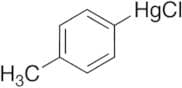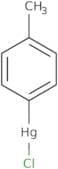
CAS 539-43-5
:Chlor(4-methylphenyl)quecksilber
- (p-Methylphenyl)mercuric chloride
- 4-Methylphenylmercuric chloride
- 4-Tolylmercuric chloride
- Chloro(4-Methylphenyl)Mercury
- Chloro-p-tolylmercury
- Mercuri-p-tolyl chloride
- Mercury, chloro(4-methylphenyl)-
- Mercury, chloro-p-tolyl-
- Mercury, chloro-p-tolyl- (8CI)
- Nsc 36721
- p-Chloromercuriotoluene
- p-Chloromercuritoluene
- p-Methylphenylmercury chloride
- p-Tolylmercury chloride
- Weitere Synonyme anzeigen
p-Tolylmercuric Chloride
CAS:Kontrolliertes ProduktApplications Shows toxicity and genotoxicity effects.
Not a dangerous good if item is equal to or less than 1g/ml and there is less than 100g/ml in the package
References Kasuya, M., et al.: Toxicol. Appl. Pharmacol., 23(1), 136 (1972),Formel:C7H7ClHgFarbe und Form:NeatMolekulargewicht:327.17p-Tolylmercuric chloride
CAS:Kontrolliertes Produktp-Tolylmercuric chloride is a potent neurotoxin that is used to study the effects of mercury on mammalian neurons. It is a n-oxide with a molecular weight of 208.24. The x-ray crystal structures of p-tolylmercuric chloride have been determined and compared to mercuric chloride, which has the same chemical formula but different physical properties. These studies show that p-tolylmercuric chloride is more water soluble than mercuric chloride, which may be due to the presence of an ether linkage between the phenyl group and chlorine atom at position 3. Resazurin reduction assays showed that p-tolylmercuric chloride produces higher tissue concentrations in dorsal root ganglia than mercuric chloride, suggesting that it may be more toxic to these cells.
Formel:C7H7ClHgReinheit:Min. 95%Molekulargewicht:327.17 g/mol