CAS 54-35-3
:Penicillin G Procain
Beschreibung:
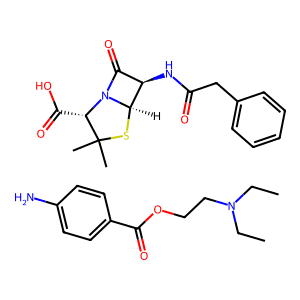
Penicillin G Procain, mit der CAS-Nummer 54-35-3, ist ein halbsynthetisches Antibiotikum, das Penicillin G mit Procain kombiniert, um seine pharmakologischen Eigenschaften zu verbessern. Diese Verbindung zeichnet sich durch ihre breit gefächerte antibakterielle Aktivität aus, die hauptsächlich gegen grampositive Bakterien und einige gramnegative Organismen wirksam ist. Sie wird typischerweise durch intramuskuläre Injektion verabreicht, da sie eine geringe orale Bioverfügbarkeit aufweist. Der Procainanteil dient dazu, die Wirkung von Penicillin G zu verlängern, indem er dessen Freisetzung in den Blutkreislauf verlangsamt, was eine verlängerte therapeutische Wirkung ermöglicht. Penicillin G Procain wird häufig zur Behandlung verschiedener bakterieller Infektionen eingesetzt, einschließlich Atemwegsinfektionen, Hautinfektionen und bestimmten Arten von Syphilis. Ihre Formulierung ist darauf ausgelegt, das Risiko allergischer Reaktionen im Zusammenhang mit Penicillin zu minimieren, obwohl Überempfindlichkeit bei einigen Personen dennoch auftreten kann. Wie bei anderen Penicillinen wirkt es, indem es die Synthese der bakteriellen Zellwand hemmt, was zu Zelllyse und -tod führt. Eine ordnungsgemäße Lagerung und Handhabung sind entscheidend, um die Wirksamkeit aufrechtzuerhalten, da es empfindlich gegenüber Wärme und Feuchtigkeit ist.
Formel:C16H18N2O4S·C13H20N2O2
InChl:InChI=1S/C16H18N2O4S.C13H20N2O2/c1-16(2)12(15(21)22)18-13(20)11(14(18)23-16)17-10(19)8-9-6-4-3-5-7-9;1-3-15(4-2)9-10-17-13(16)11-5-7-12(14)8-6-11/h3-7,11-12,14H,8H2,1-2H3,(H,17,19)(H,21,22);5-8H,3-4,9-10,14H2,1-2H3/t11-,12+,14-;/m1./s1
InChI Key:InChIKey=WHRVRSCEWKLAHX-LQDWTQKMSA-N
SMILES:C(O)(=O)[C@@H]1N2[C@@]([C@H](NC(CC3=CC=CC=C3)=O)C2=O)(SC1(C)C)[H].C(OCCN(CC)CC)(=O)C1=CC=C(N)C=C1
Synonyme:- (2S,5R,6R)-3,3-dimethyl-7-oxo-6-[(phenylacetyl)amino]-4-thia-1-azabicyclo[3.2.0]heptane-2-carboxylic acid-2-(diethylamino)ethyl 4-aminobenzoate (1:1)
- (2S,5R,6R)-3,3-dimethyl-7-oxo-6-[(phenylacetyl)amino]-4-thia-1-azabicyclo[3.2.0]heptane-2-carboxylic acid-2-(diethylamino)ethyl 4-aminobenzoate hydrate (1:1:1)
- 3,3-Dimethyl-7-Oxo-6-[(Phenylacetyl)Amino]-4-Thia-1-Azabicyclo[3.2.0]Heptane-2-Carboxylic Acid-2-(Diethylamino)Ethyl 4-Aminobenzoate (1:1)
- 4-Thia-1-azabicyclo[3.2.0]heptane-2-carboxylic acid, 3,3-dimethyl-7-oxo-6-(2-phenylacetamido)-, compd. with 2-(diethylamino)ethyl p-aminobenzoate (1:1)
- 4-Thia-1-azabicyclo[3.2.0]heptane-2-carboxylic acid, 3,3-dimethyl-7-oxo-6-[(2-phenylacetyl)amino]- (2S,5R,6R)-, compd. with 2-(diethylamino)ethyl 4-aminobenzoate (1:1)
- 4-Thia-1-azabicyclo[3.2.0]heptane-2-carboxylic acid, 3,3-dimethyl-7-oxo-6-[(phenylacetyl)amino]- (2S,5R,6R)-, compd. with 2-(diethylamino)ethyl 4-aminobenzoate (1:1)
- 4-Thia-1-azabicyclo[3.2.0]heptane-2-carboxylic acid, 3,3-dimethyl-7-oxo-6-[(phenylacetyl)amino]-[2S-(2α,5α,6β)]-, compd. with 2-(diethylamino)ethyl 4-aminobenzoate (1:1)
- Abbocillin DC
- Afsillin
- Ampin-penicillin
- Aquacilina
- Aquacillin
- Aquasuspen
- Avloprocil
- Benzoic acid, 4-amino-, 2-(diethylamino)ethyl ester, mono[(2S,5R,6R)-3,3-dimethyl-7-oxo-6-[(phenylacetyl)amino]-4-thia-1-azabicyclo[3.2.0]heptane-2-carboxylate]
- Benzoic acid, 4-amino-, 2-(diethylamino)ethyl ester, mono[[2S-(2α,5α,6β)]-3,3-dimethyl-7-oxo-6-[(phenylacetyl)amino]-4-thia-1-azabicyclo[3.2.0]heptane-2-carboxylate]
- Benzylpenicillin
- Benzylpenicillin Procaine
- Benzylpenicillin novocaine salt
- Benzylpenicillin procaine salt
- Carepen
- Cilicaine
- Crysticillin
- Depocillin
- Despacilina
- Distaquaine
- Dorsallin AR
- Duphapen
- Duracillin
- Ethacilin
- Flo-Cillin Aqueous
- Geepenil
- Hostacillin
- Hydracillin
- Ilcocillin P
- Jenacillin O
- Kabipenin
- Ledercillin
- Lenticillin
- Mammacillin
- Masticillin
- Megapen
- Micro-Pen
- Millicillin
- Mylipen
- Neoproc
- Nopcaine
- Novocaine penicillin
- Pen 50
- Pen-Fifty
- Penaquacaine G
- Penicillin G Procaine Sterile
- Penicillin G procaine
- Penicillin procaine
- Penovet
- Pentaquacaine G
- Penzal N 300
- Premocillin
- Pro-Pen
- Procain Penicillin G
- Procaine Benzylpenicillin
- Procaine benzylpenicillin salt
- Procaine benzylpenicillinate
- Procaine penicillin (G)
- Procanodia
- Prostabillin
- Retardillin
- Sharcillin
- Vetspen
- Vitablend
- Wycillin
- Sterile Penicillin G Procaine/SodiuM3∶1 API
- Benzylpenicillinic acid, procaine
- Penicillin G procaine Benzylpenicillin procaine API
- Procaine penicillin G(fortified) USP/EP/BP
- BENZYLPENICILLIN PROCAIN SALT
- PROCAINE BENZYLPENICILLIN (PROCAINE PENICILLIN) ASSAY STANDARD BP(CRM STANDARD)
- PENICILLIN-G PROCAIN SALT
- Penicillin G Procaine/Sodium 3:1 USP/EP/BP
- PROCAINE BENZYLPENICILLIN EPP(CRM STANDARD)
- Procaine penicillin G(1% lecithin/citrate acid)
- 4-Thia-1-azabicyclo3.2.0heptane-2-carboxylic acid, 3,3-dimethyl-7-oxo-6-(phenylacetyl)amino- (2S,5R,6R)-, compd. with 2-(diethylamino)ethyl 4-aminobenzoate (1:1)
- (2S,5R,6R)-3,3-dimethyl-7-oxo-6-[(1-oxo-2-phenylethyl)amino]-4-thia-1-azabicyclo[3.2.0]heptane-2-carboxylic acid
- Penicillin G procaine +1% lecithin CP200/BP/USP/EP
- Procain-Penicillin
- PENICILLIN G PROCAINE USP/EP/BP
- Penicillin G procaine sterile CP200/BP/USP/EP
- Procaine penicillin G USP/EP/BP
- BENZYLPENICILLIN PROCAINE + POTASSIC 3:1
- Weitere Synonyme anzeigen
Sortieren nach
Reinheit (%)
0
100
|
0
|
50
|
90
|
95
|
100
5 Produkte.
Procaine benzylpenicillin
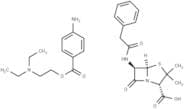
CAS:Procaine benzylpenicillinFormel:C13H20N2O2 / C13H20N2O2C16H18N2O4SH2OFarbe und Form:White PowderMolekulargewicht:236.15248(2S,5R,6R)-3,3-dimethyl-7-oxo-6-(2-phenylacetamido)-4-thia-1-azabicyclo[3.2.0]heptane-2-carboxylic acid; 2-(diethylamino)ethyl 4-aminobenzoate
CAS:Formel:C29H38N4O6SReinheit:98%Molekulargewicht:570.7002Procaine penicillin G
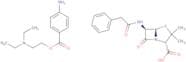
CAS:Procaine penicillin G treats syphilis, anthrax, oral infections, pneumonia, diphtheria, cellulitis, and bites.Formel:C29H38N4O6SReinheit:99.73%Farbe und Form:A White Crystalline PowderMolekulargewicht:570.7Penicillin G procaine
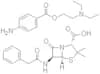
CAS:Kontrolliertes ProduktPenicillin G procaine is a form of penicillin that is commonly used to treat bacterial infections. It is a prodrug that undergoes hydrolysis in the body to release penicillin, its active form. Penicillin G procaine has been shown to be effective against Streptococcus pyogenes, which causes streptococcal pharyngitis, and other bacteria that are sensitive to penicillin. Penicillin G procaine is less toxic than other forms of penicillin and has minimal side effects. The pharmacological effects of the drug are due primarily to the inhibition of bacterial cell wall synthesis by binding to peptidoglycan precursors and blocking their cross-linking. The concentration–time curve for penicillin G procaine shows that it has a long half-life in humans, making it suitable for continuous treatment in patients with chronic infections.Formel:C16H18N2O4S·C13H20N2O2Reinheit:Min. 95%Molekulargewicht:570.7 g/mol


![(2S,5R,6R)-3,3-dimethyl-7-oxo-6-(2-phenylacetamido)-4-thia-1-azabicyclo[3.2.0]heptane-2-carboxylic…](/_next/image/?url=https%3A%2Fstatic.cymitquimica.com%2Fproducts%2FIN%2Fthumb%2FDA00I9MZ.jpg&w=3840&q=75)