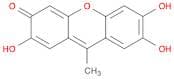
CAS 5407-46-5
:2,6,7-Trihydroxy-9-methyl-3H-xanthen-3-on
Beschreibung:
2,6,7-Trihydroxy-9-methyl-3H-xanthen-3-on, allgemein bekannt als eine Xanthone, ist eine chemische Verbindung, die durch ihre polyphenolische Struktur gekennzeichnet ist, die mehrere Hydroxylgruppen umfasst. Diese Verbindung zeigt typischerweise eine gelbe bis orange Farbe, die für viele Xanthone charakteristisch ist. Sie ist in organischen Lösungsmitteln löslich und hat eine begrenzte Löslichkeit in Wasser, was ihre hydrophobe Natur aufgrund der in ihrer Struktur vorhandenen aromatischen Ringe widerspiegelt. Das Vorhandensein von Hydroxylgruppen trägt zu ihren potenziellen antioxidativen Eigenschaften bei, was sie in verschiedenen biologischen und pharmazeutischen Anwendungen von Interesse macht. Darüber hinaus sind Xanthone für ihre vielfältigen biologischen Aktivitäten bekannt, einschließlich entzündungshemmender, antimikrobieller und krebsbekämpfender Wirkungen. Die molekulare Struktur der Verbindung ermöglicht verschiedene Wechselwirkungen mit biologischen Systemen, die für therapeutische Anwendungen erforscht werden können. Insgesamt stellt 2,6,7-Trihydroxy-9-methyl-3H-xanthen-3-on eine bedeutende Klasse von Verbindungen mit potenziellen Anwendungen in der Gesundheit und Medizin dar.
Formel:C14H10O5
InChl:InChI=1S/C14H10O5/c1-6-7-2-9(15)11(17)4-13(7)19-14-5-12(18)10(16)3-8(6)14/h2-5,15-17H,1H3
InChI Key:InChIKey=TZVNNUHRZXQCHM-UHFFFAOYSA-N
SMILES:CC1=C2C(OC=3C1=CC(O)=C(O)C3)=CC(=O)C(O)=C2
Synonyme:- 2,6,7-Trihydroxy-9-Methylxanthen-3-One
- 2,6,7-trihydroxy-9-methyl-3H-xanthen-3-one
- 3H-Xanthen-3-one, 2,6,7-trihydroxy-9-methyl-
- 9-Methyl-2,3,7-trihydroxy-6-fluorone sulphate
- Methylfluorone
- NSC 5426
- NSC 66209
Sortieren nach
Reinheit (%)
0
100
|
0
|
50
|
90
|
95
|
100
2 Produkte.
9-Methyl-2,3,7-trihydroxy-6-fluorone
CAS:9-Methyl-2,3,7-trihydroxy-6-fluorone (9MHF) is a natural compound found in honeybee propolis. It has been shown to have anticancer activity against a range of tumour types. 9MHF inhibits the replication of DNA by binding to single-stranded regions in the DNA molecule and preventing the formation of double helices. The optimum concentration for 9MHF is 0.1 μM. At this concentration, it was found that 9MHF had chemoresistance properties and could inhibit replication in staphylococcus cells at concentrations as low as 1 μM. This compound also has antioxidant properties, with redox potentials of -0.09 V and -0.06 V for its oxidized and reduced forms respectively.BR>BR> 9MHF is an inhibitor that binds to basic dyes such as methylene blue or gentian violet and prevents them from binding to the bacterial cellFormel:C14H10O5Reinheit:Min. 95%Farbe und Form:Yellow PowderMolekulargewicht:258.23 g/mol