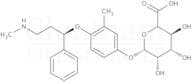
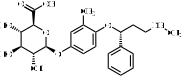
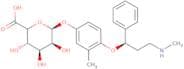
![(3S,4S,5S,6S)-3,4,5-trihydroxy-6-[3-methyl-4-[(1R)-3-(methylamino)-1-phenyl-propoxy]phenoxy]tetrah…](/_next/image/?url=https%3A%2Fstatic.cymitquimica.com%2Fcas-image%2Fthumb-webp%2F213234-3s-4s-5s-6s-345-trihydroxy-6-3-methyl-4-1r-3-methylamino-1-phenyl-propoxy-phenoxy-tetrahydropyran-2-carboxylic-acid.webp&w=3840&q=75)
CAS 540729-08-6
:(3S,4S,5S,6S)-3,4,5-trihydroxy-6-[3-methyl-4-[(1R)-3-(methylamino)-1-phenyl-propoxy]phenoxy]tetrahydropyran-2-carbonsäure
Beschreibung:
Die chemische Substanz mit dem Namen "(3S,4S,5S,6S)-3,4,5-trihydroxy-6-[3-methyl-4-[(1R)-3-(methylamino)-1-phenyl-propoxy]phenoxy]tetrahydropyran-2-carbonsäure" und der CAS-Nummer 540729-08-6 ist eine komplexe organische Verbindung, die durch ihre mehrfachen Hydroxylgruppen und eine Carbonsäurefunktion gekennzeichnet ist, die zu ihrer Hydrophilie und potenziellen biologischen Aktivität beitragen. Das Vorhandensein eines Tetrahydropyranrings weist auf eine zyklische Struktur hin, die ihre Stereochemie und Reaktivität beeinflussen kann. Die Verbindung weist auch eine Phenoxygruppe auf, die ihre Wechselwirkung mit biologischen Zielen verbessern kann, was sie potenziell in der medizinischen Chemie relevant macht. Die Methylamino- und Phenylsubstituenten deuten darauf hin, dass sie spezifische pharmakologische Eigenschaften aufweisen könnte, möglicherweise als Ligand oder Inhibitor in biochemischen Wegen wirken könnte. Insgesamt deutet die komplexe Struktur und die funktionellen Gruppen dieser Verbindung darauf hin, dass sie bedeutende Implikationen im Design und in der Entwicklung von Arzneimitteln haben könnte, insbesondere bei der gezielten Ansprache spezifischer Rezeptoren oder Enzyme in biologischen Systemen.
Formel:C23H29NO8
InChl:InChI=1/C23H29NO8/c1-13-12-15(30-23-20(27)18(25)19(26)21(32-23)22(28)29)8-9-16(13)31-17(10-11-24-2)14-6-4-3-5-7-14/h3-9,12,17-21,23-27H,10-11H2,1-2H3,(H,28,29)/t17-,18+,19+,20+,21?,23-/m1/s1
Sortieren nach
Reinheit (%)
0
100
|
0
|
50
|
90
|
95
|
100
6 Produkte.
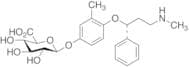
4’-Hydroxy Atomoxetine Glucuronide
CAS:Formel:C23H29NO8Farbe und Form:Off-White SolidMolekulargewicht:447.484'-Hydroxy Atomoxetine beta-D-Glucuronide
CAS:Kontrolliertes ProduktApplications A metabolite of Atomoxetine (A791400).
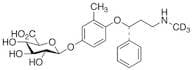
References Wong, D., et al.: J. Pharmacol. Exp. Ther., 222, 61 (1982), Steiner, E., et al.: Clin. Pharmacol. Ther., 44, 431 (1988), Gehlert, D., et al.: Neurosci. Lett., 157, 203 (1993), Kuczenski, R., et al.: J. Neurochem., 68, 2032 (1997), Sauer, J., et al.: Drug Metab. Dispos., 31, 98 (2003),Formel:C23H29NO8Farbe und Form:Light BrownMolekulargewicht:447.484’-Hydroxy Atomoxetine β-D-Glucuronide-d3
CAS:Kontrolliertes ProduktFormel:C23D3H26NO8Farbe und Form:NeatMolekulargewicht:450.4974'-Hydroxy atomoxetine b-D-glucuronide
CAS:4'-Hydroxy atomoxetine b-D-glucuronide is a synthetic compound that has been modified for use in the synthesis of saccharides and oligosaccharides. The modification is a high-yielding, efficient, and economical method for the preparation of complex carbohydrates. This compound is an intermediate in the synthesis of glycosylations. It can be used for the click modification of proteins or polysaccharides.br>br> 4'-Hydroxy atomoxetine b-D-glucuronide is an intermediate in the synthesis of glycosylations. It can be used for the click modification of proteins or polysaccharides. Click chemistry is a form of chemical reaction used to modify molecules by attaching them to other molecules with similar reactive groups, such as hydroxyl groups, through a process called "click" chemistry. The term was coined by K. Barry Sharpless at Stanford University in 2000 after he demonstrated that certain metalFormel:C23H29NO8Reinheit:Min. 95%Molekulargewicht:447.49 g/mol