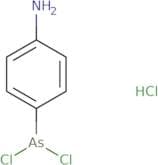
CAS 5410-78-6
:(4-Aminophenyl)arsen-dichlorid
Beschreibung:
(4-Aminophenyl)arsen-dichlorid, mit der CAS-Nummer 5410-78-6, ist eine organoarsenische Verbindung, die durch das Vorhandensein einer arsonösen (trivalente Arsen) funktionellen Gruppe, die an ein Para-Aminophenyl-Moiety gebunden ist, gekennzeichnet ist. Diese Verbindung erscheint typischerweise als Feststoff und ist bekannt für ihre potenzielle Toxizität aufgrund des Vorhandenseins von Arsen, das erhebliche Gesundheitsrisiken darstellen kann. Der Dichlorid-Aspekt zeigt an, dass zwei Chloratome an das Arsenatom gebunden sind, was seine Reaktivität und Löslichkeit in verschiedenen Lösungsmitteln beeinflusst. Das Vorhandensein der Aminogruppe (-NH2) im aromatischen Ring kann an verschiedenen chemischen Reaktionen teilnehmen, was diese Verbindung sowohl in der synthetischen organischen Chemie als auch in toxikologischen Studien von Interesse macht. Aufgrund des Arsengehalts ist es entscheidend, diese Substanz mit Vorsicht zu behandeln und die Sicherheitsprotokolle einzuhalten, um das Risiko einer Exposition zu verringern. Ihre Anwendungen können Forschungen in der Pharmakologie oder Materialwissenschaft umfassen, aber ihre Verwendung ist oft aufgrund regulatorischer Bedenken hinsichtlich arsenhaltiger Verbindungen eingeschränkt.
Formel:C6H6AsCl2N
InChl:InChI=1/C6H6AsCl2N/c8-7(9)5-1-3-6(10)4-2-5/h1-4H,10H2
SMILES:c1cc(ccc1[As](Cl)Cl)N
Synonyme:- arsonous dichloride, N-(4-aminophenyl)-
- (4-Aminophenyl)arsonous dichloride
Sortieren nach
Reinheit (%)
0
100
|
0
|
50
|
90
|
95
|
100
1 Produkte.
p-Aminophenyldichloroarsine hydrochloride
CAS:<p>p-Aminophenyldichloroarsine hydrochloride (APD) is a reversible alkylating agent that binds to sulphydryls and reversibly inhibits the activity of nicotinic acetylcholine receptors. It is also an arsenical that has been shown to react with other proteins, such as acetylcholine receptor subunits. When it reacts with the acetylcholine receptor, it forms stable complexes and irreversible bonds. This prevents the receptor from functioning normally and leads to paralysis of muscles. The APD also binds to the reactive sites on DNA and blocks rRNA synthesis, leading to cell death.<br>APD is active against many bacteria, including Mycobacterium tuberculosis, but not against Gram-positive bacteria such as staphylococci or streptococci. It is also active against some fungi and protozoa but not against viruses.</p>Formel:C6H7AsCl3NReinheit:Min. 95%Farbe und Form:PowderMolekulargewicht:274.41 g/mol