CAS 54141-72-9
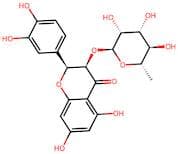
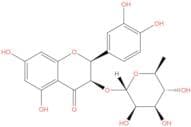
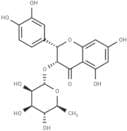
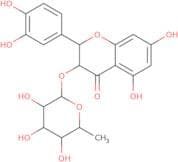
:2-(3,4-dihydroxyphenyl)-5,7-dihydroxy-4-oxo-3,4-dihydro-2H-chromen-3-yl 6-desoxyhexopyranosid
Beschreibung:
Die chemische Substanz, die als "2-(3,4-dihydroxyphenyl)-5,7-dihydroxy-4-oxo-3,4-dihydro-2H-chromen-3-yl 6-desoxyhexopyranosid" bekannt ist, mit der CAS-Nummer 54141-72-9, ist ein Flavonoidglykosid. Diese Verbindung weist ein Chromen-4-on-Gerüst auf, das für Flavonoide charakteristisch ist, und ist mit mehreren Hydroxylgruppen substituiert, die zu seinen potenziellen antioxidativen Eigenschaften beitragen. Das Vorhandensein einer Glykosidgruppe zeigt an, dass es sich um ein Zuckerdestillat handelt, was seine Löslichkeit und biologische Aktivität beeinflussen kann. Flavonoide sind bekannt für ihre vielfältigen pharmakologischen Wirkungen, einschließlich entzündungshemmender, antimikrobieller und krebsbekämpfender Aktivitäten. Die spezifische Anordnung der Hydroxylgruppen und des Zuckerteils kann die Fähigkeit der Verbindung verbessern, mit biologischen Systemen zu interagieren, was potenziell ihre Bioverfügbarkeit und Wirksamkeit beeinflusst. Insgesamt veranschaulicht diese Verbindung die strukturelle Komplexität und funktionale Vielfalt, die innerhalb von Flavonoidglykosiden zu finden ist, was sie zu einem interessanten Thema sowohl in der medizinischen Chemie als auch in der Forschung zu Naturstoffen macht.
Formel:C21H22O11
InChl:InChI=1/C21H22O11/c1-7-15(26)17(28)18(29)21(30-7)32-20-16(27)14-12(25)5-9(22)6-13(14)31-19(20)8-2-3-10(23)11(24)4-8/h2-7,15,17-26,28-29H,1H3
SMILES:CC1C(C(C(C(O1)OC1C(=O)c2c(cc(cc2OC1c1ccc(c(c1)O)O)O)O)O)O)O
Sortieren nach
Reinheit (%)
0
100
|
0
|
50
|
90
|
95
|
100
4 Produkte.
Neoisoastilbin
CAS:Neoisoastilbin may have antioxidant and anti-inflammatory activities.Formel:C21H22O11Reinheit:99.71% - 99.85%Farbe und Form:SolidMolekulargewicht:450.39Neoisoastilbin
CAS:<p>Neoisoastilbin is a chemical compound, specifically a flavonoid derivative, derived primarily from natural botanical sources such as certain species of plants. It is characterized by its unique structural configuration which distinguishes it from its closely related isomers. As a flavonoid, Neoisoastilbin acts through multiple biochemical pathways, notably by scavenging free radicals and modulating oxidative stress responses, which can have significant implications in biological systems.Neoisoastilbin's notable applications lie in its potential antioxidant properties, which are of particular interest in the fields of pharmacology and biochemistry. Researchers study its effects on cellular models to understand its role in protecting cells from oxidative damage. It also has potential applications in the development of therapeutic agents aiming to mitigate conditions associated with oxidative stress, such as neurodegenerative diseases or cardiovascular disorders. Investigations into its pharmacodynamics and pharmacokinetics are essential to elucidate its full potential and mechanisms within complex biological systems.</p>Formel:C21H22O11Reinheit:Min. 95%Molekulargewicht:450.39 g/mol