CAS 54197-66-9
:6-Hydroxy-3,4-dihydro-2(1H)-chinolinon
Beschreibung:
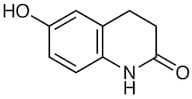
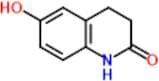
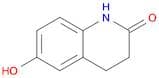
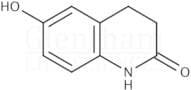
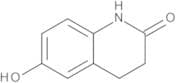
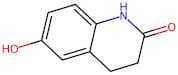
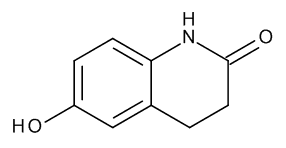
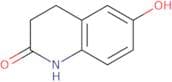
6-Hydroxy-3,4-dihydro-2(1H)-chinolinon, mit der CAS-Nummer 54197-66-9, ist eine chemische Verbindung, die zur Klasse der Chinolinone gehört, die bicyclische Verbindungen sind, die einen mit einer Lactam verschmolzenen Chinoliring enthalten. Diese Substanz ist durch das Vorhandensein einer Hydroxylgruppe an der Position 6 und einer gesättigten Dihydrostruktur gekennzeichnet, was zu ihren einzigartigen chemischen Eigenschaften beiträgt. Sie zeigt typischerweise eine moderate Löslichkeit in polaren Lösungsmitteln aufgrund der Hydroxylgruppe, während ihre aromatische Natur Interaktionen mit verschiedenen biologischen Zielen ermöglichen kann. Die Verbindung kann biologische Aktivität besitzen, was sie in der medizinischen Chemie und Pharmakologie von Interesse macht. Ihre strukturellen Merkmale deuten auf potenzielle Anwendungen in der Arzneimittelentwicklung hin, insbesondere bei der Synthese von Derivaten, die die therapeutische Wirksamkeit verbessern könnten. Darüber hinaus können die Stabilität und Reaktivität der Verbindung durch das Vorhandensein funktioneller Gruppen beeinflusst werden, was sie zu einem Studienobjekt in der organischen Synthese und Materialwissenschaft macht.
Formel:C9H9NO2
InChl:InChI=1S/C9H9NO2/c11-7-2-3-8-6(5-7)1-4-9(12)10-8/h2-3,5,11H,1,4H2,(H,10,12)
InChI Key:InChIKey=HOSGXJWQVBHGLT-UHFFFAOYSA-N
SMILES:OC=1C=C2C(NC(=O)CC2)=CC1
Synonyme:- 2(1H)-Quinolinone, 3,4-dihydro-6-hydroxy-
- 2-Oxo-1,2,3,4-tetrahydroquinolin-6-ol
- 3,4-Dihydro-6-hydroxy-2-[1H]-quinolinone
- 3,4-Dihydro-6-hydroxycarbostyril
- 3,4-Dihydroquinoline-2,6-diol
- 6-Hydroxy-1,2,3,4-tetrahydro-2-quinolinone
- 6-Hydroxy-2(1H)-3,4-Dihydroquinolinone
- 6-Hydroxy-2-Oxo-1,2,3,4-Tetrahydro Quinoline
- 6-Hydroxy-2-Oxo-1,2,3,4-Tetrahydroquinoline (6-Hq)
- 6-Hydroxy-2-oxo-1,2,3,4-tetrahydroquinoline
- 6-Hydroxy-3,4-dihydro carbostilyl
- 6-Hydroxy-3,4-dihydro-1H-quinolin-2-one
- 6-Hydroxy-3,4-dihydrocarbostyril
- 6-Hydroxy-3,4-dihydroquinazolone
- 6-Hydroxyl-3.4-dihydro-2-(1H)-quinolinone
- 6-hydroxy-3,4-dihydro-2(1H)-quinolinone
- 6-hydroxy-3,4-dihydroquinolin-2(1H)-one
- Carbostyril, 3,4-dihydro-6-hydroxy-
- Weitere Synonyme anzeigen
Sortieren nach
Reinheit (%)
0
100
|
0
|
50
|
90
|
95
|
100
12 Produkte.
3,4-Dihydro-6-hydroxy-2(1H)-quinolinone
CAS:Formel:C9H9NO2Reinheit:>98.0%(HPLC)(N)Farbe und Form:White to Almost white powder to crystalMolekulargewicht:163.18Cilostazol Related Compound A (6-hydroxy-3,4-dihydro-1H-quinolin-2-one)
CAS:Lactams not elsewhere specified or includedFormel:C9H9NO2Farbe und Form:Yellow White PowderMolekulargewicht:163.063333,4-Dihydro-6-hydroxy-2(1H)-quinolinone
CAS:Formel:C9H9NO2Reinheit:98%Farbe und Form:SolidMolekulargewicht:163.17336-Hydroxy-2-oxo-1,2,3,4-tetrahydroquinoline
CAS:Formel:C9H9NO2Reinheit:≥ 98.0%Farbe und Form:White to off-white crystalline powderMolekulargewicht:163.176-Hydroxy-3,4-dihydro-1H-quinolin-2-one
CAS:Kontrolliertes ProduktFormel:C9H9NO2Farbe und Form:NeatMolekulargewicht:163.173,4-Dihydro-6-hydroxyquinolin-2(1H)-one
CAS:3,4-Dihydro-6-hydroxyquinolin-2(1H)-oneReinheit:98%Molekulargewicht:163.17g/mol6-Hydroxy-3,4-dihydro-1H-quinoline-2-one
CAS:Kontrolliertes ProduktImpurity Cilostazol USP Related Compound A
Applications A metabolite of Cilostazole.
References Gitto, R., et al.: J. Med. Chem., 46, 3758 (2003), Xie, Z., et al.: Bioorg. Med. Chem. Lett., 15, 4803 (2005),Formel:C9H9NO2Farbe und Form:NeatMolekulargewicht:163.176-Hydroxy-2-oxo-1,2,3,4-tetrahydroquinoline
CAS:Formel:C9H9NO2Reinheit:97%Farbe und Form:SolidMolekulargewicht:163.1766-Hydroxy-3,4-dihydro-1H-quinoline-2-one
CAS:This is a quinoline derivative that has been shown to have inotropic and cardioprotective effects. It has been shown to increase the duration of action potentials and contractions in isolated heart muscle, as well as to improve the function of the heart by reducing the rate of myocardial oxygen consumption. 6-Hydroxy-3,4-dihydro-1H-quinoline-2-one has been shown to have anti-inflammatory properties and may be useful for treating respiratory diseases such as asthma. This compound is also used as a precursor for some pharmaceutical drugs, including chloroquine, mefloquine, amodiaquine, and primaquine. The compound is metabolized into conjugates that are recycled back into the body or excreted in human urine; this process is regulated by the balance between conjugation reactions and hydrolysis reactions.Formel:C9H9NO2Reinheit:Min. 95%Molekulargewicht:163.17 g/mol