CymitQuimica logo

CAS 5448-43-1

:

6-Chlorchinoxalin

Beschreibung:
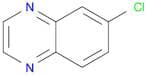
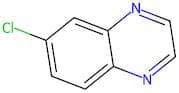
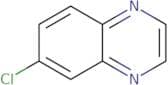
6-Chlorchinoxalin ist eine heterocyclische Verbindung, die durch eine fusionierte bicyclische Struktur gekennzeichnet ist, die sowohl einen Benzol- als auch einen Pyrazinring enthält. Ihre molekulare Formel ist C8H6ClN3, was auf die Anwesenheit von Chlor-, Kohlenstoff-, Wasserstoff- und Stickstoffatomen hinweist. Diese Verbindung erscheint typischerweise als festes Material von gelb bis hellbraun und ist bekannt für ihre Rolle in verschiedenen chemischen und biologischen Anwendungen, einschließlich ihres Potenzials als pharmakologisches Mittel. 6-Chlorchinoxalin zeigt eine moderate Löslichkeit in organischen Lösungsmitteln wie Ethanol und Dimethylsulfoxid, ist jedoch in Wasser weniger löslich. Die Anwesenheit des Chloratoms an der Position 6 des Quinoxalinrings beeinflusst seine Reaktivität und biologische Aktivität, was es zu einem interessanten Thema in der medizinischen Chemie macht. Darüber hinaus kann es an verschiedenen chemischen Reaktionen teilnehmen, einschließlich nucleophiler Substitutionen und Cycloadditionen, die in der synthetischen organischen Chemie wertvoll sind. Insgesamt dient 6-Chlorchinoxalin als vielseitiger Baustein in der Entwicklung neuer Verbindungen mit potenziellen therapeutischen Anwendungen.
Formel:C8H5ClN2
InChl:InChI=1/C8H5ClN2/c9-6-1-2-7-8(5-6)11-4-3-10-7/h1-5H
SMILES:c1cc2c(cc1Cl)nccn2
Synonyme:
  • Quinoxaline, 6-chloro-
Sortieren nach

Reinheit (%)
0
100
|
0
|
50
|
90
|
95
|
100
4 Produkte.
  • 6-Chloroquinoxaline

    CAS:
    Formel:C8H5ClN2
    Reinheit:98%
    Farbe und Form:Solid
    Molekulargewicht:164.5917

    Ref: IN-DA00D8BN

    1g
    24,00€
    5g
    40,00€
    10g
    60,00€
    25g
    107,00€
  • 6-Chloroquinoxaline

    CAS:
    <p>6-Chloroquinoxaline</p>
    Formel:C8H5ClN2
    Reinheit:≥95%
    Farbe und Form: brown solid
    Molekulargewicht:164.59g/mol

    Ref: 54-OR11146

    1g
    32,00€
    5g
    42,00€
    25g
    115,00€
  • 7-Chloroquinoxaline

    CAS:
    <p>7-Chloroquinoxaline is a nucleophilic compound that can be synthesized by reductive chlorination of 7-chloroquinoline. 7-Chloroquinoxaline has been shown to have anticancer activity in vitro, as well as the ability to inhibit the proliferation of human breast cancer cells (MCF-7) in culture. It also inhibits glyoxalase I and II, which are enzymes that catalyze the conversion of glyoxal to D-lactate and H2O2. This inhibition may be due to its ability to react with the C=N bond at carbon 2 of dimethylformamide (DMF), forming a covalent adduct with DMF and an anticancer agent such as methotrexate or 5-fluorouracil. The formation of this conjugate would result in a decrease in DMF concentration, leading to decreased production of H2O2 and increased levels of D-l</p>
    Formel:C8H5ClN2
    Reinheit:Min. 95%
    Molekulargewicht:164.59 g/mol

    Ref: 3D-FC66699

    25g
    232,00€
    50g
    400,00€
    100g
    646,00€
  • 6-Chloroquinoxaline

    CAS:
    Formel:C8H5ClN2
    Reinheit:98%
    Farbe und Form:Solid
    Molekulargewicht:164.59

    Ref: 10-F241868

    5g
    20,00€
    10g
    38,00€
    25g
    83,00€
    100g
    279,00€
    500g
    1.203,00€