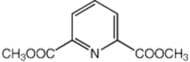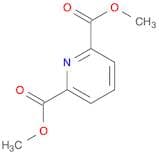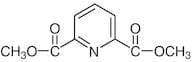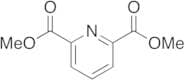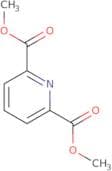
CAS 5453-67-8
:Dimethyl-2,6-pyridindicarboxylat
- 2,6-Bismethoxycarbonylpyridine
- 2,6-Dicarbomethoxypyridine
- 2,6-Dimethyl pyridine-2,6-dicarboxylate
- 2,6-Dipicolinic acid dimethyl ester
- 2,6-Pyridinedicarboxylic acid dimethyl ester
- 2,6-Pyridinedicarboxylic acid, 2,6-dimethyl ester
- Dimethyl pyridine-2,6-dicarboxylate
- Dipicolinic acid dimethyl ester
- NSC 18855
- Dimethyl 2,6-pyridinedicarboxylate
Dimethyl pyridine-2,6-dicarboxylate, 98%
CAS:Eight macrocyclic bisamides and tetramides have been synthesized by reaction of dimethyl pyridine-2,6-dicarboxylate 1 with ,-diaminoethers in methanol as a solvent. Silver(I) coordination polymer and nine-coordinated cadmium(II) complex with dimethyl pyridine-2,6-dicarboxylate supported by solid staFormel:C9H9NO4Reinheit:98%Farbe und Form:White to pale cream, Crystals or powder or crystalline powderMolekulargewicht:195.17Dimethyl pyridine-2,6-dicarboxylate
CAS:Formel:C9H9NO4Reinheit:97%Farbe und Form:SolidMolekulargewicht:195.1721Dimethyl pyridine-2,6-dicarboxylate
CAS:Dimethyl pyridine-2,6-dicarboxylateReinheit:98%Farbe und Form:SolidMolekulargewicht:195.17g/molDimethyl 2,6-Pyridinedicarboxylate
CAS:Formel:C9H9NO4Reinheit:>98.0%(GC)Farbe und Form:White to Almost white powder to crystalMolekulargewicht:195.17Dimethyl 2,6-pyridinedicarboxylate
CAS:Formel:C9H9NO4Reinheit:95%Farbe und Form:SolidMolekulargewicht:195.174Dimethyl 2,6-Pyridinedicarboxylate
CAS:Kontrolliertes ProduktApplications Dimethyl 2,6-Pyridinedicarboxylate (cas# 5453-67-8) is a compound useful in organic synthesis.
Formel:C9H9NO4Farbe und Form:NeatMolekulargewicht:195.172,6-Pyridinedicarboxylic acid dimethyl ester
CAS:2,6-Pyridinedicarboxylic acid dimethyl ester is a drug that has shown anticancer activity in animal models. It binds to DNA, forming a ternary complex with the DNA and the enzyme topoisomerase I. The binding of this drug to the enzyme prevents it from breaking the DNA strands during replication, causing the cell to die. It has been shown that 2,6-pyridinedicarboxylic acid dimethyl ester can be used as a non-competitive inhibitor of topoisomerase I. Furthermore, it has been demonstrated that 2,6-pyridinedicarboxylic acid dimethyl ester is able to bind to human endometrial cancer cells with high affinity. Finally, 2,6-pyridinedicarboxylic acid dimethyl ester was found in x-ray crystal structures of complexes with hydrogen bonds and low activation enthalpy and entropy.
Formel:C9H9NO4Reinheit:Min. 95%Farbe und Form:White PowderMolekulargewicht:195.17 g/molRef: 3D-FP44227
Ausgelaufenes produkt