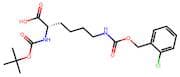
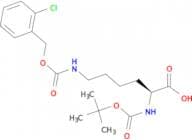
![N6-[[(2-Chlorophenyl)methoxy]carbonyl]-N2-[(1,1-dimethylethoxy)carbonyl]-L-lysine](/_next/image/?url=https%3A%2Fstatic.cymitquimica.com%2Fcas-image%2Fthumb-webp%2F309578-n-boc-n-2-chlorobenzyloxycarbonyl-l-lysine.webp&w=3840&q=75)
CAS 54613-99-9
:N6-[[(2-chlorphenyl)methoxy]carbonyl]-N2-[(1,1-dimethylethoxy)carbonyl]-L-lysin
Beschreibung:
N6-[[(2-chlorphenyl)methoxy]carbonyl]-N2-[(1,1-dimethylethoxy)carbonyl]-L-lysin, mit der CAS-Nummer 54613-99-9, ist ein synthetisches Derivat von Aminosäuren, das ein modifiziertes Lysin-Gerüst mit verschiedenen funktionellen Gruppen aufweist. Diese Verbindung zeichnet sich durch das Vorhandensein einer Chlorphenylgruppe aus, die zu ihren hydrophoben Eigenschaften beiträgt, sowie durch Methoxy- und Carbonylgruppen, die ihre Reaktivität und Löslichkeit in organischen Lösungsmitteln erhöhen. Die Dimethylethoxycarbonylgruppe bietet sterische Hinderung, die ihre biologische Aktivität und Wechselwirkungen mit anderen Molekülen beeinflussen kann. Typischerweise sind solche Modifikationen darauf ausgelegt, die Stabilität, Bioverfügbarkeit oder Spezifität der Verbindung in biochemischen Anwendungen zu verbessern. Die Verbindung kann in der pharmazeutischen Forschung verwendet werden, insbesondere bei der Entwicklung von peptidbasierten Arzneimitteln oder als Baustein in der organischen Synthese. Ihre einzigartige Struktur deutet auf potenzielle Wechselwirkungen mit biologischen Zielen hin, was sie in der medizinischen Chemie von Interesse macht. Detaillierte Studien wären jedoch erforderlich, um ihre Eigenschaften und potenziellen Anwendungen vollständig zu erhellen.
Formel:C19H27ClN2O6
InChl:InChI=1/C19H27ClN2O6/c1-19(2,3)28-18(26)22-15(16(23)24)10-6-7-11-21-17(25)27-12-13-8-4-5-9-14(13)20/h4-5,8-9,15H,6-7,10-12H2,1-3H3,(H,21,25)(H,22,26)(H,23,24)/t15-/m0/s1
InChI Key:InChIKey=ATUMDPHEFWGCJF-HNNXBMFYSA-N
SMILES:C(OC(NCCCC[C@H](NC(OC(C)(C)C)=O)C(O)=O)=O)C1=C(Cl)C=CC=C1
Synonyme:- <span class="text-smallcaps">L</span>-Lysine, N<sup>6</sup>-[[(2-chlorophenyl)methoxy]carbonyl]-N<sup>2</sup>-[(1,1-dimethylethoxy)carbonyl]-
- Boc-L-Lys(2-Cl-Z)-OH
- Boc-Lys(2-Cl-Cbz)-OH
- Boc-Lys(2-Cl-Z)-OH
- Boc-Lys(2-Cl-Z)-OH (cryst.)
- Boc-Lys(2-chloro-Z)-OH
- Boc-Lys(Cl-Z)-Oh
- N-Boc-N'-(2-chlorobenzyloxycarbonyl)-L-lysine
- N-T-boc-N-(2-chloro-bcz)-L-lysine
- N<sup>6</sup>-[[(2-Chlorophenyl)methoxy]carbonyl]-N<sup>2</sup>-[(1,1-dimethylethoxy)carbonyl]-<span class="text-smallcaps">L</span>-lysine
- N~2~-(tert-butoxycarbonyl)-N~6~-{[(2-chlorobenzyl)oxy]carbonyl}-D-lysine
- N~2~-(tert-butoxycarbonyl)-N~6~-{[(2-chlorobenzyl)oxy]carbonyl}-L-lysine
- N~2~-(tert-butoxycarbonyl)-N~6~-{[(2-chlorobenzyl)oxy]carbonyl}lysine
- N6-[[(2-Chlorophenyl)methoxy]carbonyl]-N2-[(1,1-dimethylethoxy)carbonyl]-L-lysine
- L-Lysine, N6-[[(2-chlorophenyl)methoxy]carbonyl]-N2-[(1,1-dimethylethoxy)carbonyl]-
- NA-BOC-NE-(2-CHLOROBENZYLOXYCARBONYL)-L-LYSINE
- NALPHA-TERT-BUTOXYCARBONYL-NEPSILON-(2-CHLOROBENZYLOXYCARBONYL)-L-LYSINE
- N ALPHA-T-BUTOXYCARBONYL-N-EPSILON-(2-CHLOROBENZYLOXYCARBONYL)-L-LYSINE
- BOC-L-LYSINE(2-CHLOROCBZ)
- N-ALPHA-BOC-N-EPSILON-(2-CHLOROBENZYLOXYCARBONYL)-L-LYSINE
- BOC-N-EPSILON-(2-CHLORO-Z)-L-LYSINE
- N-ALPHA-T-BUTYLOXYCARBONYL-N-EPSILON-(2-CHLOROBENZYLOXYCARBONYL)-L-LYSINE
- N-ALPHA-T-BOC-N-EPSILON-2-CHLORO-CBZ-L-LYSINE
- BOC-LYS(2-CLZ)
- N-ALPHA-T-BOC-N-EPSILON-2-CHLOROBENZYLOXYCARBONYL-L-LYSINE
- N-ALPHA-T-BUTOXYCARBONYL-N-EPSILON-2-CHLOROCARBOBENZOXY-L-LYSINE
- BOC-L-LYS(CL-Z)
- BOC-LYSINE(2-CHLORO-Z)-OH
- BOC-LYS(CL-Z)
- Weitere Synonyme anzeigen
Sortieren nach
Reinheit (%)
0
100
|
0
|
50
|
90
|
95
|
100
7 Produkte.
Boc-Lys(2-chloro-Z)-OH
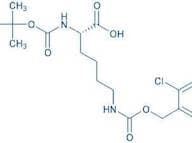
CAS:More stable towards treatment with acids than the N-ε-Z-derivative.Formel:C19H27ClN2O6Reinheit:> 99%Farbe und Form:WhiteMolekulargewicht:414.89L-Lysine,N6-[[(2-chlorophenyl)methoxy]carbonyl]-N2-[(1,1-dimethylethoxy)carbonyl]-
CAS:Formel:C19H27ClN2O6Reinheit:98%Farbe und Form:SolidMolekulargewicht:414.8805Boc-Lys(2-Cl-Z)-OH
CAS:Formel:C19H27ClN2O6Reinheit:>98.0%(T)Farbe und Form:White to Almost white powder to crystalineMolekulargewicht:414.88Boc-Lys(2-Cl-Z)-OH
CAS:M03298 - Boc-Lys(2-Cl-Z)-OH
Formel:C19H27ClN2O6Reinheit:95%Farbe und Form:Crystalline Powder,PowderMolekulargewicht:414.88Boc-Lys(Cl-Z)-OH
CAS:Boc-Lys(Cl-Z)-OH is a research tool that belongs to the group of peptides. It is an inhibitor of ion channels and can be used as a pharmacological agent. Boc-Lys(Cl-Z)-OH is an agonist of G protein coupled receptors, which are found on cell membranes. It may also be used to activate receptor tyrosine kinases. Boc-Lys(Cl-Z)-OH is a high purity product with > 99% purity.
Formel:C19H27N2O6ClReinheit:Min. 95%Molekulargewicht:414.88 g/mol

![L-Lysine,N6-[[(2-chlorophenyl)methoxy]carbonyl]-N2-[(1,1-dimethylethoxy)carbonyl]-](/_next/image/?url=https%3A%2Fstatic.cymitquimica.com%2Fproducts%2FIN%2Fthumb%2FDA00I9RE.jpg&w=3840&q=75)