CAS 547-44-4
:Sulfacarbamid
Beschreibung:
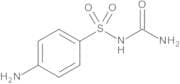
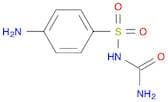
Sulfacarbamid, auch bekannt als Sulfanilamid oder Sulfanilamid-Derivat, ist eine Sulfonamidverbindung, die durch ihre antibakteriellen Eigenschaften gekennzeichnet ist. Es handelt sich um einen weißen bis schmutzig-weißen kristallinen Feststoff, der in Wasser löslich ist und einen leicht bitteren Geschmack aufweist. Die Verbindung fungiert hauptsächlich als antimikrobielles Mittel, indem sie das Bakterienwachstum hemmt, indem sie die Synthese von Folsäure stört, die für den bakteriellen Zellstoffwechsel unerlässlich ist. Sulfacarbamid wird häufig zur Behandlung verschiedener bakterieller Infektionen eingesetzt und hat Anwendungen sowohl in der Human- als auch in der Veterinärmedizin. Sein Wirkmechanismus umfasst die kompetitive Hemmung des Enzyms Dihydropteroat-Synthase, das für die Biosynthese von Folsäure in Bakterien entscheidend ist. Darüber hinaus kann Sulfacarbamid Nebenwirkungen haben, einschließlich allergischer Reaktionen und gastrointestinaler Störungen, die eine sorgfältige Überwachung während seiner Anwendung erfordern. Wie bei vielen Sulfonamiden ist es wichtig, potenzielle Arzneimittelwechselwirkungen und Kontraindikationen bei der Verschreibung dieser Verbindung zu berücksichtigen. Insgesamt bleibt Sulfacarbamid ein bedeutendes Mittel im antimikrobiellen Arsenal, insbesondere in bestimmten klinischen Szenarien.
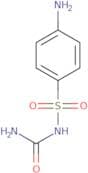
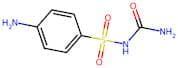
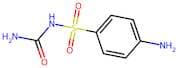
Formel:C7H9N3O3S
InChl:InChI=1S/C7H9N3O3S/c8-5-1-3-6(4-2-5)14(12,13)10-7(9)11/h1-4H,8H2,(H3,9,10,11)
InChI Key:InChIKey=WVAKABMNNSMCDK-UHFFFAOYSA-N
SMILES:S(NC(N)=O)(=O)(=O)C1=CC=C(N)C=C1
Synonyme:- (4-Aminobenzenesulfonyl)urea
- (4-Aminophenyl)sulfonylurea
- 1-(4-Aminobenzenesulfonyl)urea
- 4-Amino-N-(aminocarbonyl)benzenesulfonamide
- 4-Sulfacarbamide
- 4-amino-N-carbamoylbenzenesulfonamide
- A 435
- A 435 (Van)
- A 435 (amide)
- Benzenesulfonamide, 4-amino-N-(aminocarbonyl)-
- Benzenesulfonamide, 4-amino-N-(aminocarbonyl)- (9CI)
- Brn 2118358
- Euvernil
- K 7617
- N-Sulfanilcarbamide
- NSC 78438Q
- Nsc 78438
- Solfacarbamide
- Solfacarbamide [DCIT]
- Sulfacarbamida
- Sulfacarbamida [INN-Spanish]
- Sulfacarbamide
- Sulfacarbamide [INN:DCF]
- Sulfacarbamidum
- Sulfacarbamidum [INN-Latin]
- Sulfanilamide, N(sup1)-carbamoyl-
- Sulfanilcarbamid
- Sulfanilcarbamide
- Sulfanylharnstoff
- Sulfanyluree
- Sulfaurea
- Sulfaurea (VAN)
- Sulphacarbamide
- Sulphaurea
- Thiocarbamid
- Unii-W6Cd25Z4Qr
- Uractyl
- Uramid
- Urea, sulfanilyl-
- Urenil
- Urosulfan
- Urosulfane
- Urosulphanum
- [(p-Aminophenyl)sulfonyl]urea
- p-Aminobenzenesulfonylurea
- Weitere Synonyme anzeigen
Sortieren nach
Reinheit (%)
0
100
|
0
|
50
|
90
|
95
|
100
9 Produkte.
Sulfacarbamide
CAS:Sulfacarbamide (Sulfanilylurea) is a blood sugar-lowering agent.Formel:C7H9N3O3SReinheit:95.6% - 99.72%Farbe und Form:SolidMolekulargewicht:215.23N-[(4-Aminophenyl)sulphonyl]urea (Sulphacarbamide)
CAS:Kontrolliertes ProduktFormel:C7H9N3O3SFarbe und Form:NeatMolekulargewicht:215.23Sulfacarbamide-d4
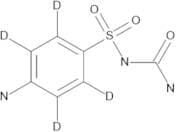
CAS:Kontrolliertes ProduktFormel:C7H5D4N3O3SFarbe und Form:NeatMolekulargewicht:215.23Sulfacarbamide
CAS:Sulfacarbamide is a broad-spectrum antimicrobial agent that is used in the treatment of infections. It is an analog of sulfadiazine and has been shown to have anti-atherogenic properties. Sulfacarbamide has a hydroxyl group, which makes it soluble in water and helps it bind to glucose in the blood. This drug can be used for the treatment of diabetic patients as it can lower levels of glucose in the blood by binding to glucose molecules. Sulfacarbamide also acts as an anti-infective agent and is effective against many types of bacteria, such as Escherichia coli and Staphylococcus aureus. The biological properties of this compound are similar to those of sulfadiazine, but sulfacarbamide has more potent antibacterial activity than its parent molecule.Formel:C7H9N3O3SReinheit:Min. 95%Molekulargewicht:215.23 g/mol



![N-[(4-Aminophenyl)sulphonyl]urea (Sulphacarbamide)](/_next/image/?url=https%3A%2Fstatic.cymitquimica.com%2Fproducts%2F86%2Fthumb%2FMM0883.02.jpg&w=3840&q=75)