CAS 547-68-2
:Zinkoxalat (ZnC2O4)
Beschreibung:
Zinkoxalat (ZnC2O4) ist eine anorganische Verbindung, die durch ihre Bildung aus Zink und Oxalsäure gekennzeichnet ist. Sie erscheint typischerweise als weißes kristallines Feststoff und ist bekannt für ihre geringe Löslichkeit in Wasser, was sie in verschiedenen Anwendungen nützlich macht, einschließlich als Vorstufe bei der Synthese von Zinkoxid und im Bereich der Materialwissenschaften. Die Verbindung kann in verschiedenen Hydratformen existieren, wobei das Dihydrat die häufigste ist. Zinkoxalat wird oft auf sein potenzielles Verwendung in der Landwirtschaft als Mikronährstoffquelle für Pflanzen untersucht, da Zink ein essentielles Spurenelement ist. Darüber hinaus wurde es wegen seiner Eigenschaften in der Katalyse und als Bestandteil bestimmter Batterietypen erforscht. Sicherheitsüberlegungen umfassen seine potenzielle Toxizität bei Einnahme oder Inhalation, was eine ordnungsgemäße Handhabung und Lagerung erforderlich macht. Insgesamt ist Zinkoxalat eine Verbindung von Interesse sowohl in industriellen als auch in Forschungseinrichtungen aufgrund seiner einzigartigen chemischen Eigenschaften und Anwendungen.
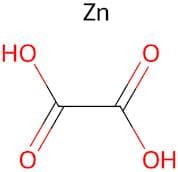
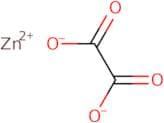
Formel:C2O4Zn
InChl:InChI=1S/C2H2O4.Zn/c3-1(4)2(5)6;/h(H,3,4)(H,5,6);/q;+2/p-2
InChI Key:InChIKey=ZPEJZWGMHAKWNL-UHFFFAOYSA-L
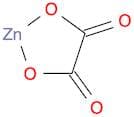
SMILES:O=C1C(=O)O[Zn]O1
Synonyme:- Oxalic acid, zinc salt (1:1)
- Tegokat 634
- Tmg-634
- Zinc oxalate (1:1)
- Zinc oxalate (ZnC<sub>2</sub>O<sub>4</sub>)
- Zinc, (ethanedioato(2-)-kappaO1,kappaO2)-
- Zinc, [ethanedioato(2-)-κO<sup>1</sup>,κO<sup>2</sup>]-
- Zinc-Ethanedioic Acid (1:1)
- [Ethanedioato(2-)-κO<sup>1</sup>,κO<sup>2</sup>]zinc
- Zinc oxalate (ZnC2O4)
- Zinc, [ethanedioato(2-)-κO1,κO2]-
- [Ethanedioato(2-)-κO1,κO2]zinc
- Weitere Synonyme anzeigen
Sortieren nach
Reinheit (%)
0
100
|
0
|
50
|
90
|
95
|
100
3 Produkte.
Zinc oxalate dihydrate
CAS:Zinc oxalate hydrate is a skin condition treatment that is made of zinc oxide and oxalic acid. It is used to treat acne, eczema, and psoriasis by inhibiting bacterial growth. The reaction solution is prepared by adding sodium citrate to a solution of vitamin B3 in dextrose. The mixture is heated until the crystals dissolve and then cooled down. The final product has a liquid phase synthesis and contains ZnO, Na2C6H5O7, C6H12O6, and H2O. Other uses for this compound include its use as an antibacterial agent for biomineralization or as a dextrose substitute in the manufacture of cyclic hydrocarbons. This product also has the ability to form nanowires when it is dehydrated under high temperatures.Formel:ZnC2O4•2H2OReinheit:Min. 95%Farbe und Form:Powder