CAS 547-96-6
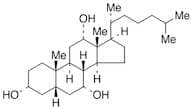
:5β-Cholestan-3α,7α,12α-triol
- Trihydroxycoprostane
- (3alpha,5beta,7alpha,12alpha)-Cholestane-3,7,12-triol
- 5β-Cholestane-3α,7α,12α-triol
- 3α,7α,12α-Trihydroxycoprostane
- Cholestane-3,7,12-triol, (3α,5β,7α,12α)-
- (3α,5β,7α,12α)-Cholestane-3,7,12-triol
Trihydroxycoprostane
CAS:Kontrolliertes ProduktApplications A sterol, similar to cholesterol and is a substrate for the sterol 27-hydroxylase enzyme in the bile salt synthetic pathway. The accumulation of this compound in urine can manifest as jaundice or, in more extreme cases, is a sign of Xanthomatosis.
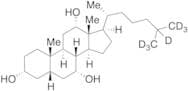
References Honda, A., et al.: J. Biol. Chem., 276, 34579 (2001), Krasowski, M., et al.: Mol. Endocrinol., 19, 1720 (2005), Mast, N., et al.: Biochem., 45, 4396 (2006),Formel:C27H48O3Farbe und Form:NeatMolekulargewicht:420.67Trihydroxycoprostane-d7
CAS:Kontrolliertes ProduktApplications Isotope labelled Trihydroxycoprostane analog, a sterol similar to cholesterol and is a substrate for the sterol 27-hydroxylase enzyme in the bile salt synthetic pathway.
References Honda, A., et al.: J. Biol. Chem., 276, 34579 (2001), Krasowski, M., et al.: Mol. Endocrinol., 19, 1720 (2005), Mast, N., et al.: Biochem., 45, 4396 (2006),Formel:C27D7H41O3Farbe und Form:NeatMolekulargewicht:427.71Trihydroxycoprostane
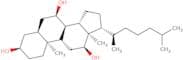
CAS:Kontrolliertes ProduktTrihydroxycoprostane is a natural compound and metabolite of cholesterol. It is produced by the microsomal cytochrome P450 enzymes in the liver, where it is converted to dihydroxycoprostane. Trihydroxycoprostane has been found to be a precursor of acid formation in humans, which may be due to its conversion to p-hydroxyphenylacetaldehyde and then to p-hydroxyphenylacetic acid. The uptake, metabolism and excretion of trihydroxycoprostanes have been studied in human liver cells and rat liver microsomes. This study found that trihydroxycoprostanes are metabolized by 3β-HSD or 3α-HSD and converted into dihydroxycoprostanes. Trihydroxycoprostane has also been shown to increase serum levels of alanine and urea nitrogen, but does not affect cholesterol levels in rats with cerebrotendinous xanthomat
Formel:C27H48O3Reinheit:Min. 95%Molekulargewicht:420.67 g/mol