CAS 5470-37-1
:1-Methyl-1,2,3,4-tetrahydro-β-carbolin-3-carbonsäure
Beschreibung:
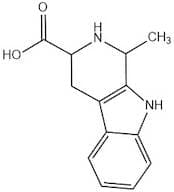
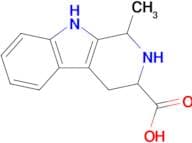
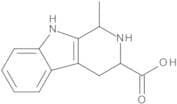
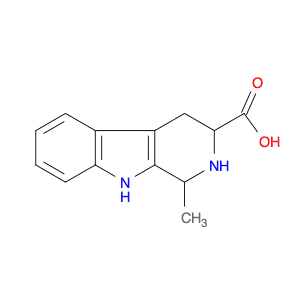
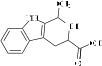
1-Methyl-1,2,3,4-tetrahydro-β-carbolin-3-carbonsäure, identifiziert durch seine CAS-Nummer 5470-37-1, ist eine chemische Verbindung, die zur Familie der β-Carboline gehört und durch eine bicyclische Struktur gekennzeichnet ist, die einen fusionierten Indol- und Pyridinring enthält. Diese Verbindung weist eine Methylgruppe an der Stickstoffposition und eine Carbonsäurefunktionalgruppe auf, die zu ihrer potenziellen biologischen Aktivität beiträgt. Sie ist bekannt für ihre Rolle in verschiedenen biochemischen Prozessen und wurde aufgrund ihrer neuroprotektiven Eigenschaften sowie ihrer potenziellen Implikationen bei der Behandlung neurodegenerativer Erkrankungen untersucht. Das Vorhandensein der Tetrahydrostruktur deutet darauf hin, dass es sich um ein gesättigtes Derivat handelt, was seine Löslichkeit und Reaktivität beeinflussen kann. Darüber hinaus kann diese Verbindung Wechselwirkungen mit Neurotransmittersystemen aufweisen, insbesondere mit solchen, die Serotonin und Dopamin betreffen, was sie für die pharmakologische Forschung von Interesse macht. Ihre Synthese und Charakterisierung sind wichtig, um ihre Eigenschaften und potenziellen Anwendungen in der medizinischen Chemie zu verstehen.
Formel:C13H14N2O2
InChl:InChI=1S/C13H14N2O2/c1-7-12-9(6-11(14-7)13(16)17)8-4-2-3-5-10(8)15-12/h2-5,7,11,14-15H,6H2,1H3,(H,16,17)
InChI Key:InChIKey=ZUPHXNBLQCSEIA-UHFFFAOYSA-N
SMILES:CC1C2=C(C=3C(N2)=CC=CC3)CC(C(O)=O)N1
Synonyme:- 1,2,3,4-Tetrahydro-3-carboxyharmane
- 1,2,3,4-Tetrahydroharman-3-carboxylic acid
- 1-Methyl-1,2,3,4-Tetrahydropyrido[3,4-b]indole-3-carboxylic acid
- 1-Methyl-1,2,3,4-tetrahydro-beta-carboline-3-carboxylic acid
- 1-Methyl-1,2,3,4-tetrahydro-beta-carboline-3-carboxylic acid, sodium nitrite treated
- 1-Methyl-1,2,3,4-tetrahydro-β-carboline-3-carboxylic acid
- 1-Methyl-1H,2H,3H,4H,9H-pyrido[3,4-b]indole-3-carboxylic acid
- 1-Methyl-2,3,4,9-tetrahydro-1H-pyrido[3,4-b]indole-3-carboxylic acid
- 1-Methyl-2,3,4,9-tetrahydro-1H-β-carboline-3-carboxylic acid
- 1-Methyl-tetrahydro-beta-carboline-3-carboxylic acid
- 1-methyl-2,3,4,9-tetrahydro-1H-beta-carboline-3-carboxylic acid
- 1H-Pyrido(3,4-b)indole-3-carboxylic acid, 2,3,4,9-tetrahydro-1-methyl-
- 2,3,4,9-Tetrahydro-1-methyl-1H-pyrido[3,4-b]indole-3-carboxylic acid
- 2-[(Benzylamino)(Hydroxy)Methylidene]-4-[(5-Methyl[1,2,4]Triazolo[4,3-A]Quinolin-1-Yl)Sulfanyl]-3-Oxobutanenitrile
- Ccris 6487
- Nsc 26225
- Tetrahydroharman-3-carboxylic acid
- Weitere Synonyme anzeigen
Sortieren nach
Reinheit (%)
0
100
|
0
|
50
|
90
|
95
|
100
8 Produkte.
HARMANE-1,2,3,4-TETRAHYDRO-3-CARBOXYLIC ACID
CAS:Formel:C13H14N2O2Reinheit:97%Farbe und Form:SolidMolekulargewicht:230.2625Tryptophan EP Impurity I (Mixture of Diastereomers)
CAS:Formel:C13H14N2O2Farbe und Form:White To Off-White SolidMolekulargewicht:230.271-Methyl-2,3,4,9-tetrahydro-1H-pyrido[3,4-b]indole-3-carboxylic acid
CAS:1-Methyl-2,3,4,9-tetrahydro-1H-pyrido[3,4-b]indole-3-carboxylic acidReinheit:97%Molekulargewicht:230.27g/mol1-methyl-1,2,3,4-tetrahydro-β-carboline-3-carboxylic acid
CAS:Natural alkaloidFormel:C13H14N2O2Reinheit:≥ 95.0 % (HPLC)Molekulargewicht:230.261-methyl-2,3,4,9-tetrahydro-1H-β-carboline-3-carboxylic acid
CAS:Reinheit:95.0%Molekulargewicht:230.266998291015621-Methyl-2,3,4,9-tetrahydro-1H-b-carboline-3-carboxylic Acid
CAS:Kontrolliertes ProduktFormel:C13H14N2O2Farbe und Form:NeatMolekulargewicht:230.261,2,3,4-Tetrahydro-3-carboxyharmane
CAS:Tetrahydro-3-carboxyharmane is a polycyclic aromatic compound that has been shown to have antioxidant properties. It also has the ability to inhibit protein synthesis and growth factor production in cells, which may be due to its reactivity with ethyl bromoacetate. Tetrahydro-3-carboxyharmane is a product of the reaction between 1,2,3,4-tetrahydroquinoline and ethyl bromoacetate. The molecule contains an asymmetric carbon atom in its structure, which prevents it from being synthesized by wild-type strains of bacteria. Tetrahydro-3-carboxyharmane inhibits acid formation by acting as a buffer against protons and can cross cell membranes through passive diffusion. This molecule has been shown to have antioxidative activity in mammals and can bind glutathione ethyl ester.Formel:C13H14N2O2Farbe und Form:PowderMolekulargewicht:230.26 g/mol


![1-Methyl-2,3,4,9-tetrahydro-1H-pyrido[3,4-b]indole-3-carboxylic acid](/_next/image/?url=https%3A%2Fstatic.cymitquimica.com%2Fproducts%2F54%2Fthumb%2FOR1069341.jpg&w=3840&q=75)