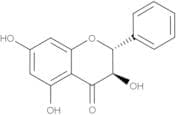
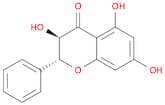
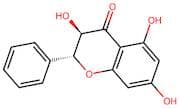
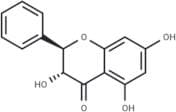
CAS 548-82-3
:Pinobanksin
Beschreibung:
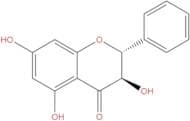
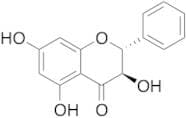
Pinobanksin, mit der CAS-Nummer 548-82-3, ist eine natürlich vorkommende Flavonoidverbindung, die hauptsächlich in verschiedenen Pflanzen vorkommt, insbesondere im Harz bestimmter Kiefernarten. Es wird als Flavanon klassifiziert, eine Art von Flavonoid, das durch eine spezifische chemische Struktur gekennzeichnet ist, die ein Chromon-Rückgrat umfasst. Pinobanksin zeigt antioxidative Eigenschaften, die zu seinen potenziellen gesundheitlichen Vorteilen beitragen, einschließlich entzündungshemmender und antimikrobieller Wirkungen. Die Verbindung wird häufig wegen ihrer Rolle in der traditionellen Medizin und ihrer potenziellen Anwendungen in der Lebensmittelkonservierung und Kosmetik untersucht, da sie in der Lage ist, freie Radikale zu beseitigen. In Bezug auf die physikalischen Eigenschaften ist Pinobanksin typischerweise ein gelbliches kristallines Feststoff und ist in organischen Lösungsmitteln löslich, hat jedoch eine begrenzte Löslichkeit in Wasser. Seine chemische Struktur ermöglicht verschiedene Derivate, die seine biologische Aktivität verbessern können. Insgesamt ist Pinobanksin sowohl in der pharmakologischen Forschung als auch in der Chemie natürlicher Produkte von Interesse aufgrund seiner vielfältigen biologischen Aktivitäten und potenziellen therapeutischen Anwendungen.
Formel:C15H12O5
InChl:InChI=1S/C15H12O5/c16-9-6-10(17)12-11(7-9)20-15(14(19)13(12)18)8-4-2-1-3-5-8/h1-7,14-17,19H/t14-,15+/m0/s1
InChI Key:InChIKey=SUYJZKRQHBQNCA-LSDHHAIUSA-N
SMILES:O=C1C=2C(O[C@@H]([C@H]1O)C3=CC=CC=C3)=CC(O)=CC2O
Synonyme:- (2R,3R)-2,3-Dihydro-3,5,7-trihydroxy-2-phenyl-4H-1-benzopyran-4-one
- (2R,3R)-Pinobanksin
- 3,5,7-Trihydroxyflavanone
- 4H-1-Benzopyran-4-one, 2,3-dihydro-3,5,7-trihydroxy-2-phenyl-, (2R-trans)-
- 4H-1-benzopyran-4-one, 2,3-dihydro-3,5,7-trihydroxy-2-phenyl-, (2R,3R)-
- Dihydrogalangin
- Flavanone, 3,5,7-trihydroxy-
- Pinobanksin
Sortieren nach
Reinheit (%)
0
100
|
0
|
50
|
90
|
95
|
100
8 Produkte.
Pinobanksin
CAS:Pinobanksin analytical standard provided with chromatographic purity, to be used as reference material for qualitative determination.Formel:C15H12O5Reinheit:(HPLC) ≥95%Farbe und Form:PowderMolekulargewicht:272.26(2R,3R)-2,3-Dihydro-3,5,7-trihydroxy-2-phenyl-4H-1-benzopyran-4-one
CAS:Formel:C15H12O5Reinheit:%Farbe und Form:SolidMolekulargewicht:272.2528Pinobanksin
CAS:Pinobanksin is a natural flavonoid that induces apoptosis in cancer cells. It is a potent antioxidant that inhibits the peroxidation of LDL and inhibits XO.Formel:C15H12O5Reinheit:99.92%Farbe und Form:SolidMolekulargewicht:272.25Pinobanksin
CAS:Applications Pinobanksin is a dihydroflavonol that posesses antioxidant properties. Pinobanksin is most commonly found in propolis, a material utilized by bees in the construction of their hives.
References Burdock, G.: Food Chem. Toxicol., 36, 347 (1998); Loman, A.: Bulletin, 13, no pp given (1970); Neacsu, M., et al.: Holz Roh. Werks., 65, 1 (2007)Formel:C15H12O5Farbe und Form:White To Off-WhiteMolekulargewicht:272.25rac-Pinobanksin
CAS:Rac-Pinobanksin is a flavonoid that has been shown to have antioxidant and anti-inflammatory properties. It is extracted from propolis and has been shown to stimulate the mitochondrial membrane potential in colorectal adenocarcinoma cells and increase energy metabolism. Rac-Pinobanksin also inhibits the activity of p-hydroxybenzoic acid (PHBA) hydroxylase, which metabolizes PHBA into p-hydroxybenzoic acid (PHBA). Rac-Pinobanksin acetate has also been shown to inhibit the activity of the enzyme caffeoyl esterase, which catalyzes the hydrolysis of caffeic acids (CA) into ferulic acid (FA) and p-coumaric acid (PCA). Rac-Pinobanksin acetate increases FA levels and decreases PCA levels.Formel:C15H12O5Reinheit:Min. 95%Molekulargewicht:272.25 g/mol